

Crack Job Interviews in India — Complete Fresher Prep Guide
Overview: A structured interview preparation guide for Indian freshers — covering online assessments, technical rounds, HR rounds, and the preparation timeline that actually works.

Introduction
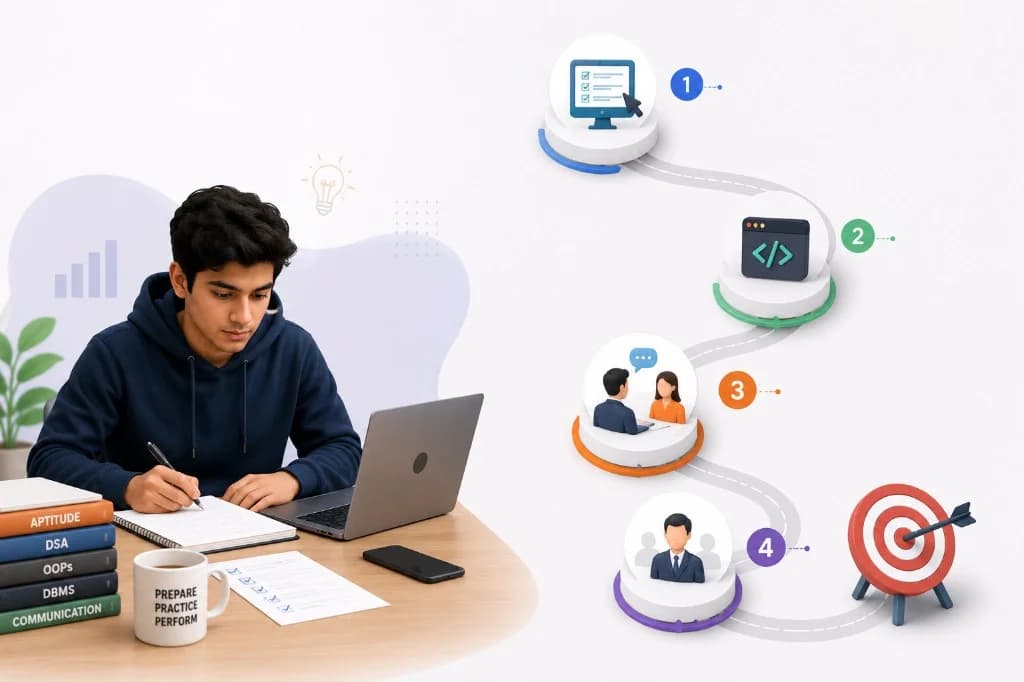
Interview preparation for freshers in India isn't one skill — it's four: clearing online assessments, surviving technical rounds, navigating HR conversations, and managing the process across multiple companies simultaneously.
The four stages of Indian fresher interviews
- Stage 1 — Online Assessment. Aptitude (quantitative, logical, verbal), technical MCQs, and coding problems. 70–80% of candidates are eliminated here.
- Stage 2 — Technical Interview. 30–45 minutes. Resume-driven. CS fundamentals (OOP, DBMS, OS), coding, and project walkthrough.
- Stage 3 — HR Interview. 20–30 minutes. Communication, motivation, fit, relocation, salary expectations.
- Stage 4 — Occasionally: Managerial Round. More common at Wipro, Deloitte, and consulting-oriented roles.
The 12-week preparation timeline
- Weeks 1–4: DSA foundation. 100 problems on LeetCode or GeeksforGeeks. Arrays, strings, linked lists, trees, basic DP. Follow Striver's SDE Sheet or Love Babbar's 450.
- Weeks 5–8: CS fundamentals revision. OOP with project examples, DBMS, OS basics, CN basics. Continue DSA to 150+ problems.
- Weeks 9–10: Resume finalisation. Master resume with all projects and skills. Tailored versions for each target company, each matched to the specific JD.
- Weeks 11–12: Mock interviews. Minimum five full mocks (technical + HR). Record at least two. Fix rambling, under-explaining, and filler words.
What separates selected candidates
- Specificity. "I optimised a database query from 3 seconds to 200ms by adding an index on the foreign key" beats "I improved database performance."
- Honesty. When asked about something they don't know, selected candidates say "I'm not sure about that specific topic, but here's what I do know about the adjacent concept."
- Visible preparation. Knowing the company's products, naming a specific programme, tailoring answers to the role — ten minutes of research, disproportionate results.
Online assessment preparation
For service companies (TCS, Infosys, Wipro, Cognizant, Accenture): focus on easy-to-medium coding, aptitude speed, and verbal accuracy. Previous papers from PrepInsta and GeeksforGeeks cover 80% of the question patterns.
For product companies: medium-to-hard DSA, system design basics (for senior roles), and deeper CS fundamentals. LeetCode premium's company-tagged problems are valuable.
Time management is the differentiator. Most candidates know the material but can't finish within the time limit. Practice under timed conditions from week one.
Technical interview preparation
Your resume is the syllabus. Every project, every skill, every technology listed will be questioned. List only what you can defend for five minutes under follow-up questions.
Prepare a 90-second walkthrough of your main project: problem statement, tech stack, your specific contribution, one challenge, one thing you'd improve. This walkthrough opens 80% of Technical Rounds.
For each programming language you list, know: syntax basics, memory management model, common libraries, and one advanced feature (generics in Java, decorators in Python, pointers in C++).
Resources by stage
- DSA: LeetCode, GeeksforGeeks, InterviewBit, Striver's sheet.
- CS fundamentals: Gate Smashers (YouTube), GeeksforGeeks articles, NPTEL courses.
- Mock interviews: Peer practice (free), GyanBatua AI interview prep (₹21 text / ₹51 voice — built from your specific target JD, not a generic bank).
Is your resume good enough?
Drop your resume here or . PDF & DOCX only. Max 5MB file size.
Resume guides
Related Resume Guides
About the Author
Director - HR & Corporate Relations at Mobiloitte
Director of HR & Corporate Relations at Mobiloitte, specializing in recruitment strategy, placement readiness, and corporate partnerships.
Pricing
Choose your plan and get started faster
Compare features, pricing, and usage clearly, then pick the plan that fits your goal.
Next step
Check your resume against a real job description
See JD match, keyword visibility, and skill gaps before you apply.
Related reading
13Recent articles
6