

Resume Format for Freshers in India — Step-by-Step Guide
Overview: The definitive resume format guide for Indian freshers. Section order, ATS formatting, what to include, what to cut, and templates that actually work.

Introduction
If you search "resume format India" you'll find hundreds of templates, most of them wrong for Indian ATS-driven hiring market. This guide gives you the format that actually works — tested against the screening systems used by TCS, Infosys, Wipro, Accenture, and most Indian mid-to-large companies.
The format Indian recruiters prefer
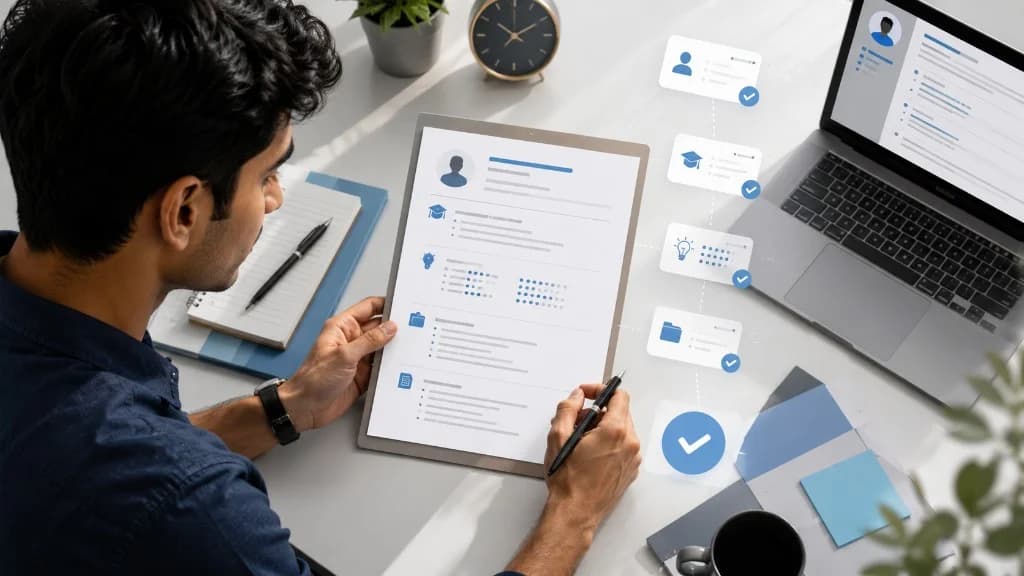
Reverse chronological. Single column. One page for freshers. This isn't a style choice — it's what ATS systems parse most reliably and what Indian HR teams consistently prefer.
A analysis of 3,200+ successful Indian resumes found that 82% used reverse chronological format. Functional and hybrid formats have their place for career changers, but for freshers entering the Indian job market, reverse chronological is the standard.
Section-by-section structure
1. Contact information
Name (16–18pt, bold), phone, email, LinkedIn URL, city. No photograph, no date of birth, no gender, no marital status, no father's name. These personal details were standard in Indian resumes a decade ago — they're outdated now and waste space.
2. Professional summary (3–4 lines)
Not an objective statement. A summary of who you are technically, what you've built, and what role you're targeting. This section should contain the job title you're applying for and two to three keywords from the JD.
3. Education
Reverse chronological. Degree, college name, university, year of completion, CGPA or percentage. For freshers, education often comes before experience — this is fine. If you have a strong internship, move experience above education.
4. Technical skills
Organised by category: Programming Languages, Frameworks/Libraries, Databases, Tools, Platforms. Use exact terms from job descriptions. "React.js" not "frontend framework." "PostgreSQL" not "database management."
5. Projects (critical for freshers)
Two to three projects. Each with: project name, tech stack on the same line, two to three bullet points describing what it does, your contribution, and one metric or scale indicator. GitHub link if available.
This section replaces the work experience section that freshers don't have. It's your proof of capability. Generic projects with no specifics score poorly. Specific projects with tech depth and results score well.
6. Experience / Internships
If you have internships: company name, role, dates, two to three bullet points with results. If you don't: skip this section entirely rather than padding it.
7. Certifications and courses (optional)
Only include certifications relevant to your target role. AWS, Google, NPTEL, and Coursera specialisations carry weight. Random Udemy certificates don't.
8. Achievements (optional)
Hackathons, competitive programming ratings, college-level awards. Keep it to two to three lines. Only include if genuinely differentiating.
What to leave out
Hobbies (unless directly relevant to the role). School/10th/12th marks (employers don't check these for engineering graduates). References ("available on request" wastes a line). Declarations or signatures (an outdated Indian resume convention). Skill bars or ratings (ATS can't parse graphics, and self-rated "Python: 8/10" means nothing).
Formatting specs
Font: Calibri, Arial, or Times New Roman. Size: 11–12pt body, 14–16pt name. Margins: 0.5–0.75 inches. Line spacing: 1.0–1.15. File: PDF from Word or Google Docs. Length: one page for freshers, two maximum for 5+ years experience.
The difference between a template and a targeted resume
Templates give you structure. They don't give you content. The resume that gets shortlisted isn't the one with the best template — it's the one where every line connects to the specific job description.
GyanBatua's resume builder (₹11) creates a clean, ATS-friendly resume with proper structure. The JD Match (₹11) then tunes it to the specific role you're applying to. Together, they replace the template-plus-guesswork approach with a build-then-target workflow.
Related reading on GyanBatua
Also useful in the Resume cluster:
Is your resume good enough?
Drop your resume here or . PDF & DOCX only. Max 5MB file size.
Resume guides
Related Resume Guides
About the Author
Vice President at Mobiloitte
Vice President at Mobiloitte, focusing on AI-first digital initiatives, resume optimization engines, and placement outcomes.
Pricing
Choose your plan and get started faster
Compare features, pricing, and usage clearly, then pick the plan that fits your goal.
Next step
Check your resume against a real job description
See JD match, keyword visibility, and skill gaps before you apply.
Related reading
13Recent articles
6