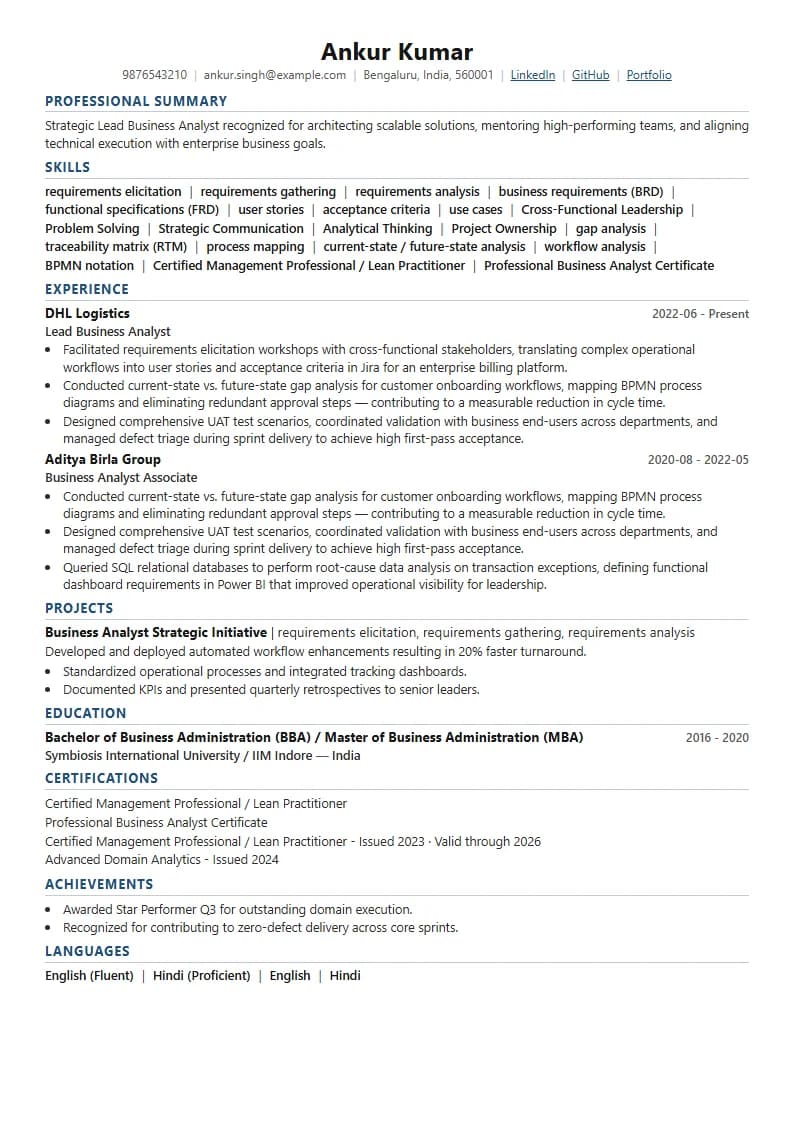

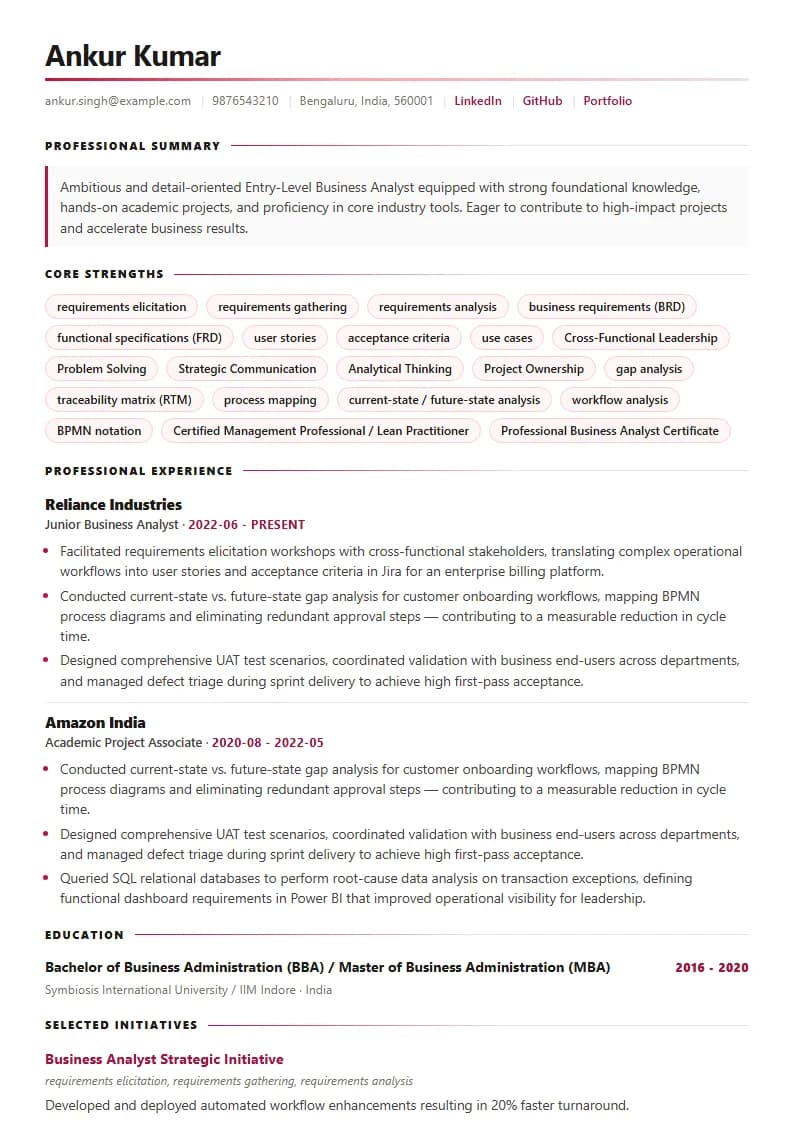
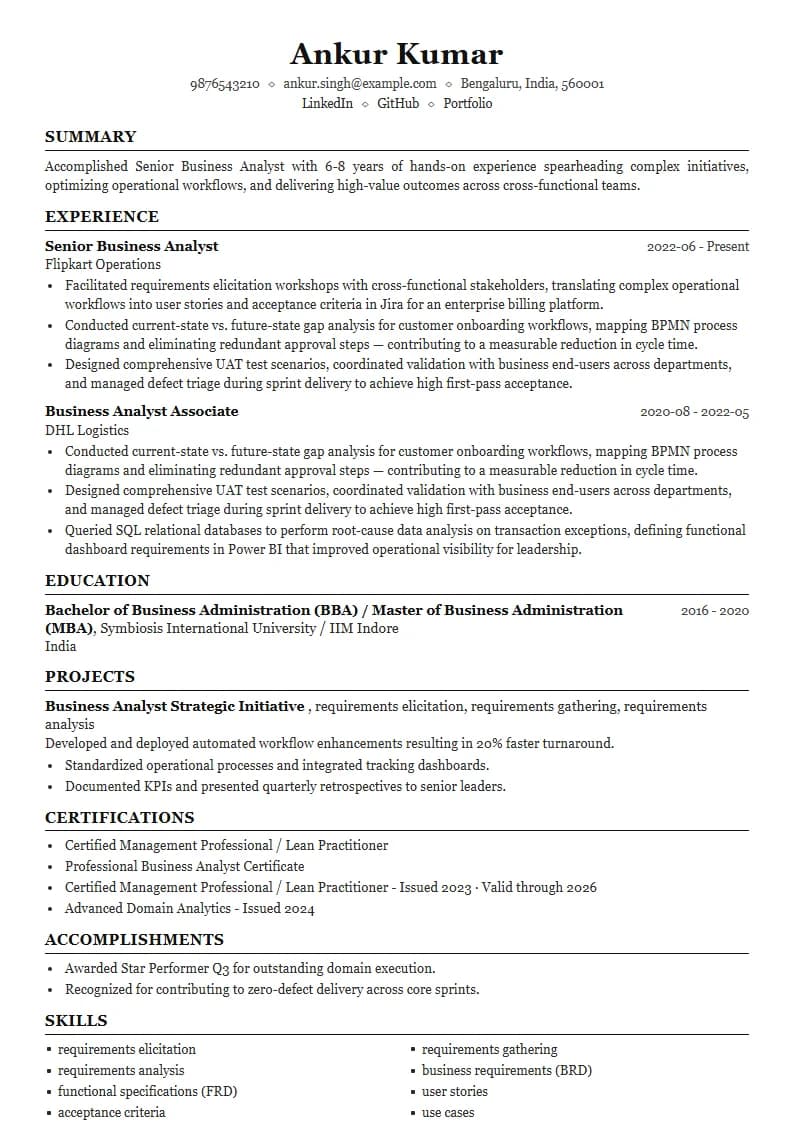
Senior Business Analyst Resume Example using Executive Onyx Gold template layout
Featured Example

Business Analyst Resume Examples & ATS Guide for 2026

Create a Business Analyst resume that clearly demonstrates requirements analysis, process improvement, stakeholder collaboration, data-informed decision-making and measurable business outcomes. Review role-specific examples, then compare your resume with a real Business Analyst job description using GyanBatua.
Updated August 2026·6 min read·Reviewed by Arvind Tyagi · Senior Project Delivery Manager, Business Analysis & Solutions Delivery
Core Focus & HighlightsVerified August 2026

What Should a Business Analyst Resume Highlight?

A strong Business Analyst resume should show how you identify business problems, gather and clarify requirements, analyse processes or data, collaborate with stakeholders, translate needs into actionable user stories or specifications, support validation and UAT, and contribute to measurable business outcomes. Tools and methodologies should support the evidence rather than replace it. Tailor the emphasis to the specific BA role because requirements-heavy, systems-heavy and data-heavy positions differ substantially.

Resume Sample

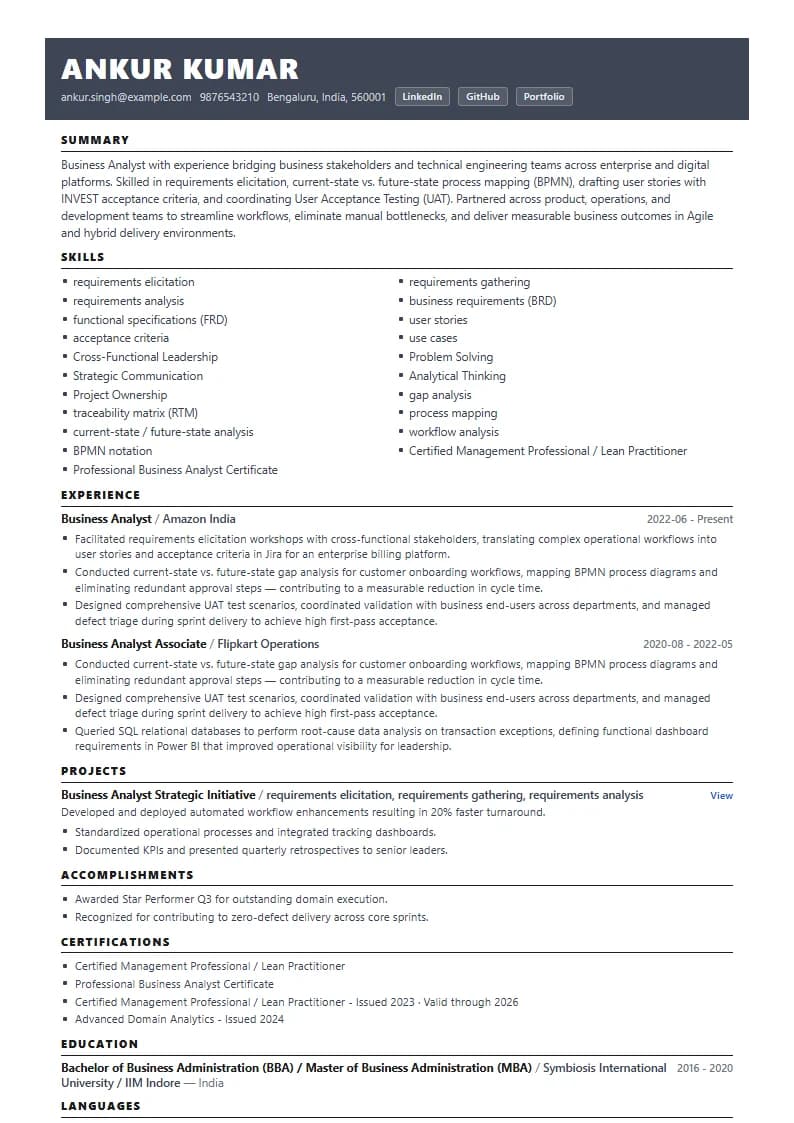
Business Analyst Resume Sample

Usable resume sample showing summary structure, categorized skills, and effective experience bullets.

Professional Summary Example

Business Analyst with experience bridging business stakeholders and technical engineering teams across enterprise and digital platforms. Skilled in requirements elicitation, current-state vs. future-state process mapping (BPMN), drafting user stories with INVEST acceptance criteria, and coordinating User Acceptance Testing (UAT). Partnered across product, operations, and development teams to streamline workflows, eliminate manual bottlenecks, and deliver measurable business outcomes in Agile and hybrid delivery environments.

Experience Bullet Examples

  • Facilitated requirements elicitation workshops with cross-functional stakeholders, translating complex operational workflows into user stories and acceptance criteria in Jira for an enterprise billing platform.
  • Conducted current-state vs. future-state gap analysis for customer onboarding workflows, mapping BPMN process diagrams and eliminating redundant approval steps — contributing to a measurable reduction in cycle time.
  • Designed comprehensive UAT test scenarios, coordinated validation with business end-users across departments, and managed defect triage during sprint delivery to achieve high first-pass acceptance.
  • Queried SQL relational databases to perform root-cause data analysis on transaction exceptions, defining functional dashboard requirements in Power BI that improved operational visibility for leadership.
Impact Guidance: Replace sample metrics and outcomes with your own verified results. Relevant Business Analyst metrics may include cycle-time reduction, processing-time reduction, manual-effort savings, error or defect reduction, UAT defect closure rate, SLA improvement, reporting-time acceleration, system adoption, or operational cost savings. When exact numbers are confidential or unavailable, describe scope, complexity, number of stakeholder groups, system coverage, or documented qualitative outcomes truthfully. Never invent metrics.

Business Analyst Projects: How to Present BA Case Studies on a Resume

Projects are invaluable for entry-level BAs, career switchers, and professionals showcasing analytical depth. Structure each project using: Project & Problem → Your Role → Analysis & Requirements Method → Validation / Solution → Outcome or Learning. Academic, capstone, or personal case studies must be clearly labelled as non-production exercises.

Customer Onboarding Process Improvement Case Study | Problem: High onboarding drop-off due to manual verification delays. Role: Business Analyst. Analysis: Current-state process mapping in Lucidchart, stakeholder interviews, and gap analysis. Solution: Proposed automated document verification flow with 14 user stories & acceptance criteria. Validation: Walked through UAT test scenarios with key business users. Outcome: Successfully streamlined verification process and reduced customer onboarding cycle time.

Competencies

Key Skills & Technical Keywords

Essential domain skills, frameworks and technologies commonly requested for business analyst positions.

Requirements & Analysis
requirements elicitationrequirements gatheringrequirements analysisbusiness requirements (BRD)functional specifications (FRD)user storiesacceptance criteriause casesgap analysistraceability matrix (RTM)
Process & Modelling
process mappingcurrent-state / future-state analysisworkflow analysisBPMN notationdata flow diagrams (DFD)root-cause analysisbusiness process improvement (BPI)
Delivery & Validation
User Acceptance Testing (UAT)test scenarios & casesAgile / ScrumSDLCbacklog refinementsprint planning participationchange enablement
Data & Reporting
advanced ExcelSQL queryingPower BITableaudata analysisdashboard requirementsKPI tracking & reporting
Stakeholder & Business Skills
stakeholder managementworkshop facilitationcross-functional collaborationbusiness communicationproblem framingexecutive presentationschange support
Education & Certifications: Degrees in Business Administration, Information Systems, Computer Science, Finance, or related analytical fields are common but not universally required. Relevant, genuine certifications — such as IIBA ECBA/CCBA/CBAP, PMI-PBA, or Agile credentials (e.g., PSPO I, CSPO) — should be listed only when officially completed. Do not list credentials you have not earned.

Career Stages

Business Analyst Resume by Experience Level

Target key expectations based on your current career stage and technical range.

1Transferable Analysis & Case Studies

Entry-Level / Fresher Business Analyst

If you have no formal BA job title, highlight genuine analytical work: academic coursework, capstone projects, business case studies, process improvement analyses, student consulting, Excel/SQL/Tableau projects, requirements documentation, and UAT participation. Emphasize transferable analytical thinking — problem framing, requirements elicitation, workflow mapping, and stakeholder communication — clearly labelled as academic or personal projects rather than commercial deployments.

2End-to-End Requirements & Delivery

Mid-Level Business Analyst

Focus on initiatives you owned end-to-end: facilitating stakeholder elicitation workshops, mapping current vs. future states, drafting functional user stories and acceptance criteria, managing backlog priorities with engineering, and driving UAT. Highlight measurable process, quality, or efficiency outcomes where genuine data exists, and describe scope, system complexity, and stakeholder alignment honestly where exact metrics are unavailable.

3Enterprise Strategy & Governance

Senior Business Analyst

Emphasize high-complexity stakeholder environments, multi-system enterprise integrations, requirements governance, business case development, cross-team risk and dependency management, mentoring junior BAs, and executive presentations. Seniority is demonstrated through strategic scope, organizational complexity, and business impact — not years of experience alone.

4Systems Architecture & Data Flows

Technical / IT Business Analyst

Highlight system requirements, API specifications, data flow diagrams (DFD), database querying with SQL, system integration workflows, and SDLC collaboration with architects and developers. Technical BAs bridge business intent and technical architecture; coding is not universally mandatory, but fluency in technical constraints, data schemas, and interface requirements is essential.

5Iterative Delivery & User Stories

Agile Business Analyst

Highlight user story slicing, INVEST acceptance criteria, backlog refinement, sprint planning support, sprint reviews, and continuous feedback loops. Demonstrate how you collaborate with Product Owners, Scrum Masters, and development teams to keep engineering backlogs well-defined, actionable, and aligned with user needs.

6Process-to-System Translation

Business Systems Analyst (BSA)

Focus on how business process requirements translate into concrete technical systems, enterprise software configurations (ERP, CRM, billing), workflow automation, data mappings, and system validation. BSAs specialize in optimizing existing systems and architecting software solutions that fit operational workflows.

JD Tailoring Steps

How to Tailor a Business Analyst Resume to a Job Description

Follow these structured steps to align your resume with target job descriptions accurately.

1

Analyze the Target BA Role

Identify whether the job description is primarily functional (user stories, BRD, UAT), technical (systems, APIs, data flows), Agile-oriented, or data-focused (SQL, Power BI). Note required methodologies and domain context.

2

Compare & Identify Gaps

Compare your background against the JD's requirements. Identify which genuine elicitation, process mapping, tools, or validation experiences deserve prominent placement, without adding skills you do not possess.

3

Adjust & Verify with GyanBatua

Refine your experience bullets using the Action → Problem → Method → Outcome framework. Use GyanBatua to compare your tailored resume with the real JD to verify requirements alignment before submitting.

Compliance & Formatting

ATS-Friendly Resume Checklist

Checklist6 items
Use clear, standard section headings: Summary, Experience, Skills, Projects, Education, and Certifications.
Align requirements terminology with the target job description — whether the JD emphasizes Agile user stories or formal functional specifications.
Connect tools (Jira, SQL, Power BI, Visio) directly to project and experience bullets showing how you used them.
Keep resume layout clean: use single-column or easily readable formats, avoiding nested tables, text boxes, and complex graphics that might confuse parsers.
Include genuine business metrics (cycle time, error reduction, cost savings, UAT defect resolution) only when verified.
Avoid keyword stuffing. Present skills within the context of actual requirements elicitation, process improvement, and stakeholder delivery.

Want to know if your resume is ATS-friendly? Check it with our free AI tool below!

Is your resume good enough?

Drop your resume here or . PDF & DOCX only. Max 5MB file size.

🔒We never share your data with 3rd parties or use it for AI model training.

Help & FAQ

Business Analyst resume: frequently asked questions

Direct answers to common Business Analyst resume questions

What should a Business Analyst resume include?
A Business Analyst resume should include: a clean header with contact details; a focused professional summary highlighting your BA specialization and domain expertise; categorized technical and functional skills (requirements elicitation, process mapping, tools, methodology, data analysis); work experience with bullets following the Action → Problem → Method → Outcome format; selected BA projects or case studies demonstrating analytical rigor; and education with genuine certifications (e.g., ECBA, CCBA, CBAP, PMI-PBA). Ensure every section provides concrete evidence of bridging business needs and technical execution.
What skills should I put on a Business Analyst resume?
Group your Business Analyst skills into logical categories: Requirements & Analysis (elicitation, user stories, acceptance criteria, BRD, FRD, gap analysis, use cases); Process & Modelling (process mapping, BPMN, current/future state, workflow analysis, root-cause analysis); Delivery & Validation (UAT, test scenarios, Agile/Scrum, backlog refinement, sprint planning); Data & Tools (Jira, Confluence, SQL, Excel, Power BI, Tableau, Visio, Lucidchart); and Stakeholder Skills (workshop facilitation, cross-functional alignment, change enablement). Prioritize the specific competencies emphasized in the target job description.
How do I write a Business Analyst resume with no direct experience?
If you have no direct Business Analyst title, highlight transferable analytical evidence: academic projects, capstone studies, business case competitions, student consulting, process-improvement exercises, or SQL and BI dashboard projects. Frame each project with: Business Problem → Your Role → Analytical Method → Proposed Solution/Artifact → Documented Learning. Highlight transferable skills from past roles in operations, customer support, sales, or quality assurance where you identified process bottlenecks or gathered requirements. Never invent commercial experience; transparent, well-documented case studies demonstrate genuine BA thinking.
What makes a strong Business Analyst resume summary?
A strong Business Analyst summary is concise, specific, and grounded in evidence. Avoid generic buzzwords like 'passionate problem solver' or 'dynamic professional' without supporting context. A recommended formula is: Role Title & Experience Level + Domain / Platform Context + Core BA Capabilities (e.g., requirements elicitation, BPMN process mapping, Agile delivery) + Measurable Business Outcome or Scope. Example: 'Business Analyst with 4+ years of experience in retail banking workflows, specializing in requirements elicitation, user stories, and UAT coordination for digital payment platforms. Partnered with cross-functional teams to streamline onboarding processes, reducing processing cycle times by 25%.'
What metrics and achievements should Business Analysts highlight?
Highlight verified metrics that connect requirements analysis to business and operational impact: cycle-time or processing-time reduction, manual effort savings, error or defect reduction rates, UAT first-pass acceptance rates, system adoption percentages, reporting-time acceleration, SLA adherence improvements, or operational cost savings. When exact financial numbers are confidential, describe scope and scale: number of business stakeholders aligned, number of workflows mapped, user volume impacted, or departments onboarded. Never invent metrics; qualitative documented outcomes and scope are far more credible than manufactured numbers.
What tools should a Business Analyst list on a resume?
Only list tools you genuinely use and that align with the target job description. Common BA tools include: Requirements & Agile Management (Jira, Confluence, Azure DevOps); Process Modelling (Microsoft Visio, Lucidchart, draw.io, Signavio); Data & Analytics (advanced Excel, SQL, Power BI, Tableau); and Collaboration (Miro, Notion, Slack, Microsoft Teams). A functional BA may emphasize Jira and Visio, while a data-focused BA should highlight SQL and Power BI. Tailor your tool section to reflect the exact platforms required by the employer.
Do Business Analysts need to know SQL and coding?
Business Analysts do not universally need programming or software development skills. However, basic to intermediate SQL is increasingly requested in data-focused and technical BA roles for querying relational databases, validating test data, and extracting reporting metrics. Functional BAs, Agile BAs, and process BAs typically focus more on requirements elicitation, stakeholder management, user stories, and process mapping than code. Check the target job description: if SQL or technical system architectures are listed, highlight your genuine database querying experience; otherwise, focus on business requirements and process excellence.
What is the difference between a Business Analyst, Data Analyst, and Business Systems Analyst resume?
A Business Analyst resume focuses on understanding business problems, eliciting stakeholder requirements, mapping business processes, drafting functional user stories, and coordinating UAT. A Data Analyst resume focuses heavily on data querying (SQL), statistical modeling, Python/R scripting, and building interactive dashboards (Tableau, Power BI) to uncover trends. A Business Systems Analyst (BSA) resume focuses on translating business requirements into technical system configurations, API integrations, data flows, and software architecture. Always tailor your resume to the specific job description, as titles can vary by employer.
How do I describe requirements gathering and UAT on a resume?
Describe requirements gathering and User Acceptance Testing (UAT) through structured, action-oriented bullet points rather than passive responsibility statements. For requirements gathering: specify the elicitation method (stakeholder workshops, 1-on-1 interviews, surveys), the artifacts created (user stories with INVEST acceptance criteria, BRDs, process flows), and the target platform. For UAT: describe test scenario creation, user coordination across departments, defect triage during sprint cycles, and validation outcomes. Example: 'Facilitated 10+ requirements workshops with department heads, drafted 50+ user stories with acceptance criteria in Jira, and coordinated UAT across 3 business units with 95% defect resolution before launch.'
How do I tailor my Business Analyst resume to a specific job description?
To tailor your BA resume: 1) Identify the primary role focus in the JD — functional, technical systems, Agile delivery, or data analytics. 2) Note the exact terminology used for requirements (e.g., user stories vs. BRD/FRD) and methodologies (Agile, Scrum, Waterfall). 3) Highlight your genuine experience with the requested tools (Jira, SQL, Visio, Power BI) and domain context (banking, healthcare, e-commerce). 4) Reorder your bullet points and skills so the most relevant achievements appear first. 5) Use GyanBatua's ATS checker to compare your resume against the target JD and identify any overlooked requirements or keyword gaps before submitting.

Resume Diagnostic

Check Your Business Analyst Resume Against a Real Job Description

Upload your resume and paste the Business Analyst job description you are targeting. GyanBatua can help you compare the two and identify relevant requirements, skills, tools, domain experience and terminology that may deserve clearer emphasis.

ATS OptimizedJD-TunedDiagnostic Assessment
Your resume data is private, secure, and used solely for diagnostic matching.