

Use This Resume
Entry-LevelMercator Marketing Executive
Create a Financial Analyst resume that clearly demonstrates financial modeling, budgeting, forecasting, variance analysis, business partnering and decision-support experience. Review examples across entry-level, corporate finance, FP&A and senior analyst roles, then compare your resume with a real Financial Analyst job description using GyanBatua.
Recruiter-approved templates and real-world examples tailored for financial analyst roles. Click any resume to customize in seconds.
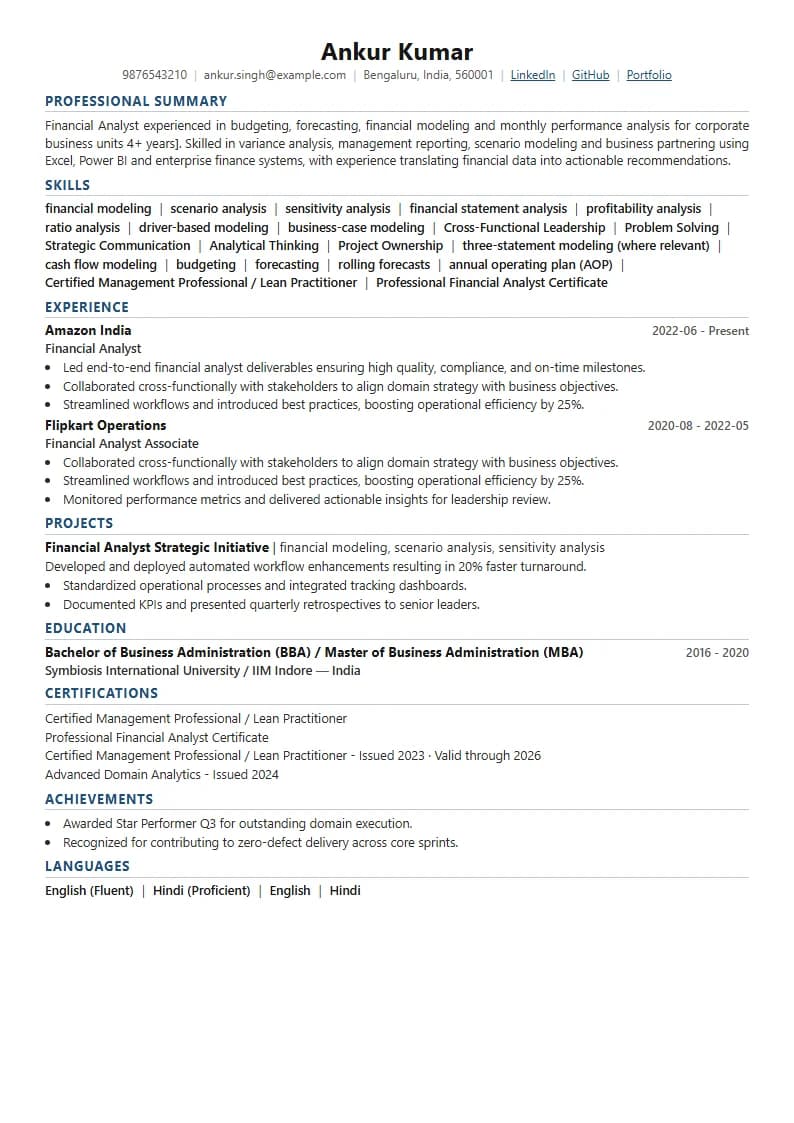
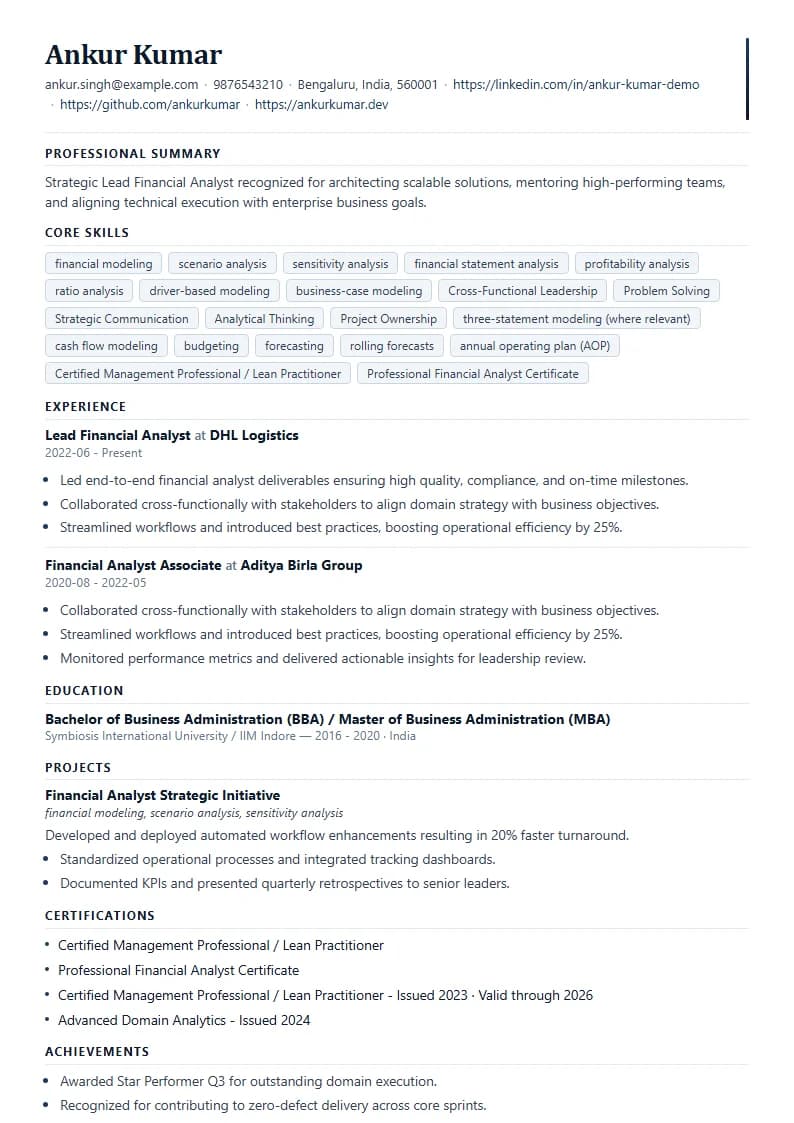
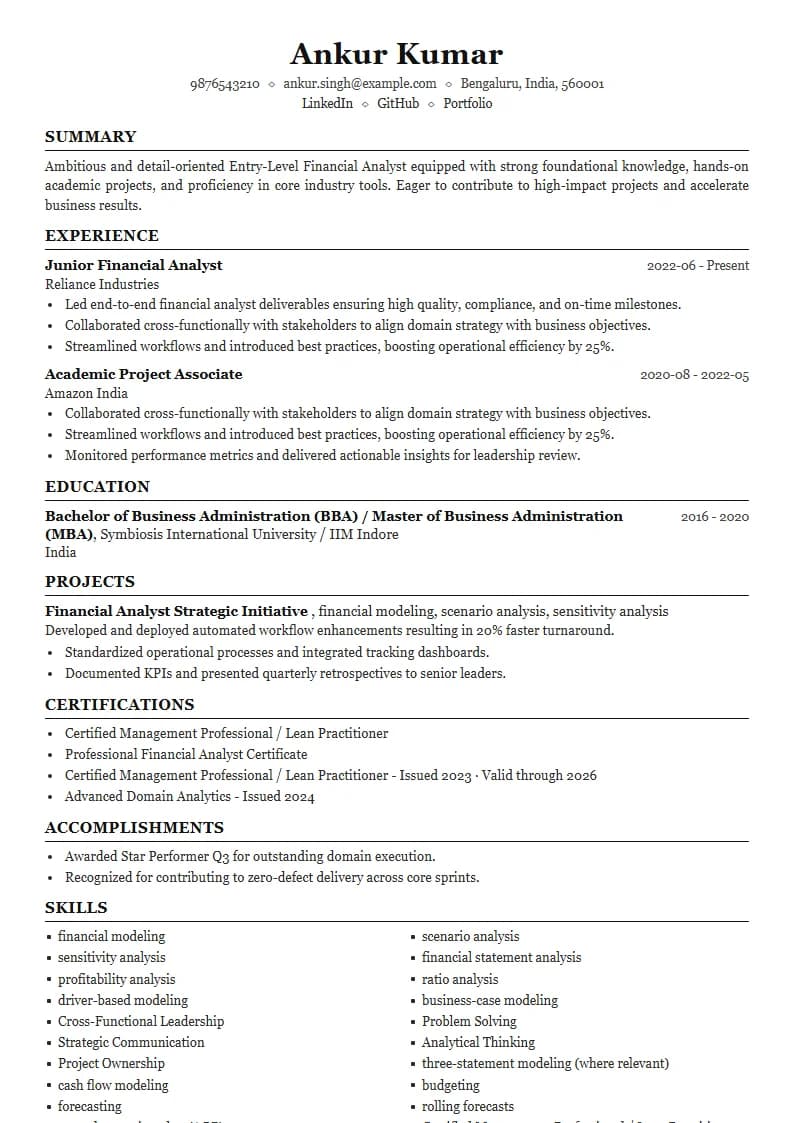
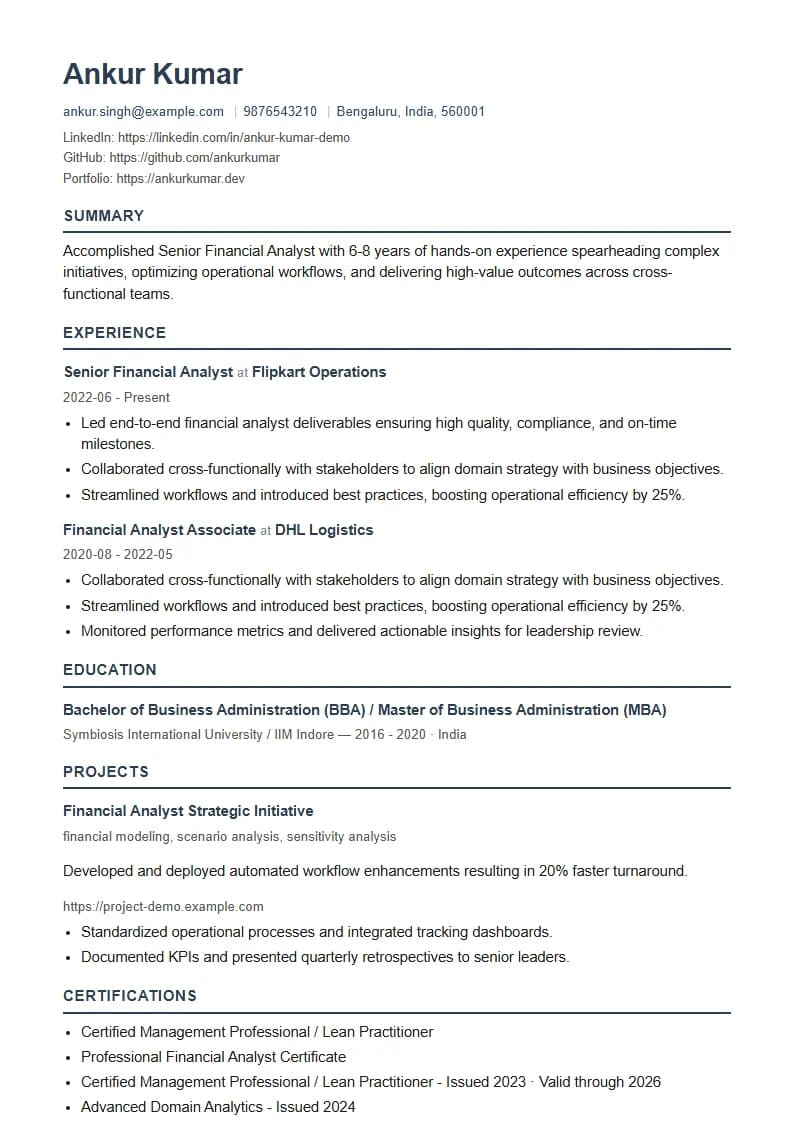
A strong Financial Analyst resume should show the financial questions you analyzed, the models or forecasts you built, the budgets or business units you supported, the tools you used, and how your analysis informed decisions. Where genuinely measured, include scope such as budget size, forecast accuracy, variance reduction, reporting cycle time, cost opportunities or business impact. Emphasize the type of Financial Analyst role being targeted because FP&A, corporate finance and investment-focused positions require different evidence.
Usable resume sample showing summary structure, categorized skills, and effective experience bullets.
Financial Analyst experienced in budgeting, forecasting, financial modeling and monthly performance analysis for corporate business units [X+ years [illustrative sample — replace with your verified result]]. Skilled in variance analysis, management reporting, scenario modeling and business partnering using Excel, Power BI and enterprise finance systems, with experience translating financial data into actionable recommendations.
Financial analysis projects such as budget model creation, rolling forecast implementation, cost structure optimization, and executive dashboard automation showcase strong analytical ownership. Structure entries using: Financial/Business Question → Data & Scope → Model/Method → Tool/System → Insights & Verified Decision/Outcome. For early-career professionals or students, academic financial case studies, financial statement analysis projects, and modeling exercises are valid when clearly designated.
Quarterly Rolling Forecast Model Implementation | Business Question: Quarterly budget rigidity creating forecast lag. Scope: [X business units] across [$X revenue scope [illustrative sample — replace with your verified result]]. System: Advanced Excel (XLOOKUP, Power Query) & Power BI. Method: Built driver-based revenue and OPEX forecast model incorporating seasonality assumptions. Outcome: Improved forecast update turnaround by [X days [illustrative sample — replace with your verified result]] and provided executive leadership with monthly scenario visibility.
Essential domain skills, frameworks and technologies commonly requested for financial analyst positions.
Target key expectations based on your current career stage and technical range.
Financial Data Analysis, Variance Tracking & Modeling Support
Focus on finance education, modeling coursework, internships, Excel data manipulation (XLOOKUP, PivotTables, INDEX/MATCH), basic budget variance tracking, financial statement analysis exercises, and assisting senior analysts with report preparation without claiming unverified management authority.
P&L Variance Analysis, Rolling Forecasts & Business Partnering
Focus on monthly business unit P&L variance analysis, driver-based rolling forecasts, budget tracking, financial dashboard maintenance (Power BI / Tableau), ERP reporting (SAP, NetSuite), and communicating insights to functional department leaders.
Forecast Ownership, Complex Modeling & Executive Decision Support
Focus on end-to-end forecast ownership, annual operating plans (AOP), multi-unit scenario modeling, capital expenditure (CAPEX) evaluation, executive reporting, business partnering with department directors, and mentoring junior analysts.
Budgeting Cycles, Rolling Forecasts & Corporate Planning
Focus on annual budgeting cycles, rolling forecast cadence, long-range planning (LRP), OPEX and headcount modeling, management reporting packs, variance analysis breakdowns, and enterprise planning platforms (Anaplan, Workday Adaptive Planning).
Strategic Planning, Capital Structure & Business Case Modeling
Focus on corporate-level strategic planning, financial evaluation of capital allocation projects, working capital analysis, business case modeling for strategic initiatives, and preparing presentation materials for board or executive reviews.
Commercial Performance, Margin Analysis & Unit Economics
Focus on commercial business unit finance, product line and customer profitability analysis, pricing scenario models, operational KPI tracking, and partnering with sales and operations teams to guide revenue and margin decisions.
Follow these structured steps to align your resume with target job descriptions accurately.
Analyze the target JD to determine whether the role emphasizes FP&A budgeting, rolling forecasts, corporate planning, commercial margin analysis, or executive reporting.
Compare required software (Excel, Power BI, SAP, Anaplan), analytical models (variance analysis, driver-based forecasting, scenario modeling), and business partnering duties against your verified experience.
Structure achievements using Action → Financial Analysis → Tool → Decision/Outcome. Compare your tailored resume with the real job description using GyanBatua to verify alignment before applying.
Resume Diagnostic
Want to know if your resume is ATS-friendly? Check it with our free AI tool below!
Drop your resume here or . PDF & DOCX only. Max 5MB file size.
Direct answers to common Financial Analyst resume questions
Build yours next
Upload your resume and paste the Financial Analyst job description you are targeting. GyanBatua helps you compare your experience against required financial models, forecasting cycles, ERP/EPM platforms, BI tools, and business-partnering skills to identify focus areas before applying.
Your resume data is private, secure, and used solely for diagnostic matching.