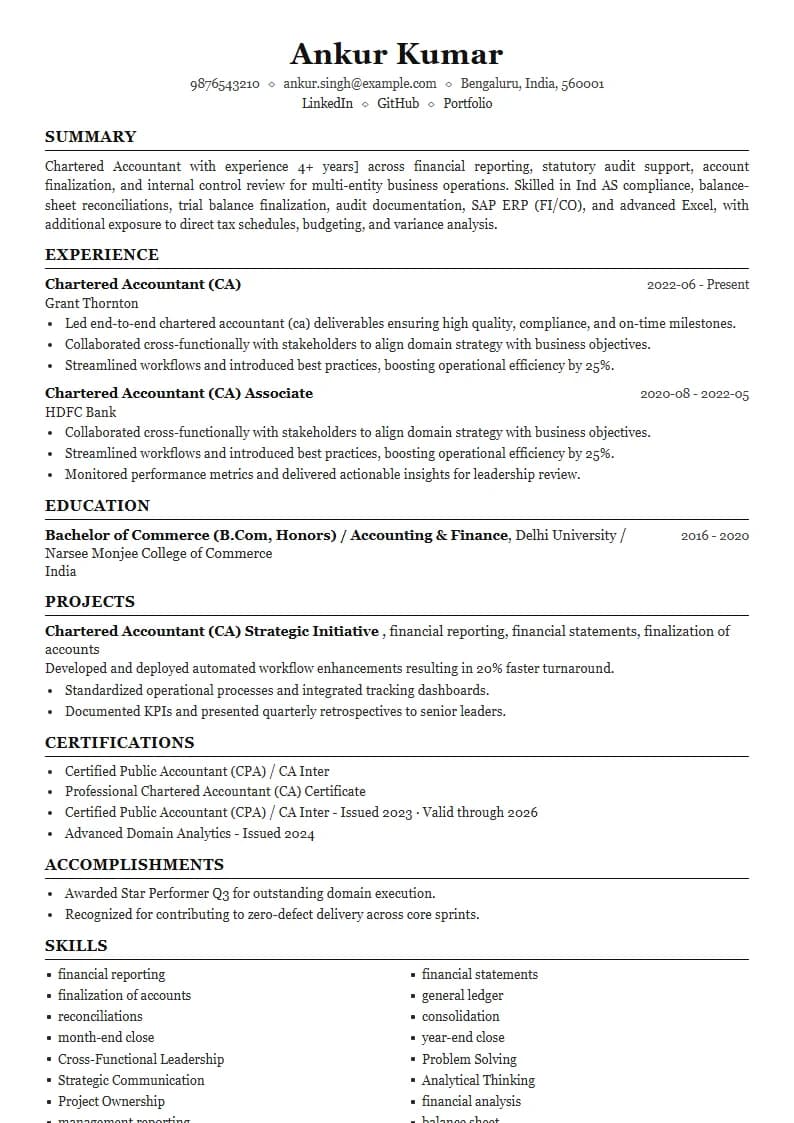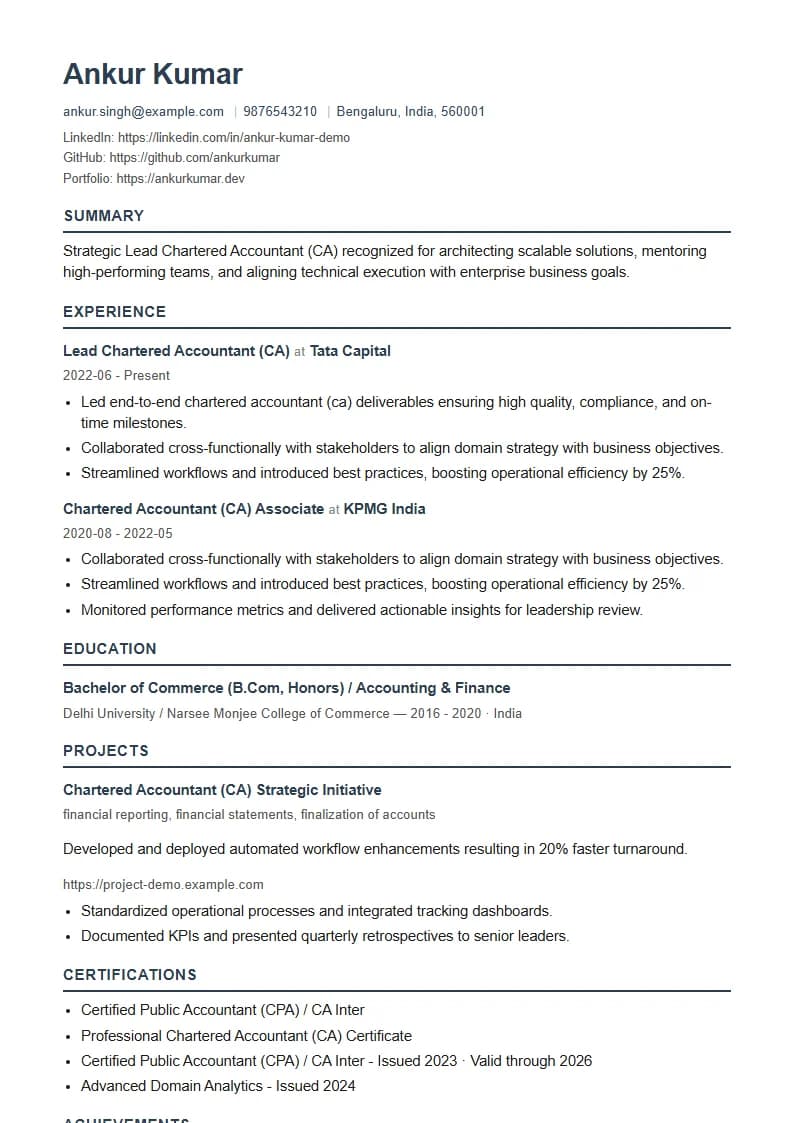

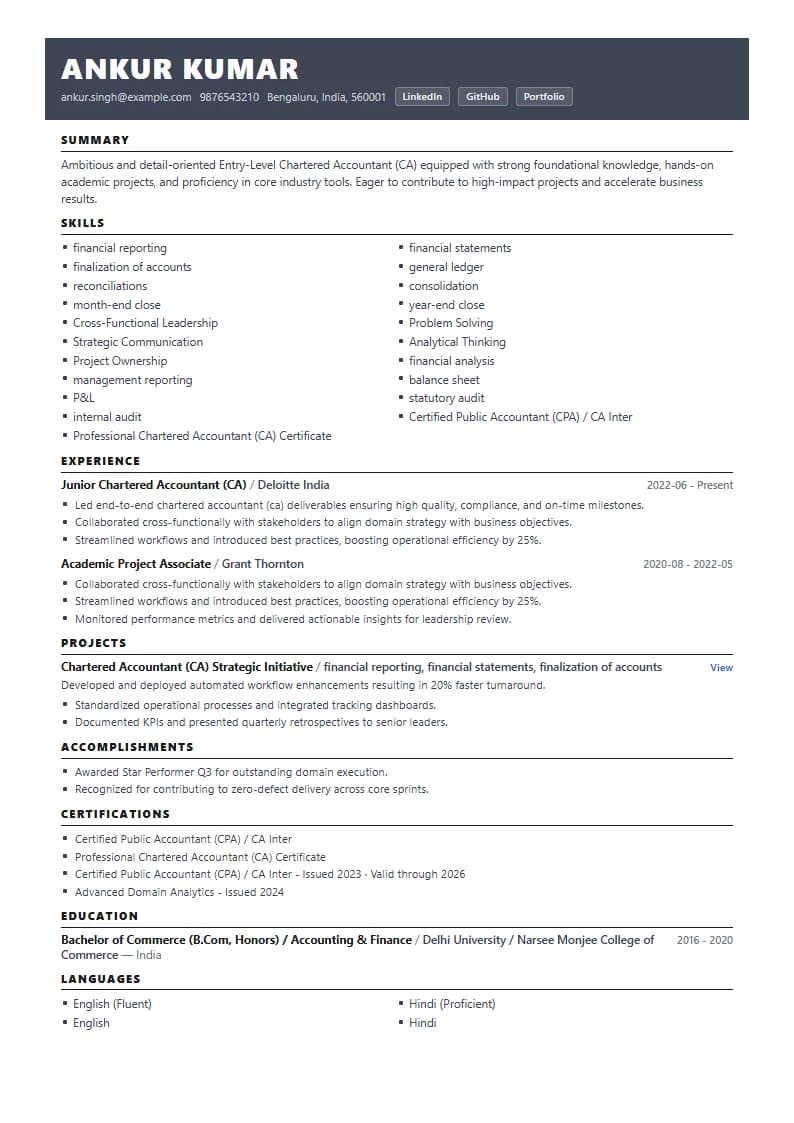
Senior Chartered Accountant (CA) Resume Example using Modern Professional template layout
Featured Example

Chartered Accountant Resume Examples & ATS Guide for 2026

Create a Chartered Accountant resume that clearly demonstrates audit, taxation, financial reporting, controls, financial analysis and relevant statutory or advisory experience. Review examples across newly qualified, audit, tax, finance, controllership and advisory roles, then compare your resume with a real Chartered Accountant job description using GyanBatua.
Updated August 2026·6 min read·Reviewed by Deepti Sahni · Director - HR & Corporate Relations
Core Focus & HighlightsVerified August 2026

What Should a Chartered Accountant (CA) Resume Highlight?

A strong Chartered Accountant resume should show your qualification status, the accounting, audit, tax, finance or advisory work you performed, the standards and regulations relevant to that work, the systems you used, and the scope or outcomes you can verify. For India-focused roles, surface ICAI qualification or membership status and articleship exposure accurately where relevant. Tailor the resume to the target function because audit, tax, controllership, FP&A and advisory roles require different evidence.

Resume Sample

Chartered Accountant (CA) Resume Sample

Usable resume sample showing summary structure, categorized skills, and effective experience bullets.

Professional Summary Example

Chartered Accountant with experience [X+ years [illustrative sample — replace with your verified result]] across financial reporting, statutory audit support, account finalization, and internal control review for multi-entity business operations. Skilled in Ind AS compliance, balance-sheet reconciliations, trial balance finalization, audit documentation, SAP ERP (FI/CO), and advanced Excel, with additional exposure to direct tax schedules, budgeting, and variance analysis.

Experience Bullet Examples

  • Executed statutory audit testing and account finalization procedures for multi-entity operations [X operating entities [illustrative sample — replace with your verified result]], preparing Ind AS financial statement draft schedules, balance-sheet reconciliations, and audit workpapers.
  • Prepared monthly financial reporting packages, trial balance reviews, and intercompany reconciliations using SAP ERP and advanced Excel, investigating variances and supporting year-end audit schedules [illustrative sample — replace with your verified result].
  • Managed direct tax computations, GST reconciliations, and quarterly TDS filing support across corporate entities, ensuring full statutory compliance and zero compliance penalty notices [illustrative sample — replace with your verified result].
  • Evaluated internal financial controls and operational procedures across key business units [X business units [illustrative sample — replace with your verified result]], identifying control gaps, recommending remediation steps, and assisting senior management with audit readiness.
Impact Guidance: Replace all sample entity counts, transaction volumes, audit counts, close timelines, tax filings, financial values and efficiency improvements with your own verified information. Never invent Chartered Accountant achievements. When exact financial figures or client details are confidential, describe entity scale, functional scope, regulatory frameworks, or software tools truthfully.

Chartered Accountant Engagements: How to Present Audit, Tax & Financial Reporting Work

Finance and audit engagements—such as statutory audit closures, Ind AS transition support, tax reconciliation cleanups, and internal control reviews—demonstrate strong functional capability. Structure entries using: Engagement Context → Industry/Entity Scope → Framework/System (Ind AS, GST, SAP, Excel) → Role & Action → Verified Outcome. Protect client confidentiality by anonymizing client names (e.g., 'multi-entity manufacturing enterprise' or 'listed financial services client') and never exposing non-public client metrics.

Statutory Audit & Account Finalization Engagement | Context: Multi-entity corporate audit closure. Scope: [X operating subsidiaries [illustrative sample — replace with your verified result]]. Framework & Tools: Ind AS, SAP ERP (FI/CO), Advanced Excel. Action: Reviewed balance-sheet reconciliations, prepared audit schedules, tested internal financial controls, and resolved audit queries with external auditors. Outcome: Delivered finalized financial schedules on time with zero material audit adjustments [illustrative sample — replace with your verified result].

Competencies

Key Skills & Technical Keywords

Essential domain skills, frameworks and technologies commonly requested for chartered accountant (ca) positions.

Financial Reporting & Accounting
financial reportingfinancial statementsfinalization of accountsgeneral ledgerreconciliationsconsolidationmonth-end closeyear-end closefinancial analysismanagement reportingbalance sheetP&L
Audit & Assurance
statutory auditinternal auditaudit planningaudit documentationrisk assessmentsubstantive testinginternal controlscontrol testingaudit schedules (PBC)audit findings & remediation
Taxation & Statutory Compliance
direct taxincome taxindirect taxGST complianceTDS returnstax computationtax audit schedulestax reconciliationstransfer pricing (where relevant)tax planning & compliance
Finance & FP&A
budgeting supportforecastingvariance analysisFP&A assistancemanagement reportingfinancial modelingcash-flow planningcost analysisbusiness partnering
Controls, Governance & Risk
internal controlsstandard operating procedures (SOPs)statutory compliancefinancial controlspolicy compliancerisk managementgovernanceaudit readiness
Systems & Analytics
Microsoft Excel (advanced)SAP ERP (FI/CO)Oracle NetSuiteTallyPrimeMicrosoft DynamicsPower QueryPower BIaudit software
Education & Certifications: Include your Chartered Accountant qualification prominently, stating your ICAI membership status (or equivalent regional professional body) accurately. List additional relevant credentials—such as B.Com / M.Com graduation degrees, DISA, Diploma in IFRS (ACCA), or financial modeling certifications—only when genuinely earned. State CA Final / Intermediate status accurately if you are currently pursuing full qualification.

Career Stages

Chartered Accountant (CA) Resume by Experience Level

Target key expectations based on your current career stage and technical range.

1Articleship Depth, Qualification & Systems Exposure

Newly Qualified Chartered Accountant

Focus on CA qualification status, articleship functional exposure (statutory audit, tax compliance, account finalization), systems used (Tally, SAP, Excel), and client engagement support without claiming unverified management authority.

2Statutory Audit, Controls & Ind AS Compliance

Audit & Assurance Chartered Accountant

Focus on statutory and internal audit execution, audit planning, risk assessment, controls testing, Ind AS/IFRS financial statement review, audit documentation, and managing external auditor communications.

3Direct Tax, Indirect Tax (GST), TDS & Tax Planning

Taxation Chartered Accountant

Focus on direct corporate tax computations, GST reconciliations and returns, TDS filing oversight, tax audit schedules, transfer pricing documentation support, and statutory tax compliance.

4Account Finalization, Consolidation & ERP Reporting

Financial Reporting & Corporate Finance CA

Focus on financial statement finalization, multi-entity consolidation, general ledger close oversight, variance analysis, ERP platform execution (SAP, Oracle), and management reporting.

5Budgeting, Forecasting, Variance Analysis & Decision Support

FP&A / Business Finance CA

Focus on annual budgeting, rolling forecasts, operational variance analysis, financial modeling, management MIS reporting, cost optimization, and business partnering with executive leadership.

6Financial Governance, Reporting Oversight & Team Leadership

Finance Controller / Senior CA

Focus on end-to-end controllership, financial governance, internal control frameworks, regulatory reporting oversight, treasury oversight, audit committee coordination, and leading finance teams.

7Financial Due Diligence, M&A Support & Quality of Earnings

Transaction Advisory / Due Diligence CA

Focus on financial due diligence engagements, historical balance sheet and P&L analysis, quality of earnings review, working capital analysis, transaction documentation support, and advisory reporting.

JD Tailoring Steps

How to Tailor a Chartered Accountant Resume to a Job Description

Follow these structured steps to align your resume with target job descriptions accurately.

1

Identify the Primary Finance Function

Analyze the target job description to determine whether the role emphasizes statutory audit, direct/indirect taxation, account finalization, FP&A, or controllership.

2

Match Genuine Frameworks, Systems & Experience

Compare required accounting standards (Ind AS, IFRS), tax regulations (GST, Income Tax Act), ERP platforms (SAP, NetSuite, Tally), and scope against your verified background.

3

Refine Evidence & Compare with GyanBatua

Structure achievements using Action → Responsibility → Framework/Tool → Outcome. Compare your tailored resume with the real job description using GyanBatua to verify alignment before applying.

Compliance & Formatting

ATS-Friendly Resume Checklist

Checklist8 items
Use standard section headings: Professional Summary, Qualification & Status, Core Competencies, Work Experience, Articleship / Engagements, Education, and Certifications.
State your Chartered Accountant qualification status accurately (e.g., ICAI Member, Newly Qualified CA, or CA Final candidate) in your resume header and summary.
Surface your primary finance function (Statutory Audit, Tax, Corporate Controllership, FP&A, or Advisory) clearly in your summary and experience section.
Connect statutory frameworks (Ind AS, IFRS, GST, Income Tax Act) directly to experience bullets showing how you prepared reports or performed audits under those standards.
Connect ERP platforms (SAP FI/CO, Oracle NetSuite, TallyPrime, Excel) to work experience showing hands-on execution.
Protect client confidentiality by anonymizing client names, financial values, and non-public audit or tax findings.
Structure experience bullets using Action → Responsibility → Framework/Tool → Verified Outcome.
Avoid keyword stuffing and decorative graphics or tables that may hinder automated document parsing.

Want to know if your resume is ATS-friendly? Check it with our free AI tool below!

Is your resume good enough?

Drop your resume here or . PDF & DOCX only. Max 5MB file size.

🔒We never share your data with 3rd parties or use it for AI model training.

Help & FAQ

Chartered Accountant resume: frequently asked questions

Direct answers to common Chartered Accountant resume questions

What should a Chartered Accountant resume include?
A Chartered Accountant resume should include: a header with contact details and ICAI qualification/membership status; a focused professional summary highlighting your core finance function (audit, tax, reporting, controllership, or FP&A), key accounting standards (Ind AS, IFRS), and ERP systems; grouped technical skills; work experience bullets structured in Action → Responsibility → Tool/Standard → Outcome format; an articleship or engagement section detailing major audit/tax projects; education and professional credentials; and anonymized verified metrics. Ensure your resume directly aligns with the target job description.
What skills should I put on a Chartered Accountant resume?
Group CA skills into clear functional categories: Financial Reporting & Accounting (finalization of accounts, Ind AS, IFRS, balance sheet, consolidation, GL close); Audit & Assurance (statutory audit, internal audit, audit workpapers, internal financial controls, risk assessment); Taxation (direct tax, GST returns, TDS compliance, tax audit, tax reconciliations); Finance & FP&A (budgeting, forecasting, variance analysis, financial modeling); Controls & Governance (SOPs, financial controls, compliance, audit readiness); and Systems & Analytics (SAP FI/CO, Oracle NetSuite, TallyPrime, advanced Excel, Power BI).
How should a newly qualified CA write a resume?
A newly qualified CA should highlight their qualification status prominently and detail their 3-year articleship (or practical training) experience with specific functional responsibilities. Describe the client industries, audit testing executed, tax returns prepared, account finalization tasks supported, and systems used (Tally, SAP, Excel). Use accurate verbs like 'assisted', 'prepared', 'executed', and 'tested' to reflect your genuine contribution during articleship without claiming unverified management authority.
How do I show CA articleship experience on my resume?
Present articleship as a dedicated practical training section under Work Experience or Articleship Experience. Detail specific engagement types (e.g., statutory audit, internal audit, tax audit, GST reconciliation, bank audit), the client industry context (e.g., manufacturing, retail, financial services), the tools and standards used (Ind AS, Income Tax Act, SAP, Tally, Excel), and verified contributions. Protect client confidentiality by describing client entities by scale and industry rather than disclosing proprietary client names.
What makes a strong Chartered Accountant resume summary?
A strong CA resume summary is concise (3–4 sentences) and follows the formula: Qualification Status + Primary Finance Function + Key Accounting Standards & ERP Systems + Core Domain Experience + Verified Impact. Example: 'Chartered Accountant with experience [X+ years [illustrative sample — replace with your verified result]] in financial reporting, statutory audit support, and account finalization for multi-entity corporate operations. Skilled in Ind AS compliance, SAP ERP (FI/CO), and advanced Excel modeling, with a proven record of managing audit workpapers, tax reconciliations, and month-end close schedules.'
What audit and tax experience should I include on a CA resume?
Include audit experience relevant to the role: statutory audit planning, substantive testing, balance-sheet schedule validation, internal financial control (IFC) testing, and audit workpaper compilation. For tax experience, detail direct tax computations, GST reconciliations (GSTR-1, 3B, 9), quarterly TDS filings, tax audit schedules, and advance tax calculations. Always connect tax and audit tasks to real standards (Ind AS, Income Tax Act, GST Law) and systems used.
What accounting software and ERPs should a CA list?
List enterprise ERP platforms and financial tools you have genuinely executed in practice, such as SAP ERP (FI/CO modules), Oracle NetSuite, Microsoft Dynamics, TallyPrime (widely used in Indian practices), and Microsoft Excel (advanced functions, PivotTables, Power Query). Connect each software tool to work experience bullets demonstrating how you used it for account finalization, reconciliation, or audit testing.
What is the difference between an Accountant and a Chartered Accountant resume?
An Accountant resume typically focuses on transactional accounting, general ledger maintenance, bank reconciliations, AP/AR operations, and routine month-end close. A Chartered Accountant resume highlights professional qualification status, in-depth statutory compliance (Ind AS, IFRS, Companies Act), complex audit procedures, statutory tax filings (GST, direct tax, transfer pricing), internal financial controls, and financial governance or advisory responsibilities.
How should I show Ind AS, IFRS, GST, or taxation experience?
Show accounting standards and tax laws through concrete work experience rather than keyword lists. For example: 'Prepared balance-sheet draft schedules and notes to accounts under Ind AS for [X operating entities] during annual statutory audit' or 'Reconciled GSTR-2B with purchase register using advanced Excel, identifying GST input tax credit variances and updating monthly tax schedules.' This demonstrates applied proficiency.
How do I tailor a Chartered Accountant resume to a job description?
To tailor your CA resume: 1) Identify whether the JD requires statutory audit, direct tax, corporate controllership, FP&A, or transaction advisory. 2) Lead your summary and skills section with the specific functional specialization and accounting standards requested. 3) Match the employer's ERP software (SAP, NetSuite, Tally). 4) Reorder experience bullets to highlight relevant engagements first. 5) Use GyanBatua's JD comparison tool to check your draft against the job description before submitting.
What Chartered Accountant keywords are useful for ATS?
Useful ATS keywords depend on the target job description. Common categories include: Functional Keywords (statutory audit, internal audit, direct tax, GST compliance, controllership, FP&A); Standards & Laws (Ind AS, IFRS, Companies Act, Income Tax Act, TDS); Reporting (finalization of accounts, balance sheet, trial balance, consolidation); and Systems (SAP FI/CO, NetSuite, TallyPrime, Excel). Include keywords naturally within genuine experience context.
How long should a Chartered Accountant resume be?
For newly qualified CAs and professionals with up to 5 years of experience, a clean one-page or focused two-page resume works well when it highlights articleship engagements, functional skills, ERP tools, and credentials. Senior CAs, Controllers, and Audit Managers with extensive engagement portfolios across multiple entities or jurisdictions may use two pages to present their leadership and technical scope.

Resume Diagnostic

Check Your Chartered Accountant Resume Against a Real Job Description

Upload your resume and paste the Chartered Accountant job description you are targeting. GyanBatua helps you compare your experience against required statutory frameworks, ERP platforms, audit procedures, tax compliance, and reporting skills to identify focus areas before applying.

ATS OptimizedJD-TunedDiagnostic Assessment
Your resume data is private, secure, and used solely for diagnostic matching.