

Use This Resume
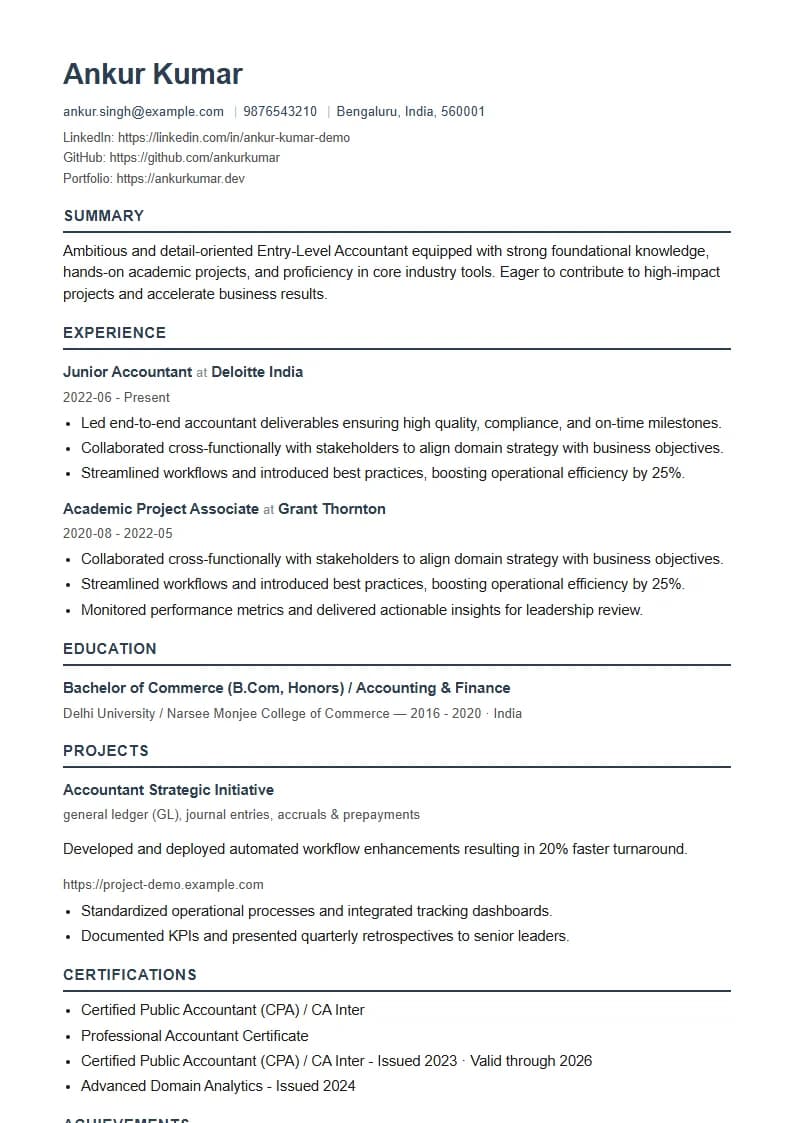
Entry-LevelModern Professional
Create an Accountant resume that clearly demonstrates financial reporting, reconciliations, general-ledger work, close processes, controls, accounting systems and measurable business outcomes. Review examples across entry-level, staff, senior, tax, cost and financial accounting roles, then compare your resume with a real Accountant job description using GyanBatua.
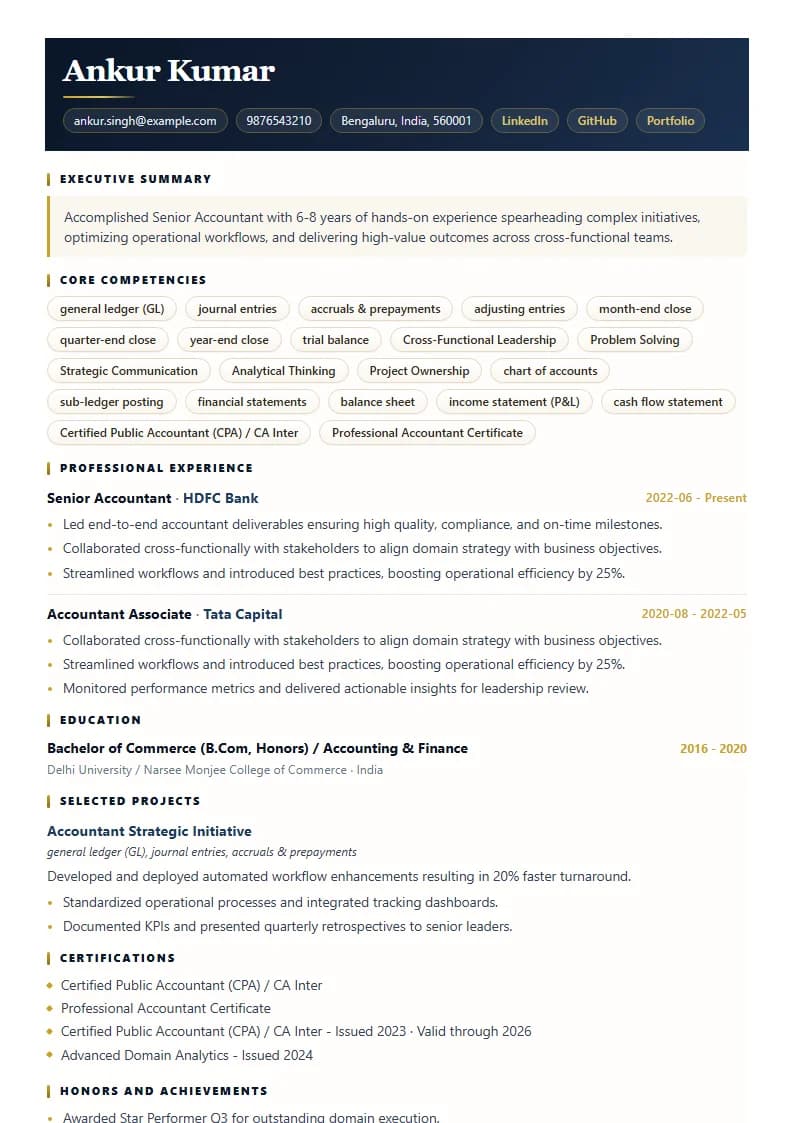
Recruiter-approved templates and real-world examples tailored for accountant roles. Click any resume to customize in seconds.
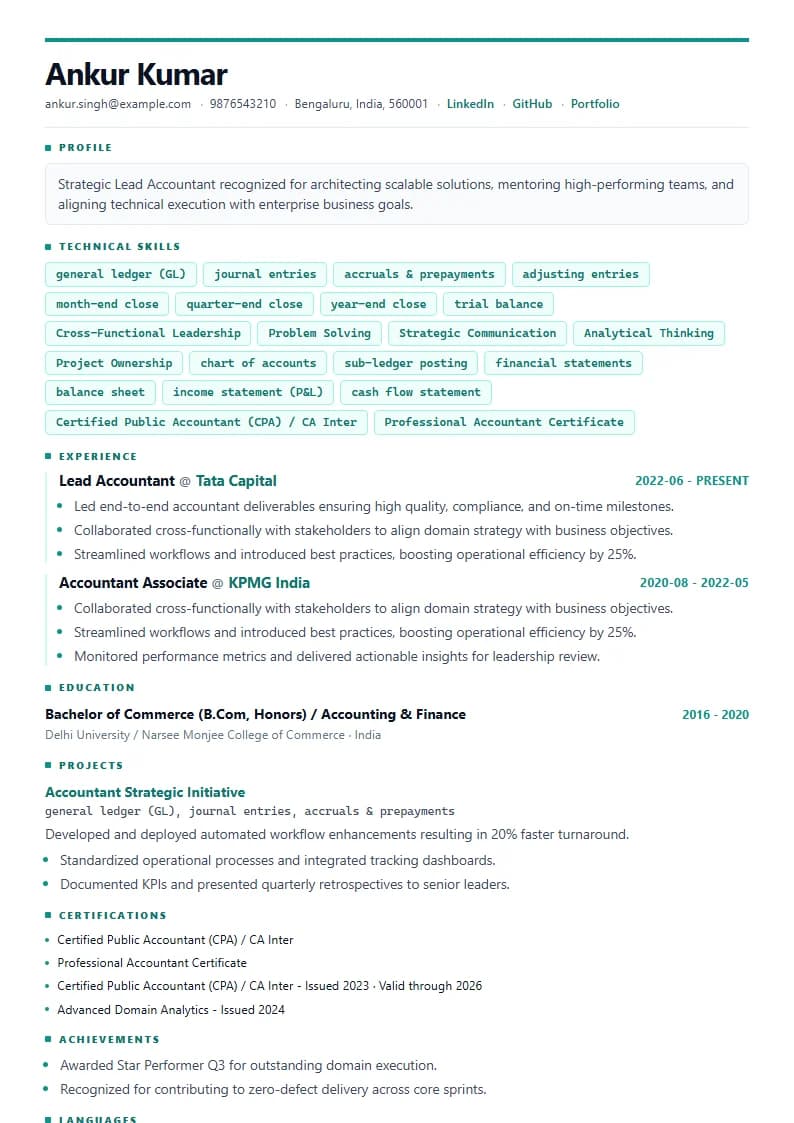
A strong Accountant resume should show the accounting processes you handled, the financial records or reporting you supported, the systems you used, the controls or compliance responsibilities relevant to your role, and the measurable outcomes of your work. Where genuine, include scope such as account volume, close timelines, transaction volume, reporting frequency, error reduction or process improvement. Highlight the accounting standards, software and specialization requested by the target role only when they accurately reflect your experience.
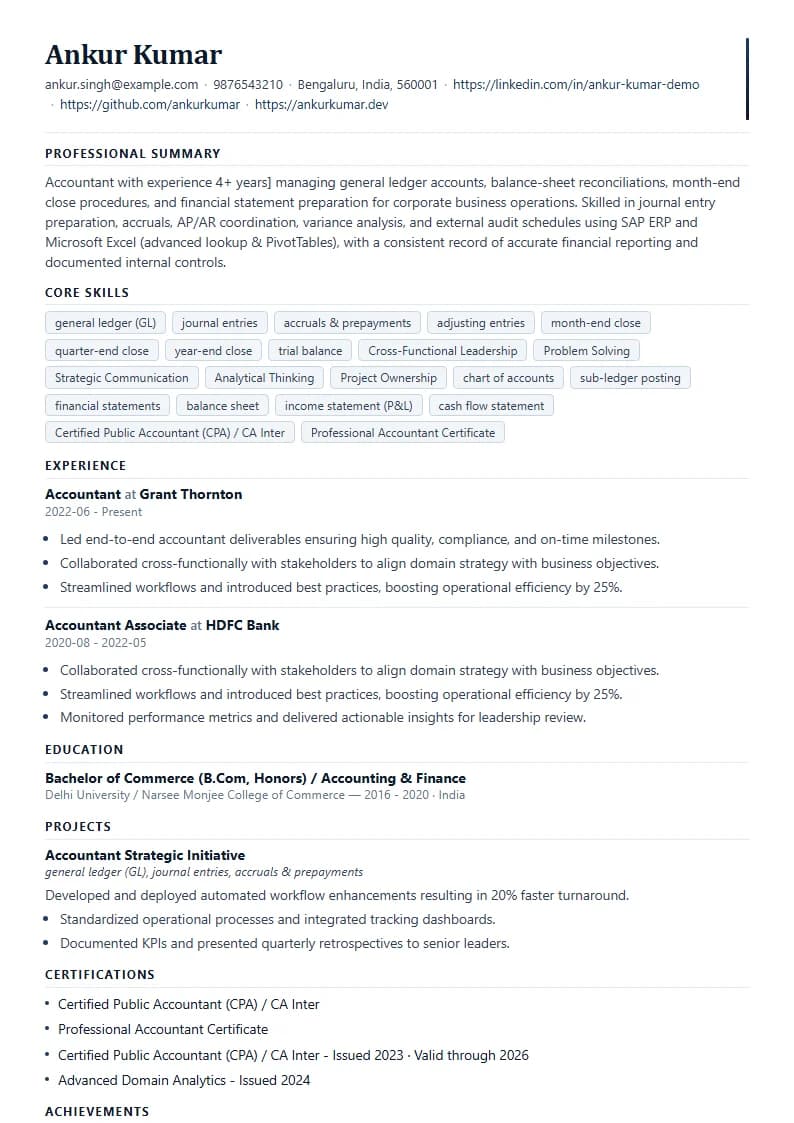
Usable resume sample showing summary structure, categorized skills, and effective experience bullets.
Accountant with experience [X+ years [illustrative sample — replace with your verified result]] managing general ledger accounts, balance-sheet reconciliations, month-end close procedures, and financial statement preparation for corporate business operations. Skilled in journal entry preparation, accruals, AP/AR coordination, variance analysis, and external audit schedules using SAP ERP and Microsoft Excel (advanced lookup & PivotTables), with a consistent record of accurate financial reporting and documented internal controls.
Accounting initiatives such as month-end close optimization, chart-of-accounts cleanup, reconciliation backlog resolution, and accounting software migrations demonstrate strong process ownership. Structure entries using: Accounting Challenge → Scope & Entity Volume → Tool/System (ERP, Excel, Power Query) → Action & Internal Controls → Documented Outcome. For early-career professionals or students, academic case studies, bookkeeping projects, and volunteer financial records are valid when clearly designated.
Month-End Reconciliation Streamlining Initiative | Challenge: Monthly bank and intercompany reconciliation delays extending close timeline. Scope: [X bank accounts] across [X operating entities [illustrative sample — replace with your verified result]]. System: Oracle NetSuite & Advanced Excel (Power Query). Action: Standardized bank feed matching, revised discrepancy escalation protocols, and created monthly close checklist. Outcome: Reduced monthly close cycle time by [X days [illustrative sample — replace with your verified result]] while supporting recurring audit documentation.
Essential domain skills, frameworks and technologies commonly requested for accountant positions.
Target key expectations based on your current career stage and technical range.
Bookkeeping, Reconciliations & Close Support
Focus on accounting education, internships, articleship, bookkeeping exposure, basic journal entries, AP/AR processing, bank reconciliations, Excel data manipulation (VLOOKUP, PivotTables), and assisting senior staff with month-end close tasks without claiming unverified management authority.
General Ledger, Accruals & Monthly Close
Focus on general-ledger maintenance, journal entry preparation, accruals, prepayments, balance-sheet reconciliations, trial balance review, AP/AR coordination, audit schedule preparation, and ERP software execution.
Close Ownership, Controls & Financial Reporting
Focus on end-to-end month-end close ownership, complex multi-entity reconciliations, financial statement draft preparation, variance analysis, internal controls oversight, external audit management, junior staff mentoring, and accounting process improvement.
Financial Statements, GAAP/IFRS & Audit Support
Focus on corporate financial statement preparation (balance sheet, P&L, cash flow), accounting standards compliance (US GAAP, IFRS, or local statutory frameworks as applicable), technical accounting schedules, intercompany accounting, and formal audit support.
Tax Returns, Statutory Filings & Compliance
Focus on direct and indirect tax preparation, tax reconciliations, statutory filing compliance (jurisdiction-specific tax returns, GST/TDS where applicable, corporate tax schedules), tax audit support, and maintaining tax documentation.
Cost Accounting, Variance Analysis & Budgeting
Focus on product/service cost allocation, standard costing, inventory valuation, cost center variance analysis, operational budgeting, break-even analysis, and preparing management decision-support reports.
Follow these structured steps to align your resume with target job descriptions accurately.
Analyze the target JD to determine whether the role emphasizes general ledger close, financial statement preparation, AP/AR, tax compliance, cost accounting, or audit support.
Compare required tools (SAP, NetSuite, QuickBooks, Excel), accounting standards (GAAP, IFRS, statutory rules), and close workflows against your verified experience.
Structure achievements using Action → Accounting Process → Tool → Outcome. Compare your tailored resume with the real job description using GyanBatua to verify alignment before applying.
Resume Diagnostic
Want to know if your resume is ATS-friendly? Check it with our free AI tool below!
Drop your resume here or . PDF & DOCX only. Max 5MB file size.
Direct answers to common Accountant resume questions
Build yours next
Upload your resume and paste the Accountant job description you are targeting. GyanBatua helps you compare your experience against required accounting standards, ERP platforms, close responsibilities, reconciliations, and audit skills to identify focus areas before applying.
Your resume data is private, secure, and used solely for diagnostic matching.