
Credit Risk Matcher

Resume for a Credit Analyst: Match the Lending Type and Risk Framework the JD Uses

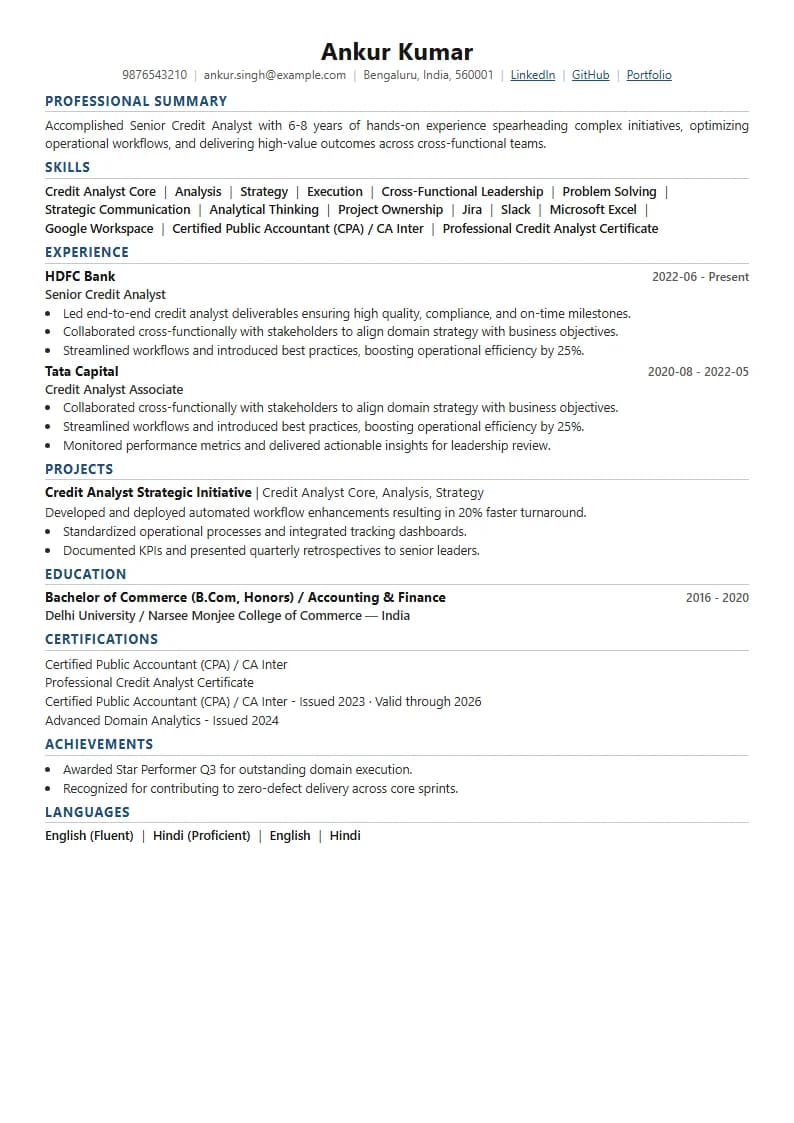
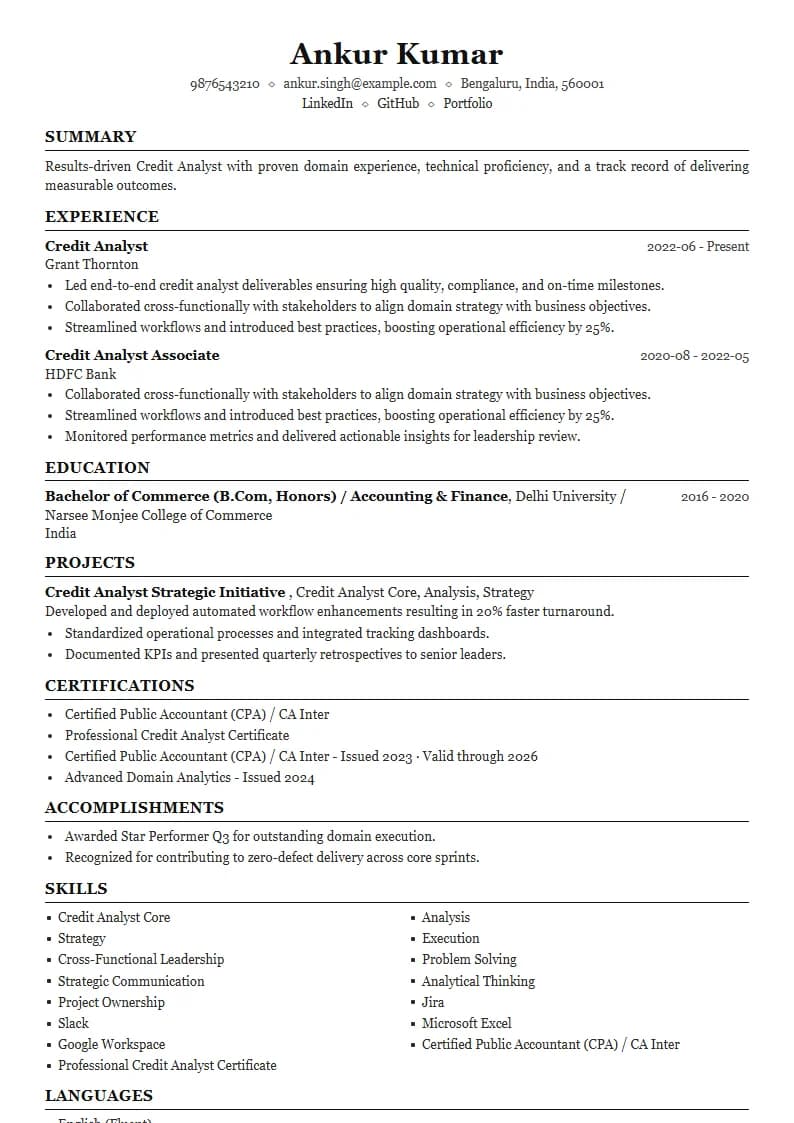
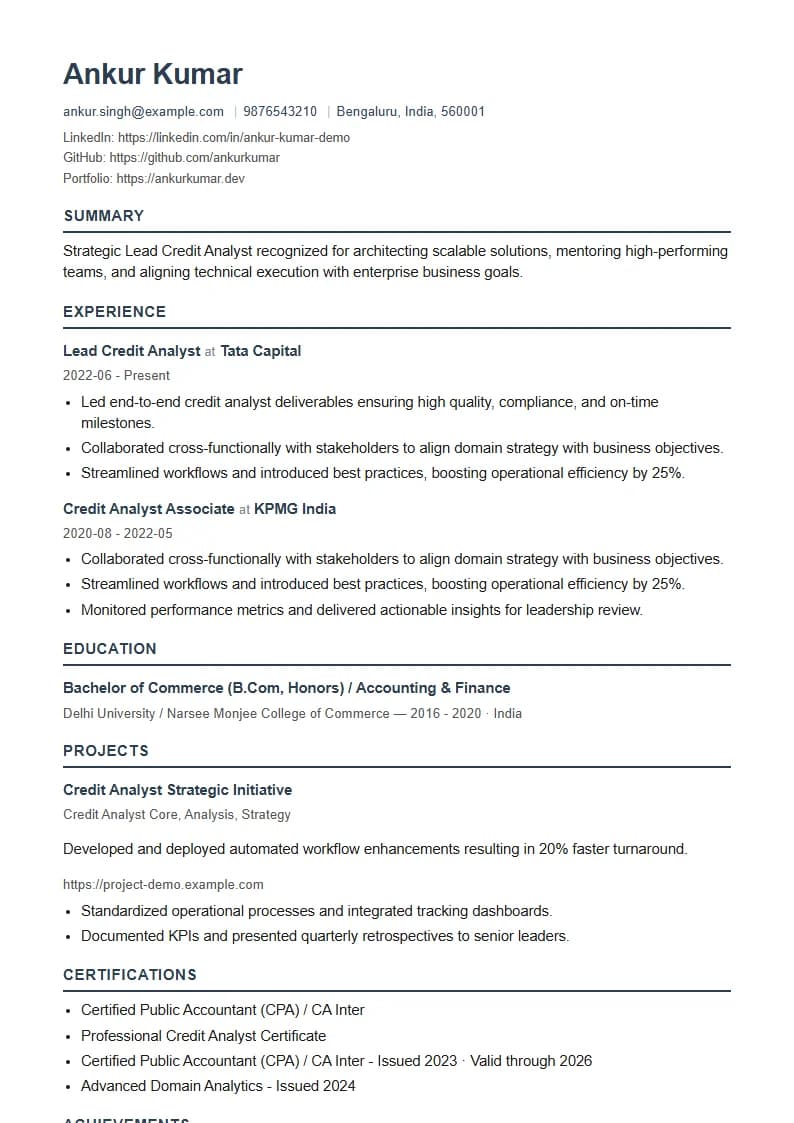
A Credit Analyst resume is judged on demonstrated credit-assessment skill within the specific lending type and risk framework the job description names. Credit analysis splits by what is being lent — retail, SME, corporate, or wholesale credit — and by how risk is assessed, and a resume matched to one lending type under-matches the others. GyanBatua AI scores your resume against the exact JD, names the gaps, and helps you close them before you apply.

Credit Risk Matcher

Target: Corporate Credit Analyst JD

ATS Match OK
78%Match

Optimization Report

Found 2 critical risk framework gaps in core signals.

Lending TypeCorporate & SME lending focus
Risk & RegulatoryMissing RBI guidelines/provisioning
Financial AnalysisRatio analysis, Statement appraisal
Free Scan JD-Tuning Micro-payment

Assessment Parameters

What a Credit Analyst job description screens for

Understanding each one tells you what your resume has to prove for that specific role.

This lending-type split is why one credit-analyst resume rarely wins across openings. A retail-credit JD and a corporate-credit JD reward different analysis depth and frameworks, and the JD signals which the lender is hiring for.

The Lending Filter

Lending type

Lending type is the first filter. Retail/consumer credit, SME lending, corporate or wholesale credit, project finance — the JD is built around one, and a resume that does not foreground it under-matches even with broad credit exposure.

Analysis Capability

Financial analysis depth

Financial statement analysis, ratio analysis, cash flow assessment, and credit appraisal show the candidate can actually assess borrower risk rather than process applications, which most credit JDs weight heavily.

The Risk Threshold

Risk and regulatory framework

Risk and regulatory framework signals maturity. Credit risk, rating models, RBI guidelines, NPA norms, provisioning, and exposure norms appear in JDs, and matching the relevant ones distinguishes a specialist.

The Outcome Metric

Credit-decision outcomes

Credit-decision outcomes convert a match into a shortlist. The strongest credit-analyst resumes show outcomes — proposals appraised, portfolio quality maintained, defaults reduced, turnaround time improved — rather than listing duties.

Credit Keywords

The Credit Analyst resume keywords that matter in 2026

The keywords that matter for a credit-analyst resume are the ones the target JD names — but these categories recur across most Indian Credit Analyst JDs in 2026, and your resume should reflect the ones present in the JD.

Lending Type

Match the primary segment of credit being assessed.

retail creditconsumer lendingSME lendingcorporate creditwholesale creditproject financeworking capital

Financial Analysis

Analytical parameters proving solid risk discovery.

financial statement analysisratio analysiscash flow analysiscredit appraisalcredit underwritingdue diligence

Risk & Regulation

Compliance frameworks governing exposure limits.

credit riskrisk ratingRBI guidelinesNPAprovisioningexposure normscollateral assessment

Analysis Tools

Packages used to score borrowers.

Excelcredit appraisal softwareCIBIL/bureau reportsfinancial modelling

Outcome Language

Business impact indicating underwriting efficiency.

proposals appraisedportfolio qualitydefault rateTATsanction value

Avoid Keyword Stuffing: Matching beats padding. A credit-analyst resume that proves the JD's lending type, analysis depth, and one credit-quality outcome will out-score a generic banking resume.

Underwriting Mismatch

Why credit-analyst resumes under-match on lending type

Credit-analyst resumes under-match when they read as generic banking or processing rather than genuine credit assessment in the JD's lending type. A candidate strong in retail credit applying to a corporate-credit role under-matches if the resume does not foreground the right lending type and the deeper financial analysis corporate roles expect.

The fix is to weight the same base resume toward the JD's lending type, analysis depth, and frameworks for each application, and to confirm the match before applying.

Credit Analyst Fit Comparison

Corporate Credit Underwriting88% Match

Proven corporate financial ratios, statement appraisal.

Retail Loan Processing38% Match

Under-weights deep balance sheet analysis and risk models.

Simple Checking loops

How to check your Credit Analyst resume against a real JD

The fastest way to know whether your credit-analyst resume will clear screening is to score it against the actual job description first. GyanBatua AI does this in three steps.

1

Upload & Paste

Upload your resume and paste the Credit Analyst JD you are targeting. The free match score shows your alignment now, with the gaps named.

2

Review Gaps

Review the lending-type, analysis, and framework gaps. You will see which JD signals your resume is missing or under-weighting for this specific role.

3

Tune & Re-Check

Tune and re-check. Get a JD-matched version; re-run the score to confirm the gaps closed before you submit.

Affordable Micro-payments

GyanBatua's micro-payment model means you pay only for the applications you are serious about — nothing for the months you are not searching — and every user gets the same advanced AI on every action.

Interview Protocol

From shortlist to offer: prepare for the credit interview on the same JD

A matched resume gets you the interview; the same JD should shape your preparation for it. GyanBatua AI's interview practice is built around the job description you matched against, so a retail-credit role and a corporate-credit role generate different practice — financial-analysis and appraisal scenarios, risk and regulatory questions, and the credit-judgement cases the role implies. Resume optimization improves your shortlisting odds; JD-based interview prep improves your odds in the room. Both work on the same target role.

FAQ Help

Common questions about Credit Analyst resumes

FAQ Help

What should a Credit Analyst resume include in 2026?

A Credit Analyst resume should foreground the lending type the JD hires for (retail, SME, corporate, or project finance), show financial analysis and credit-appraisal depth, name the relevant risk and regulatory frameworks, and attach credit-quality outcomes. Because credit analysis splits by lending type, the emphasis should change per JD.

What is the difference between a credit analyst and a financial analyst resume?

A credit analyst resume centres on assessing borrower risk and creditworthiness within a lending framework, while a financial analyst resume centres on forecasting, modelling, and business-finance decisions. Credit JDs weight credit appraisal, risk rating, and regulatory norms, so a general finance resume under-matches them without that specific framing.

Why does my credit-analyst resume get rejected despite banking experience?

A credit-analyst resume with banking experience still gets rejected when it reads as generic processing rather than genuine credit assessment in the JD's lending type, or omits the risk frameworks the JD names. The screening layer scores those signals, so framing and lending-type mismatches cause under-matching.

How do freshers write a credit analyst resume?

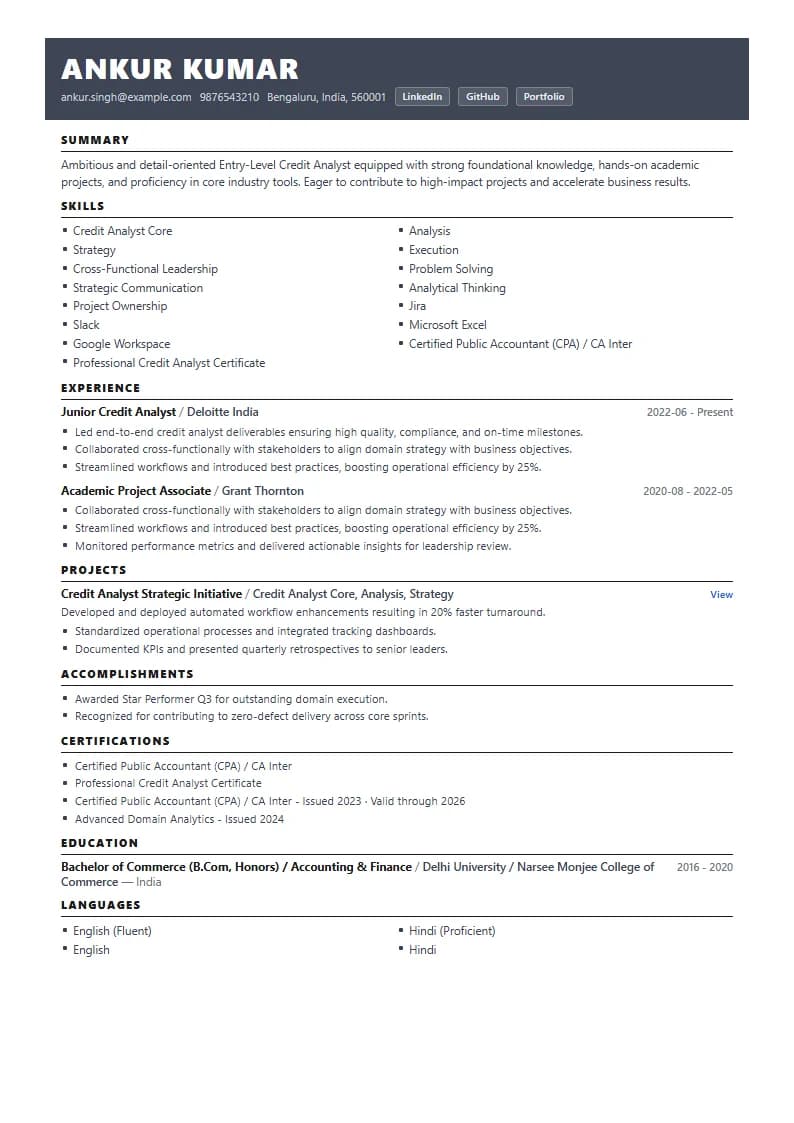
Freshers should foreground financial-analysis coursework, any credit or lending internship work, and projects involving statement or ratio analysis, in the JD's lending-type language. Demonstrated analysis ability matters more than listing subjects. Scoring against a real JD shows whether it is landing.

Does GyanBatua charge a subscription for credit-analyst resume help?

No. GyanBatua AI uses micro-payments — you pay per action (for example for a JD-matched resume) only while job-hunting. There is no forced monthly subscription, and every user gets the same advanced AI on every action regardless of price.

Check your Credit Analyst resume against a real job description

Ensure risk parameters are matched, analyze statement tools, and score instantly.

ATS Optimized
JD-Tuned
Micro-payments