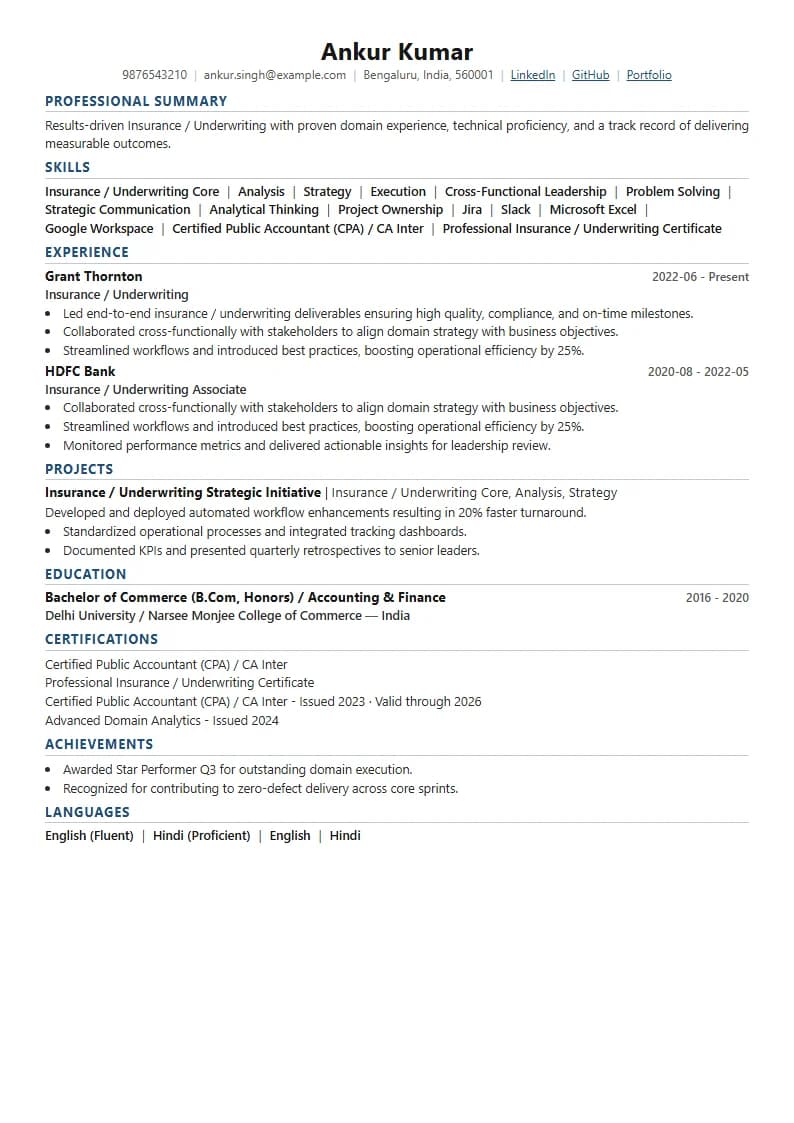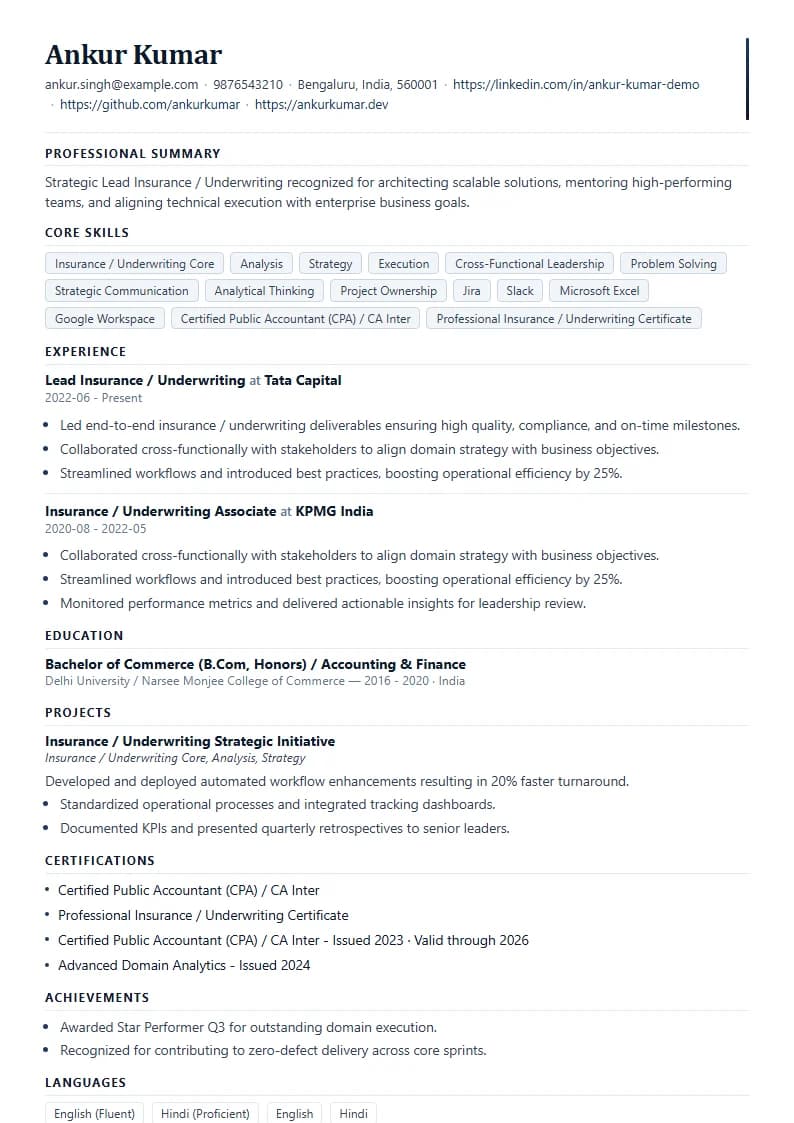

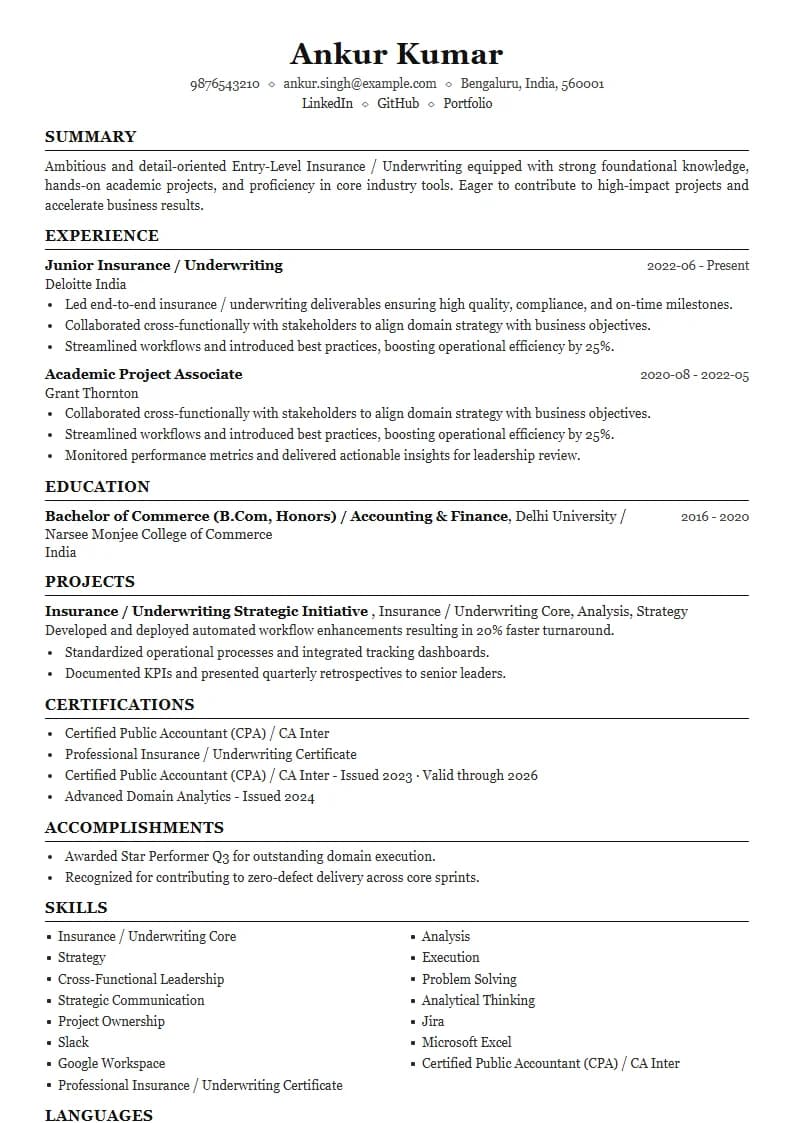
Senior Insurance / Underwriting Resume Example using Timeless Serif Classic template layout
Featured Example

Insurance Underwriter Resume Examples & ATS Guide

Build an Insurance Underwriter resume that demonstrates your risk appraisal acumen, policy pricing precision, loss ratio management, and regulatory compliance across Life, Health, or General (Property & Casualty) insurance domains. Align your resume with target job descriptions before applying.
Updated August 2026·6 min read·Reviewed by Deepti Sahni · Director - HR & Corporate Relations, Insurance & Risk Management
Core Focus & HighlightsVerified August 2026

What Should a Insurance Underwriter Resume Highlight?

An Insurance Underwriter resume should clearly show your insurance sector focus (Life, Health, Property, Casualty, Marine, or Commercial lines), risk appraisal methodology (medical underwriting, financial underwriting, hazard evaluation), delegated underwriting authority limits, and loss ratio management. Highlight reinsurance coordination, policy wording drafting, policy admin software, and compliance with IRDAI regulations matching the target job description.

Resume Sample

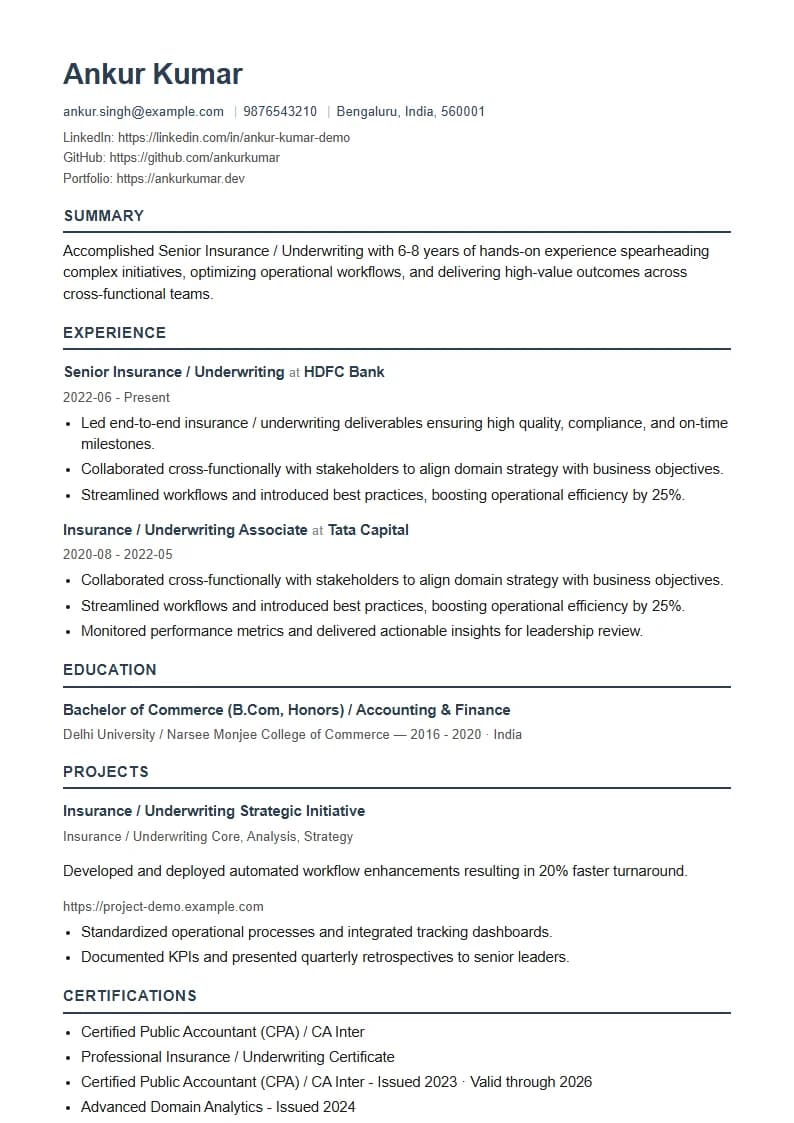
Insurance Underwriter Resume Sample

Usable resume sample showing summary structure, categorized skills, and effective experience bullets.

Professional Summary Example

Insurance Underwriter experienced in assessing risk profiles, determining policy pricing, and issuing coverage across Life, Health, and Commercial General Insurance lines. Proficient in financial and medical underwriting, risk scoring models, loss ratio control, delegated authority limits, reinsurance treaty compliance, and core policy administration systems under strict IRDAI regulatory standards.

Experience Bullet Examples

  • Underwrote and evaluated risk proposals across [X+ commercial and retail insurance policies [illustrative sample — replace with your verified result]], sanctioning coverage up to delegated authority limits of [₹X Cr per risk [illustrative sample — replace with your verified result]].
  • Assessed complex medical histories, laboratory reports, and financial statements to determine mortality/morbidity loadings or special policy exclusions in alignment with underwriting guidelines.
  • Collaborated with treaty and facultative reinsurance partners to structure risk-sharing arrangements for high-sum-insured and catastrophic hazard properties.
  • Monitored portfolio claims frequency and loss ratios across assigned lines of business, maintaining a profitable loss ratio of [X% [illustrative sample — replace with your verified result]].
Impact Guidance: Quantify your underwritten portfolio volume, loss ratio performance, turnaround time (TAT), or delegated authority thresholds with verified numbers. Strictly avoid disclosing confidential policyholder medical or financial information.

Underwriting Risk Optimization & Guideline Review

Structure underwriting achievements around line of business, hazard profiling, pricing structure, and portfolio loss ratio outcomes.

Commercial Fire Risk Assessment Framework | Sector: Heavy Manufacturing Facilities | Action: Introduced standardized hazard inspection parameters and tailored deductible schedules | Outcome: Supported portfolio expansion while maintaining loss ratios below targeted thresholds.

Competencies

Key Skills & Technical Keywords

Essential domain skills, frameworks and technologies commonly requested for insurance underwriter positions.

Underwriting Specializations & Lines
Life Insurance UnderwritingHealth & Critical Illness UnderwritingCommercial Property & Fire InsuranceMarine Cargo & TransitCasualty & General LiabilityGroup Insurance Schemes
Risk Appraisal & Medical/Financial Assessment
Financial Underwriting (Income Adequacy)Medical Underwriting (Mortality / Morbidity Assessment)Hazard & Physical Risk InspectionRisk Loading & Deductible StructuringExclusions & Policy Endorsements
Portfolio Governance & Reinsurance
Loss Ratio ManagementCombined Ratio ControlDelegated Underwriting Authority (DUA)Facultative & Treaty ReinsuranceClaims Trend Analysis
Regulatory & Compliance Standards
IRDAI Guidelines & RegulationsAnti-Selection Risk PreventionInsurance Ombudsman ProtocolsFraud Detection & Medical Investigation Triggering
Underwriting Systems & Analytics
Core Policy Administration SystemsUnderwriting Rule Engines (Automated UW)Advanced MS Excel (Data Modeling)Risk Rating Calculators
Education & Certifications: Include Fellow / Associate of the Insurance Institute of India (FIII / AIII), Chartered Insurance Institute (ACII), or degrees in Actuarial Science, Statistics, Commerce, or Medicine (for medical underwriting).

Career Stages

Insurance Underwriter Resume by Experience Level

Target key expectations based on your current career stage and technical range.

1Proposal Verification & Standard Risks

Junior Underwriter / Underwriting Analyst

Focus on proposal scrutiny, straight-through processing (STP) verification, basic financial checks, and standard risk acceptance within basic limits.

2Complex Risk Assessment & Authority Limits

Senior Insurance Underwriter

Showcase independent decision-making on complex medical, high-financial-value, or hazardous commercial insurance proposals.

3Portfolio Strategy & Policy Governance

Chief Underwriter / Head of Underwriting

Detail overall underwriting policy formulation, treaty reinsurance negotiations, risk appetite definition, and loss ratio governance across all lines.

Tailoring Steps

How to Tailor an Insurance Underwriter Resume to a Job Description

Follow these structured steps to align your resume with target job descriptions accurately.

1

Identify Line of Business & Authority

Check whether the insurer is hiring for Life, Health, Group, or Commercial General lines, and note the expected underwriting authority level.

2

Align Risk Appraisal & Loss Ratio Evidence

Highlight your specific experience with medical/financial underwriting, risk loading decisions, reinsurance treaties, and portfolio loss ratio metrics.

3

Review and Validate

Ensure your professional certifications (III/CII), regulatory familiarity (IRDAI), and software skills are clearly highlighted before submitting.

Compliance & Formatting

ATS-Friendly Resume Checklist

Checklist5 items
Use standard section headings: Professional Summary, Underwriting Skills, Work Experience, and Professional Certifications.
Clearly indicate your primary insurance domain (Life, Health, Property, Marine, Casualty) in your summary and experience.
List professional insurance qualifications (AIII, FIII, ACII, Actuarial papers) prominently in your credentials.
Structure experience bullets with line of business, delegated authority limit, risk evaluation method, and loss ratio results.
Submit in standard, clean PDF format without non-standard graphic elements or multi-column parsing obstacles.

Want to know if your resume is ATS-friendly? Check it with our free AI tool below!

Is your resume good enough?

Drop your resume here or . PDF & DOCX only. Max 5MB file size.

🔒We never share your data with 3rd parties or use it for AI model training.

Help & FAQ

Frequently Asked Questions About Insurance Underwriter Resumes

FAQ Help

What should an Insurance Underwriter resume highlight?
An Insurance Underwriter resume should highlight your line of business specialization (Life, Health, Property, Casualty), risk assessment methodologies (medical, financial, physical hazards), delegated underwriting authority limits, loss ratio management, and professional certifications (AIII/FIII).
What certifications are most respected for underwriters in India?
Certifications from the Insurance Institute of India (III)—Licentiate, Associate (AIII), and Fellow (FIII)—as well as credentials from the Chartered Insurance Institute (CII UK) are widely recognized.
How do I show loss ratio performance on my resume?
Describe your portfolio governance with verified metrics, such as: 'Maintained a healthy portfolio loss ratio of [X%] on commercial property risks through rigorous pre-underwriting hazard surveys and structured deductibles.'
How do medical underwriters present their background?
Highlight your medical knowledge (MBBS, BDS, B.Pharm, or Life Sciences), ability to interpret diagnostic test reports, mortality/morbidity rating tables, and medical underwriting rule engines.
What is the difference between an Underwriter and a Claims Executive?
An Underwriter evaluates risk before policy issuance to decide pricing, terms, and acceptance. A Claims Executive evaluates policy validity and loss extent after an insured event has occurred to settle compensation.
What makes an Underwriter resume ATS-friendly?
Use standard headings, standard PDF formatting, and incorporate recognized insurance terminology (Life, Health, Property, Mortality, Loss Ratio, Reinsurance, IRDAI, FIII, Rule Engine) that matches the target job posting.
How should freshers apply for Underwriting roles?
Fresh graduates with degrees in statistics, mathematics, commerce, or life sciences should highlight data analysis skills, understanding of insurance risk principles, and progress toward III Licentiate or actuarial exams.
How long should an Insurance Underwriter resume be?
A single page is standard for underwriters with up to 5–7 years of experience. Chief underwriters and risk leaders managing multi-line portfolios may use two pages.

Resume Diagnostic

Check Your Insurance Underwriter Resume Against a Real Job Description

Compare your resume with the Insurance Underwriter role you are targeting and verify line of business alignment, risk appraisal terminology, and authority limits before applying.

ATS OptimizedJD-TunedDiagnostic Assessment
Your resume data is private, secure, and used solely for diagnostic matching.