

HR Interview Questions and Answers for Freshers in India
Overview: The 12 HR interview questions every Indian fresher faces — with honest frameworks for answering each. No scripts. No fake answers. Just the structure that gets you through.

Introduction
HR interviews for freshers in India follow a predictable pattern. The questions vary in phrasing but the topics are almost always the same: self-introduction, motivation, strengths, weaknesses, company knowledge, salary expectations, relocation, and situational judgment.
This guide covers the twelve questions that appear most frequently, with answer frameworks — not scripts. Scripts sound rehearsed. Frameworks give you structure while letting you sound like yourself.
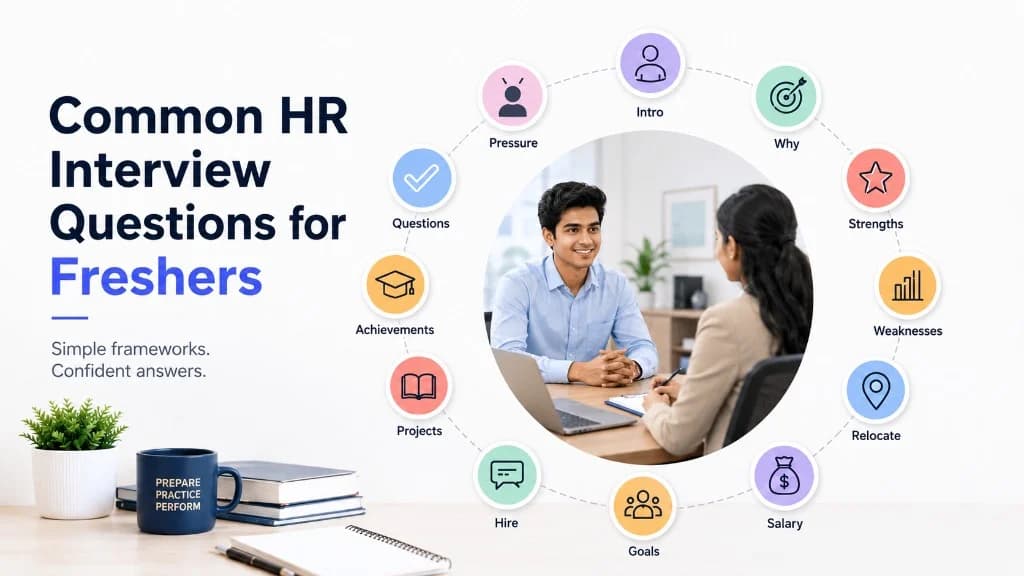
The twelve questions
1. "Tell me about yourself."
Lead with your technical identity: degree, primary skill, strongest project. End with why this company. 60–90 seconds. No biography, no hobbies, no "since childhood."
2. "Why do you want to work here?"
Name something specific: a product, a practice area, a training programme, a recent news item. "Great company with global presence" tells them you googled the name and stopped.
3. "What are your strengths?"
Name one. Give a 15-second proof. "I'm good at systematic debugging — during my project, I traced a memory leak that had been open for two weeks."
4. "What are your weaknesses?"
Name a real one. Attach what you're doing about it. "I tend to jump into code before fully planning the approach. I've started writing pseudocode and architecture notes before opening the IDE."
5. "Where do you see yourself in five years?"
Tie your growth to the company's structure. "I want deep expertise in [domain]. Your company's [specific programme/rotation/exposure] gives me the path to develop that." Don't say "in your chair" or "as a manager."
6. "Why should we hire you?"
Connect your specific skills to their specific needs. "Your JD emphasises Java backend development and agile delivery. I've built two Java projects using Spring Boot and worked in sprint cycles during my internship."
7. "Tell me about a time you faced a challenge."
Use STAR: Situation (one sentence), Task (what was needed), Action (what you did), Result (what happened). Use a real example — academic project deadlines, team conflicts, technical blockers.
8. "Are you willing to relocate?"
Yes. Service companies post freshers across India. If you have constraints, the HR interview is not where to negotiate them.
9. "What is your expected salary?"
For freshers: "I'm aware of the standard package for this role and I'm comfortable aligning with it." Don't anchor high. Don't lowball. The band is fixed for most fresher roles.
10. "Do you have any gaps in your education?"
If yes: explain briefly and honestly. "I had a one-year gap after 12th due to [reason]. I used that time to [constructive activity]." Background verification catches hidden gaps.
11. "How do you handle pressure?"
Give a real example. Not "I thrive under pressure" — that's an adjective claim. "During my final semester, I was managing my project submission and placement preparation simultaneously. I built a weekly schedule that blocked specific hours for each."
12. "Do you have any questions for us?"
Always ask at least one. Good: "What does the first six months look like for someone in this role?" or "What technology stacks is the team currently working with?" Bad: "What is the salary?" (you already discussed it) or "When can I take leave?" (wrong signal).
The meta-skill behind all twelve answers
Every HR question tests the same underlying thing: can you communicate a clear, honest, structured thought under mild pressure?
The freshers who fail this round don't fail because of wrong answers. They fail because of rambling answers, rehearsed scripts that sound robotic, or obvious dishonesty ("my weakness is I work too hard").
Prepare bullet points, not scripts. Three bullet points per question. Practice speaking from them naturally — different words each time but same structure. Record yourself. Time yourself. If any answer exceeds 90 seconds, cut it.
Practise these questions against your actual role
The phrasing and emphasis of HR questions shifts between companies and roles. "Why TCS?" needs different research than "Why Deloitte?" "Where do you see yourself?" is framed differently for a Systems Engineer role versus a Business Analyst role.
GyanBatua builds interview practice around the specific JD you're applying to — including HR-round questions framed for that company and role. ₹21 for text, ₹51 for voice with delivery scoring.
Is your resume good enough?
Drop your resume here or . PDF & DOCX only. Max 5MB file size.
Resume guides
Related Resume Guides
About the Author
Vice President at Mobiloitte
Vice President at Mobiloitte, focusing on AI-first digital initiatives, resume optimization engines, and placement outcomes.
Pricing
Choose your plan and get started faster
Compare features, pricing, and usage clearly, then pick the plan that fits your goal.
Next step
Check your resume against a real job description
See JD match, keyword visibility, and skill gaps before you apply.
Related reading
13Recent articles
6