Resume vs Role Fit: What Recruiters Actually Notice First
Overview: A good-looking resume is not enough if role-fit is weak. Learn what recruiters notice first and why relevance matters more than generic polish.

Introduction
A lot of candidates spend too much time trying to make the resume “good.”
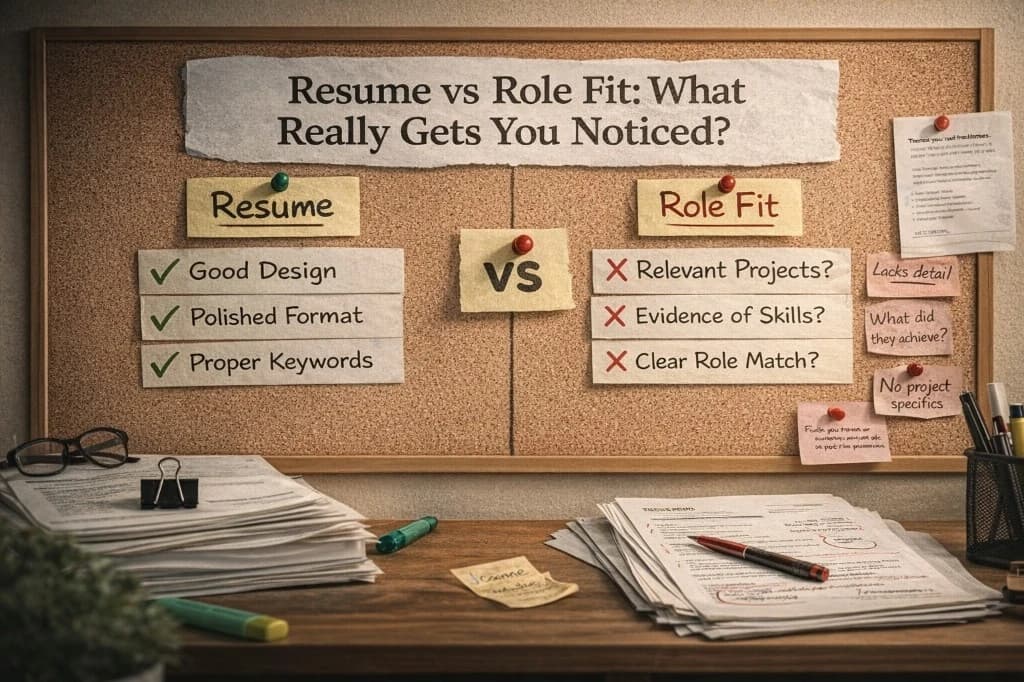
That sounds smart, but there is a problem. A good resume in general is not the same as a resume that works for a specific role. And hiring teams care much more about the second one.
That is the difference between: resume quality role fit
Understanding this difference can change the way you apply.
Because many candidates do have decent resumes.
- They are clean.
- Readable.
- Well formatted.
- Nicely structured.
Still, they do not get shortlisted. Why? Because the resume may be presentable, but not relevant enough.
What resume quality means
Resume quality usually includes:
- clean structure
- proper formatting
- readable sections
- decent writing
- no major visual clutter
All of this is useful. A messy resume is rarely a strong resume. But quality alone does not guarantee conversion. That is where people get confused.
What role fit means
Role fit means:
- the resume is aligned to the specific role
- the right skills appear early
- the relevant tools are visible
- the summary reflects the target job
- the projects or internships support the role
- the wording matches the kind of work the company wants
In simple words: resume quality helps you look professional role fit helps you look shortlist-worthy And in hiring, shortlist-worthiness matters more.
Why candidates over-focus on design
It is easy to focus on:
- template
- layout
- color
- font
- icons
- overall “look”
Because design feels visible and controllable. But it is often not the biggest bottleneck.
A recruiter is usually not asking:
- is this beautiful?
- is this modern?
- is this template premium?
They are asking:
- does this candidate fit this role?
- do I see the right skills?
- is the proof relevant enough?
- should I move this forward?
That is why a nice-looking resume can still fail.
What recruiters usually notice first
In the early scan, recruiters often notice:
1. Role direction
Can I tell what this person is applying for?
2. Relevant skills
Do I see the expected tools or capabilities?
3. Top-half clarity
Is the summary and early structure helping me understand the fit?
4. Strong proof
Do the projects, internships, or bullets sound useful?
5. Relevance to the role
Does this feel like the right kind of resume for this opening?
Notice what is missing from that list:
- fancy design
- stylish format
- decorative elements
These are not useless. They are just not the first shortlist drivers.
The mistake many candidates make
They improve the resume without improving the fit. That leads to things like:
- new template
- same generic summary
- better formatting
- same weak project descriptions
- cleaner layout
- same poor role alignment
This creates the illusion of progress. But interview calls do not improve because the core issue was not design. It was relevance.
Example: good resume vs relevant resume
Imagine two candidates.
Candidate A
- clean template
- good spacing
- polished layout
- generic summary
- random skill list
- vague project bullets
Candidate B
- simple layout
- strong role-specific summary
- relevant skills visible early
- projects written clearly
- JD-aligned wording
- obvious target role
Candidate B often gets shortlisted more easily. Not because the resume is prettier. Because it is easier to classify and trust.
Why role fit matters even more for freshers
Freshers usually have less formal experience. That means the resume needs to work harder.
A fresher resume should tell the recruiter:
- what role I want
- what relevant skills I have
- what projects support that
- why this application is serious
If the role fit is unclear, the fresher can look weaker than they really are.
That is why students should not just ask: “Is my resume good?” They should ask: “Is my resume good for this role?” That is a much better question.
How to improve role fit quickly
- Rewrite the summary for the role
- Reorder skills based on relevance
- Move the strongest role-fit projects higher
- Use JD language where truthful
- Remove unrelated clutter
- Keep different versions for different role families
These changes usually do more for shortlisting than visual redesign alone.
Final thought
A good resume helps. A relevant resume converts better. That is the real difference between resume quality and role fit.
So before changing the template again, ask something more important: Does this resume clearly show why I fit this role? That is the question recruiters care about.
Closing section
FAQ
Is your resume good enough?
Drop your resume here or . PDF & DOCX only. Max 5MB file size.
Resume guides
Related Resume Guides
About the Author
Director - HR & Corporate Relations at Mobiloitte
Director of HR & Corporate Relations at Mobiloitte, specializing in recruitment strategy, placement readiness, and corporate partnerships.
Pricing
Choose your plan and get started faster
Compare features, pricing, and usage clearly, then pick the plan that fits your goal.
Next step
Check your resume against a real job description
See JD match, keyword visibility, and skill gaps before you apply.
Related reading
13Recent articles
6