

How Many Job Applications Per Week Should You Actually Send
Overview: Forget the "apply to 50 jobs a week" advice. Here is what application volume actually correlates with offers — and what does not.

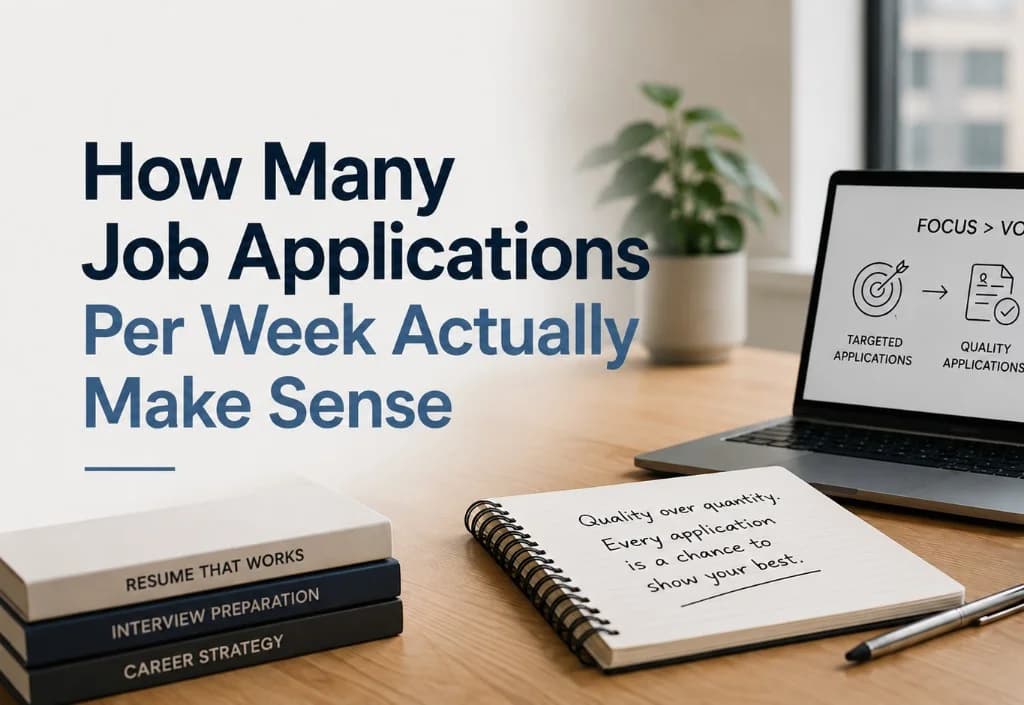
Introduction
The most common job search advice is also the most counterproductive.
"Apply to 50 jobs a week."
"Volume is everything."
"Send out 100 resumes — at least one will hit."
This advice survives because it is intuitive. Effort in equals outcome out. More applications, more chances.
It is also mostly wrong.
Volume is not the metric
What actually correlates with offers is not application volume.
It is conversion rate.
Applications to recruiter conversations. Conversations to interviews. Interviews to offers.
A candidate sending 50 generic applications a week with a 1% conversion to interview is doing worse than a candidate sending 10 carefully tailored applications a week with a 10% conversion.
Both produce roughly the same number of interviews. One produces them with a fifth of the effort, with five times the resilience, with significantly less burnout.
A realistic weekly target
For most candidates, the sustainable pace looks like this.
- 5-10 well-tailored applications per week (not 50)
- 2-3 hours per week of resume, profile, and positioning improvement
- 2-3 follow-ups on earlier applications that have not received a response
- 1-2 conversations — coffee chats, LinkedIn outreach, mentor or alumni check-ins
- real rest on at least one full day each week, with no job search activity
Compare this to the "50 a week" approach. Half the applications. Twice the depth per application. Real rest built in. Better mental health. Usually better outcomes.
When higher volume makes sense
There are situations where moderately higher volume is genuinely useful.
- Freshers and entry-level candidates — where the role pool is huge and your individual match is partly luck. Volume helps when each individual application has lower variance.
- Visa-constrained candidates — where you are applying through a narrow time window and have to maximize coverage.
- Highly transferable roles — where the JD does not need much tailoring because your background is broadly applicable across many similar roles.
Even in these cases, the right number is rarely 50. It is more like 15-25 — with each application still receiving more attention than a quick upload.
The hidden cost of over-applying and search fatigue
When candidates mass-apply to 40 or 50 listings a week, a quiet cycle of application fatigue begins. Because tailoring is skipped, response rates plummet. The searcher interprets the silence as a personal failing rather than a flawed distribution method, responding with even higher volume. This accelerates burnout, lowers attention to detail, and drains the energy needed when actual interviews arrive.
Protecting your cognitive and emotional energy is not a luxury during a job search — it is a functional requirement. An exhausted candidate shows up poorly in interviews, misses key requirements on job descriptions, and makes avoidable positioning errors.
Job search time budgeting and weekly pacing
Treat your search with clear operational boundaries rather than an open-ended grind:
- Cap active searching to 2–3 focused hours per day instead of continuous background browsing.
- Dedicate specific blocks for JD analysis and resume tailoring rather than context-switching between job boards all day.
- Set aside 1 day each week exclusively for skill building or project proof.
- Enforce at least 1 full day of complete rest with zero job board checking to prevent persistent nervous system fatigue.
What "tailored" actually means
Tailoring is not rewriting your entire resume for every application.
It is — for each role —
- reading the JD properly, twice
- adjusting your headline to match the role name
- rewriting two to three lines of your summary to match the role's priorities
- reordering your skills section so the role's top requirements appear first
- tweaking experience descriptions where appropriate
- submitting only if you can write a cover note that actually says why you, for this role
Done quickly with practice, that is 10-15 minutes per application. Not five hours. Not five minutes either.
The shift to make
Stop optimizing for applications per week.
Start optimizing for the percentage of your applications that become real conversations.
Track that number. Improve it deliberately. Watch it climb.
More conversations from fewer applications is the goal. The candidate who hits 10% conversion at 10 applications per week beats the candidate who hits 2% conversion at 50 applications per week — at the same number of interviews, with five times less stress, with a clear path to improvement.
Is your resume good enough?
Drop your resume here or . PDF & DOCX only. Max 5MB file size.
Resume guides
Related Resume Guides
About the Author
Full Stack Software Engineer at Mobiloitte
Full Stack Software Engineer at Mobiloitte, helping freshers navigate placement prep and software workflows.
Pricing
Choose your plan and get started faster
Compare features, pricing, and usage clearly, then pick the plan that fits your goal.
Next step
Check your resume against a real job description
See JD match, keyword visibility, and skill gaps before you apply.
Related reading
1Recent articles
6