

Use This Resume
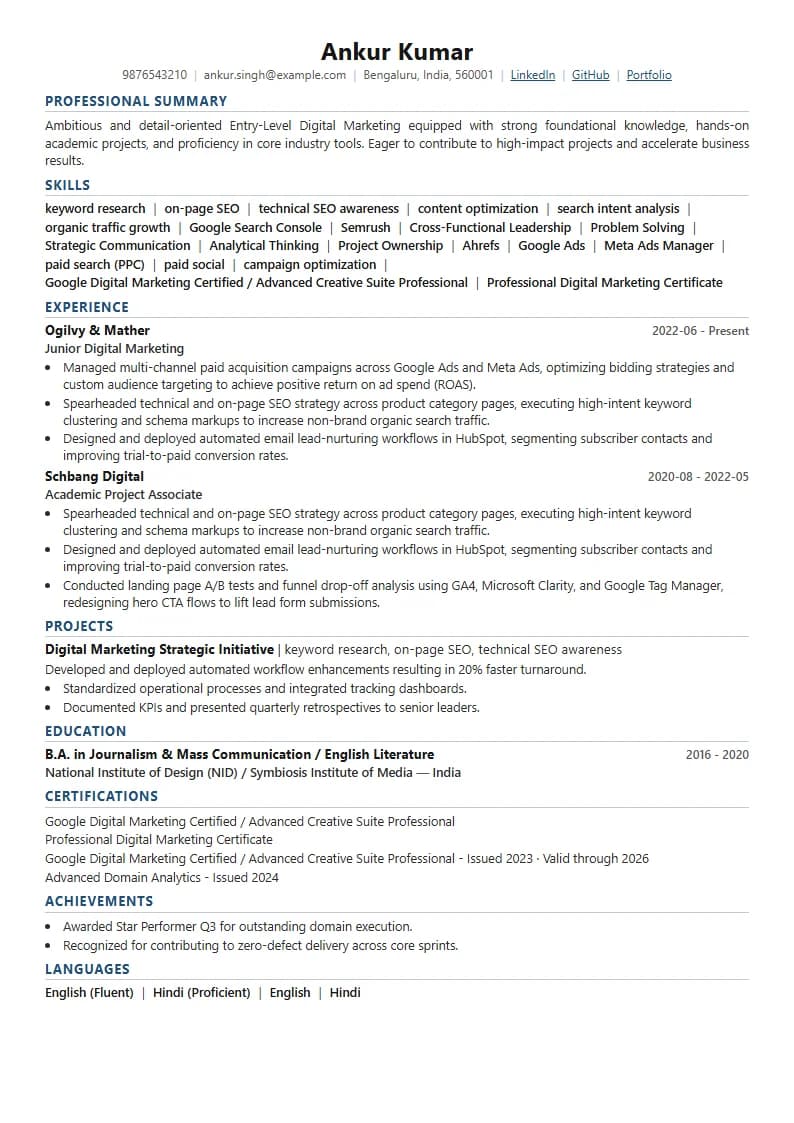
Entry-LevelExecutive Onyx Gold
Create a Digital Marketing resume that clearly demonstrates channel expertise, campaign strategy, audience targeting, analytics, experimentation and measurable marketing outcomes. Review role-specific examples across SEO, paid media, content, social, lifecycle and growth, then compare your resume with a real marketing job description using GyanBatua.
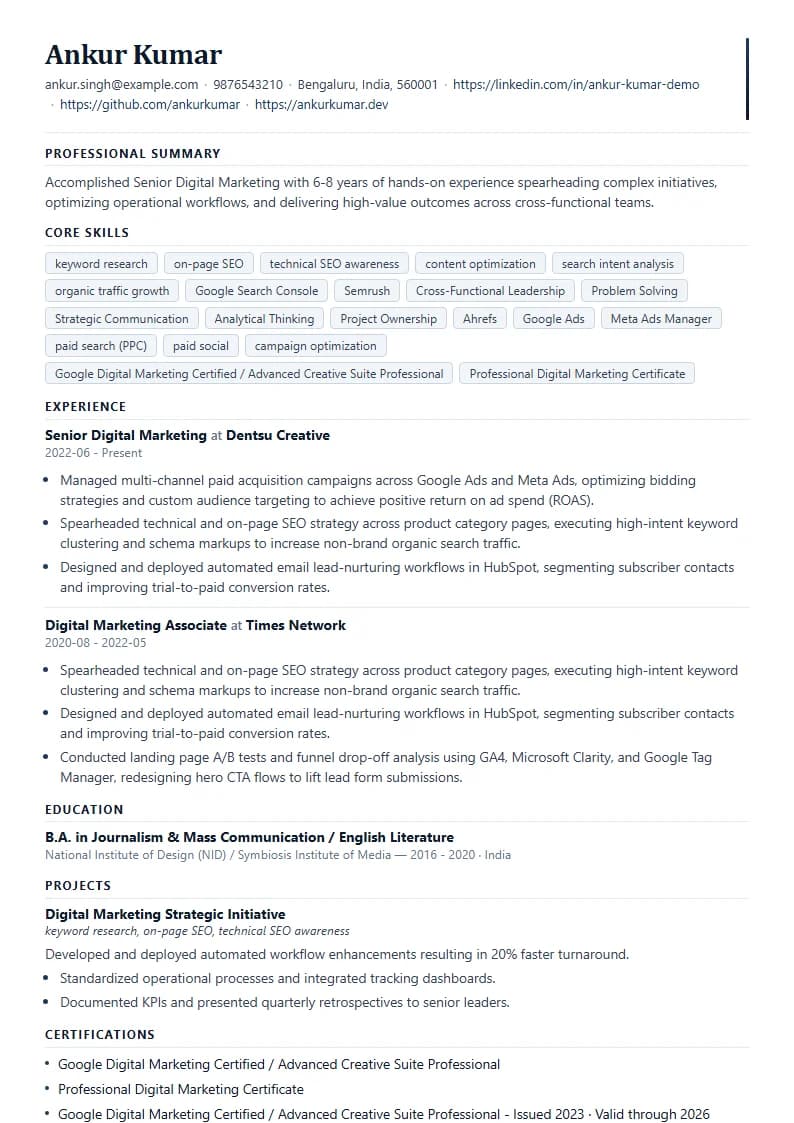
Recruiter-approved templates and real-world examples tailored for digital marketing roles. Click any resume to customize in seconds.
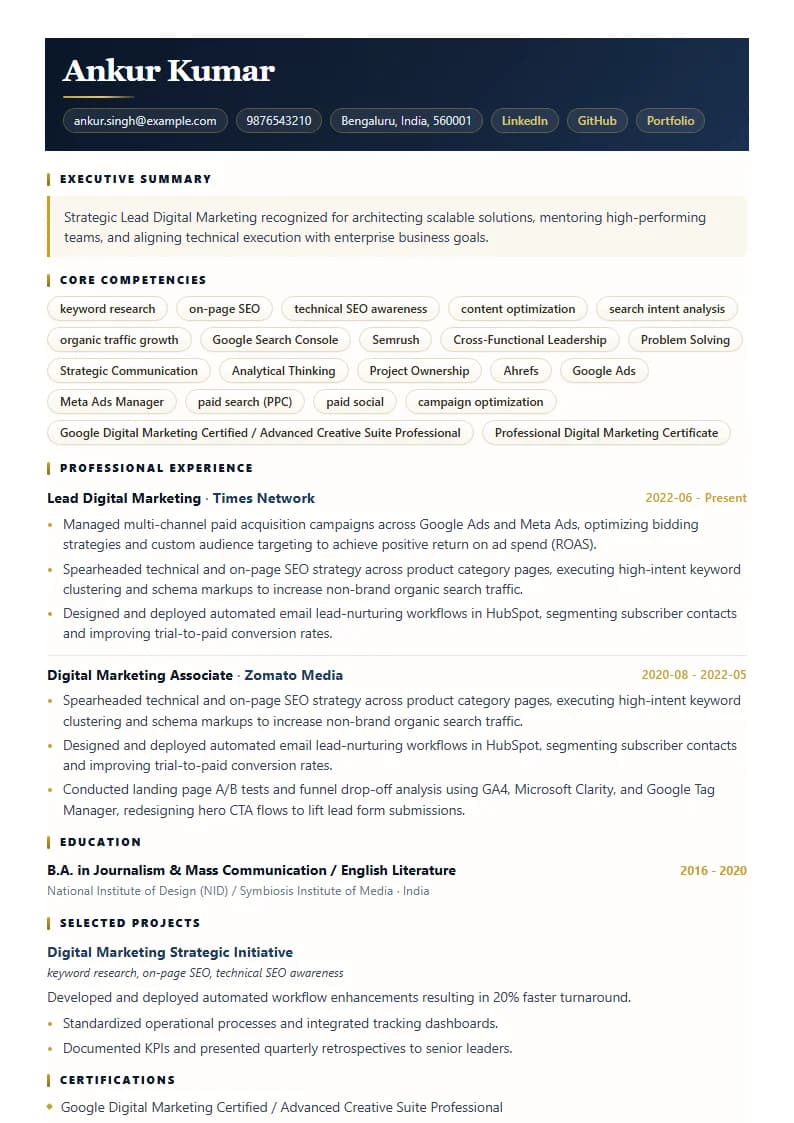
A strong Digital Marketing resume should show which channels you worked on, what campaigns or programs you owned, which tools you used, how you measured performance, and what changed because of your work. Connect SEO, paid media, content, email, social or lifecycle activity to genuine metrics such as qualified traffic, leads, conversion rate, CAC, CPL, ROAS, retention or revenue where verified. Tailor the emphasis to the target job description.
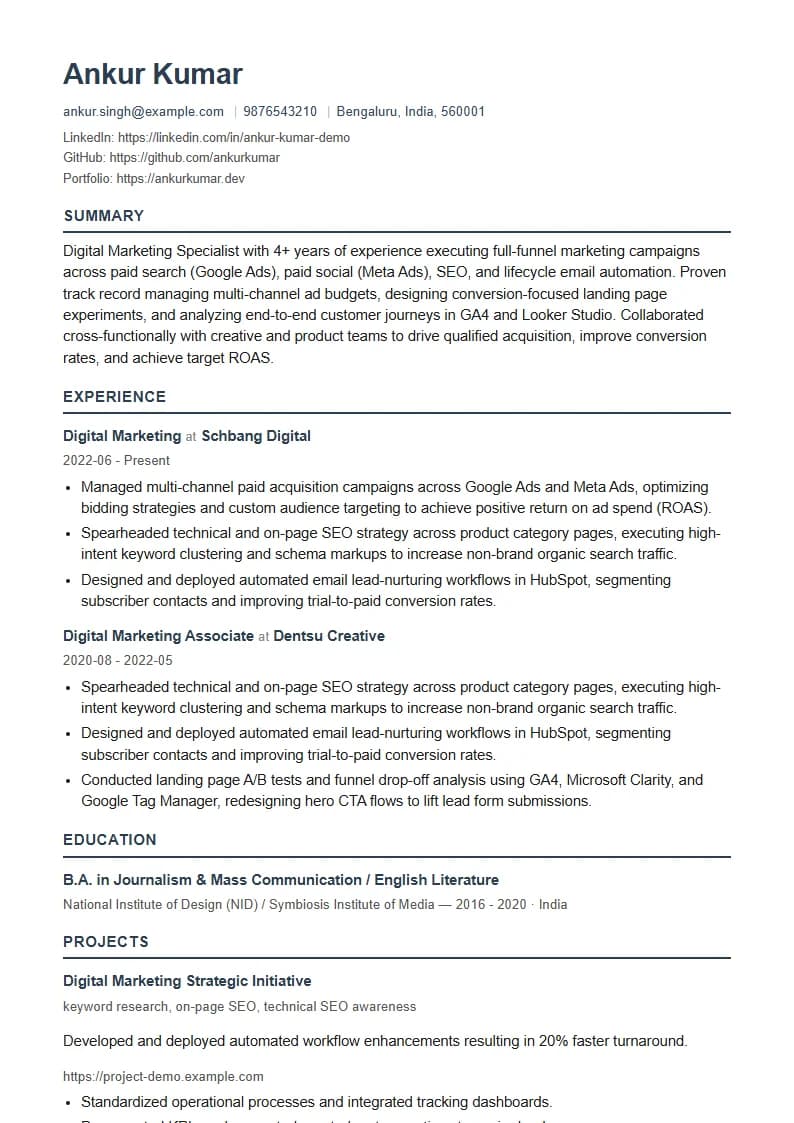
Usable resume sample showing summary structure, categorized skills, and effective experience bullets.
Digital Marketing Specialist with 4+ years of experience executing full-funnel marketing campaigns across paid search (Google Ads), paid social (Meta Ads), SEO, and lifecycle email automation. Proven track record managing multi-channel ad budgets, designing conversion-focused landing page experiments, and analyzing end-to-end customer journeys in GA4 and Looker Studio. Collaborated cross-functionally with creative and product teams to drive qualified acquisition, improve conversion rates, and achieve target ROAS.
Projects and case studies are essential for freshers, career switchers, and marketing specialists demonstrating strategic rigor. Structure each project using: Campaign / Project → Goal & Target Audience → Channels & Strategy → Tools & Execution → Measurement & Result. Personal websites, university campaigns, volunteer work, or non-profit marketing are valid when clearly labeled as non-commercial or portfolio exercises.
E-Commerce Customer Acquisition Campaign Case Study | Goal: Reduce customer acquisition cost (CAC) while expanding top-of-funnel reach. Audience: Millennial home decor buyers. Channels: Meta Ads (Instagram/Facebook) + Google Search. Execution: Structured audience testing with creative variations and single-keyword ad groups. Measurement: GA4 conversion tracking + Looker Studio dashboard. Outcome: Successfully scaled qualified inbound traffic and lowered effective cost-per-acquisition.
Essential domain skills, frameworks and technologies commonly requested for digital marketing positions.
Target key expectations based on your current career stage and technical range.
Practical Projects & Transferable Skills
If you have no formal digital marketing job title, highlight hands-on execution: internships, academic marketing projects, personal websites or blogs, social media channel management, volunteer or non-profit campaigns, ad platform coursework, and analytics exercises. Frame your experience around what you did, the channels used, how you measured performance, and what you learned. Clearly label non-commercial projects as portfolio case studies rather than claiming enterprise client ownership.
Channel Ownership & Campaign Optimization
Focus on channels and campaigns you owned end-to-end: campaign setup, creative direction, audience segmentation, budget allocation, day-to-day bid optimization, and cross-functional reporting. Highlight measurable marketing outcomes—such as ROAS improvements, CPL reductions, organic search growth, or email engagement gains—where verified data exists, and describe campaign scale and testing methodologies clearly.
Strategy, Channel Mix & Budget Ownership
Emphasize overarching marketing strategy, multi-channel budget allocation, agency and team leadership, revenue and pipeline forecasting, measurement frameworks, and cross-departmental alignment with sales and product teams. Senior marketing leadership is demonstrated through full-funnel vision, strategic trade-offs, and measurable business growth—not campaign execution tasks alone.
Search Intent & Technical Visibility
Highlight keyword research, search intent mapping, on-page optimization, content cluster strategy, technical SEO audits (crawlability, indexing, Core Web Vitals collaboration), Google Search Console analysis, and competitive backlink auditing. Demonstrate how organic search strategy drove qualified organic sessions, search rankings, and inbound conversions.
Paid Search, Paid Social & ROAS
Focus on paid advertising platforms: Google Ads (Search, Performance Max, Display), Meta Ads Manager, LinkedIn Campaign Manager, audience targeting, remarketing funnels, conversion tracking setup, and landing page CRO experiments. Highlight cost efficiency metrics like CAC, CPA, CPC, ROAS, and conversion rate improvements.
Segmentation, Automation & Retention
Highlight email list segmentation, automated nurture workflows (onboarding, abandoned cart, reactivation), lead scoring, CRM integration (HubSpot, Klaviyo, Salesforce), deliverability best practices, and A/B subject line testing. Show how lifecycle communication improved engagement, subscriber retention, and customer lifetime value (LTV).
Follow these structured steps to align your resume with target job descriptions accurately.
Identify the primary marketing specialization in the JD: paid acquisition (Google/Meta Ads), organic SEO, content marketing, or lifecycle/email. Note required platforms, target audience (B2B vs. B2C), and expected funnel stage ownership.
Compare the JD's requirements against your background. Highlight your genuine experience with requested platforms (GA4, HubSpot, Semrush) and relevant metrics (ROAS, CAC, conversion rate, organic sessions) without claiming unverified results.
Structure your experience bullets using Action → Channel/Campaign → Method/Tool → Outcome. Use GyanBatua to compare your tailored resume with the real marketing JD to verify channel alignment and identify any missing signals before submitting.
Resume Diagnostic
Want to know if your resume is ATS-friendly? Check it with our free AI tool below!
Drop your resume here or . PDF & DOCX only. Max 5MB file size.
Direct answers to common Digital Marketing resume questions
Build yours next
Upload your resume and paste the Digital Marketing job description you are targeting. GyanBatua helps you compare your experience against required channels, tools, metrics, and campaign scope to identify focus areas before applying.
Your resume data is private, secure, and used solely for diagnostic matching.