

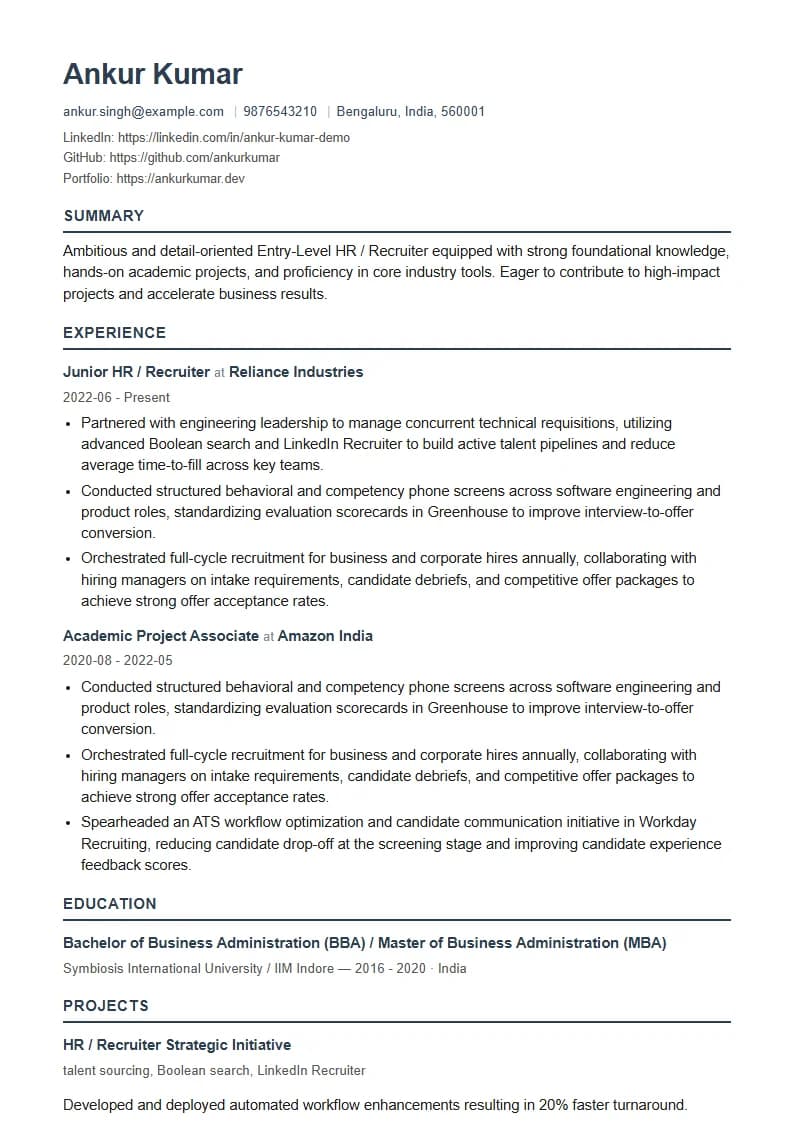
Use This Resume
Entry-LevelModern Professional
Create an HR Recruiter resume that clearly demonstrates sourcing, candidate screening, full-cycle recruiting, hiring-manager partnership, ATS proficiency and measurable recruiting outcomes. Review examples for recruiter and talent acquisition roles, then compare your resume with a real recruiter job description using GyanBatua.
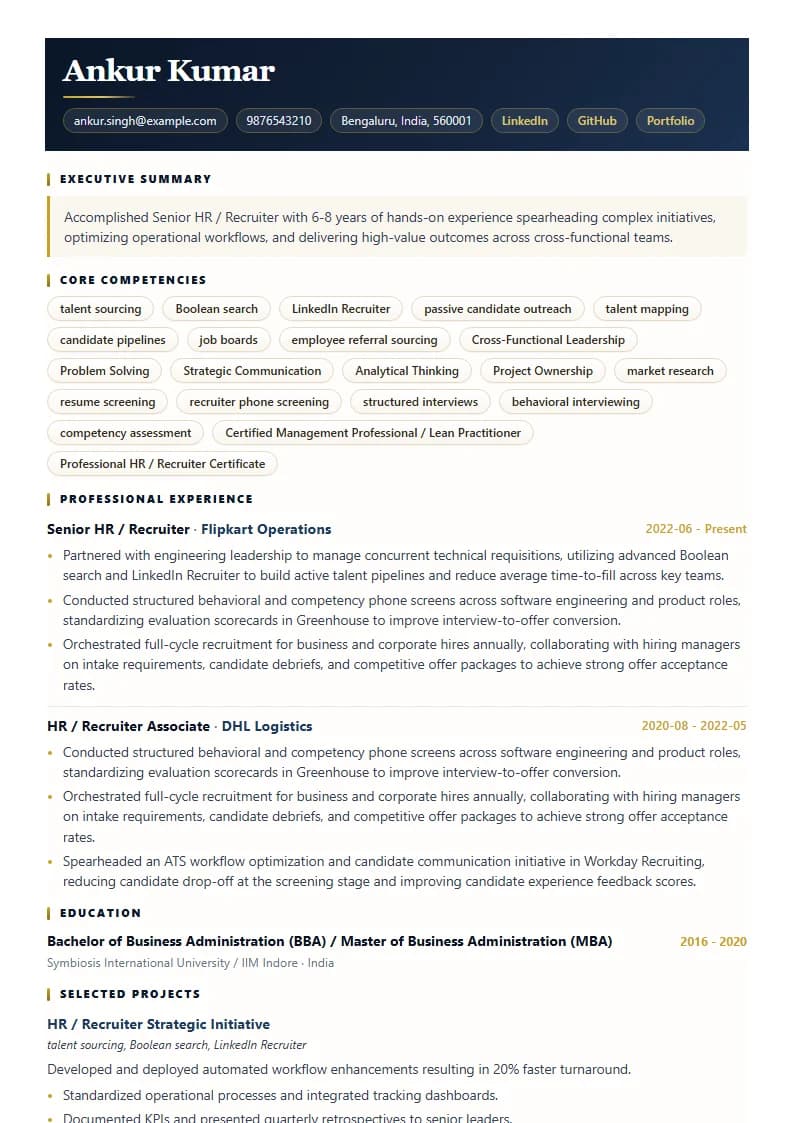
Recruiter-approved templates and real-world examples tailored for hr / recruiter roles. Click any resume to customize in seconds.
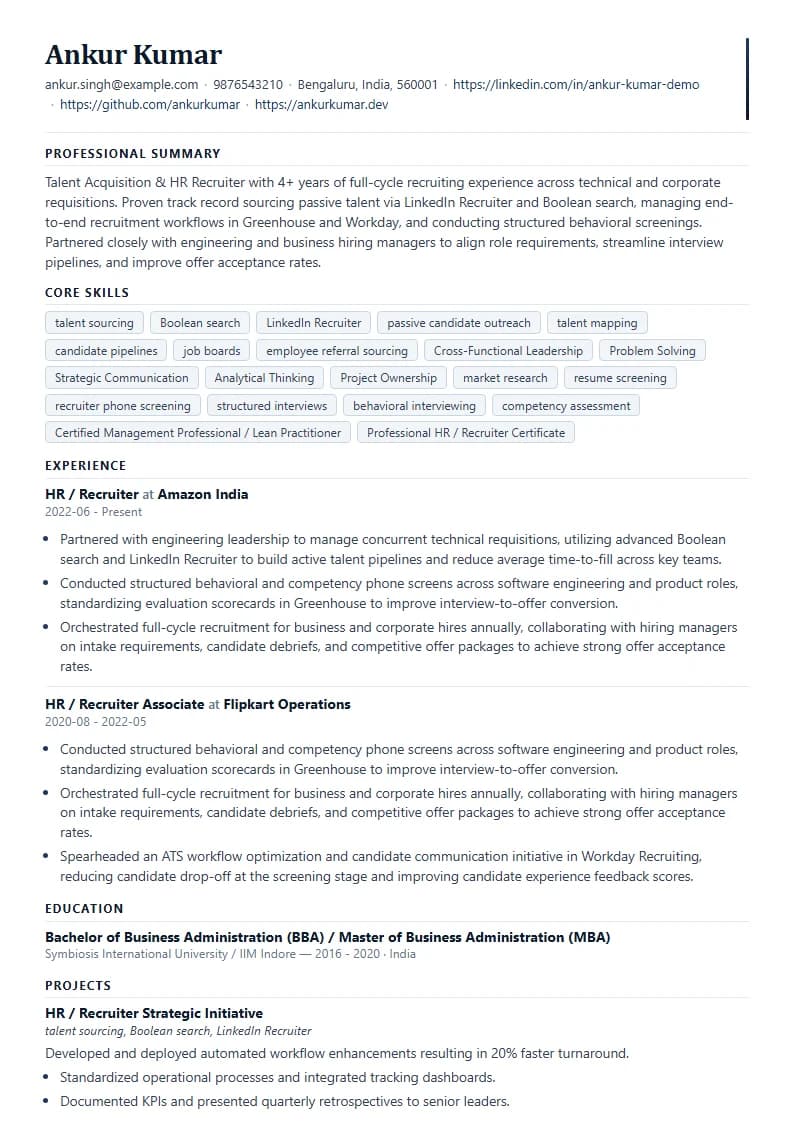
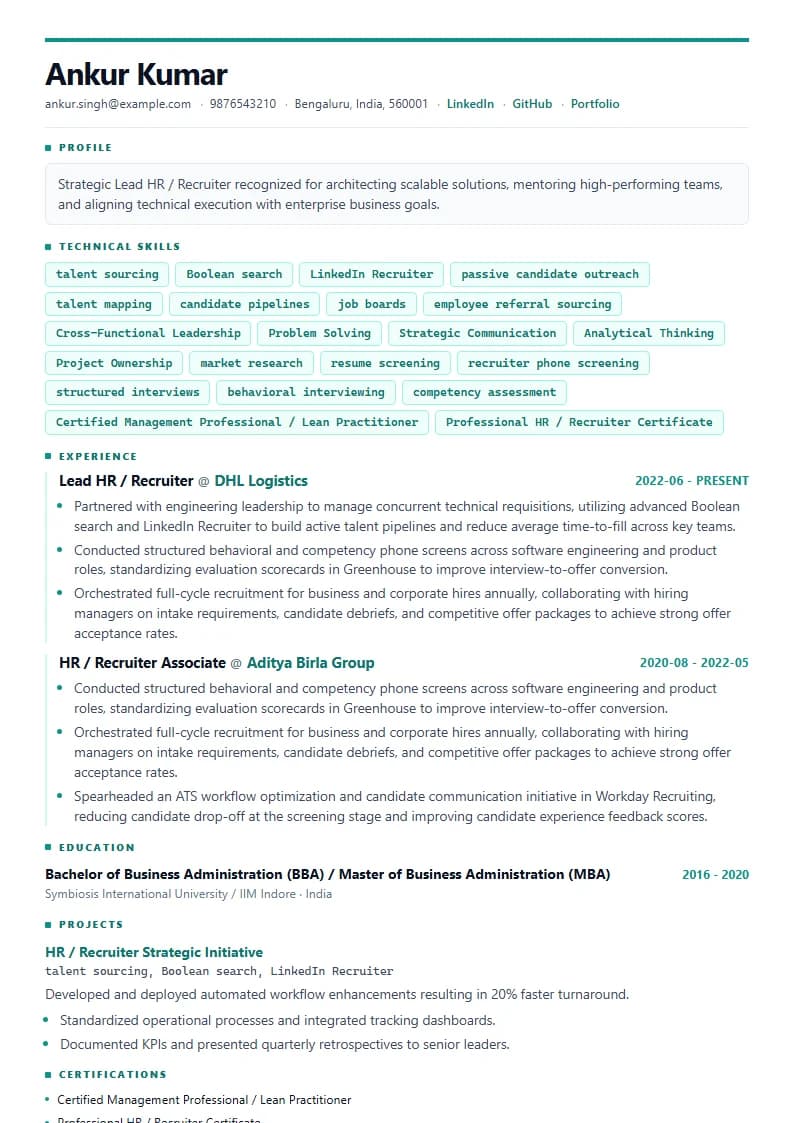
A strong HR Recruiter resume should show the roles you recruited for, how you sourced and evaluated candidates, how you partnered with hiring managers, which recruiting systems you used, and the scale or outcomes of your hiring work. Where genuine, include metrics such as requisitions handled, time-to-fill, offer acceptance, candidate-pipeline conversion or hiring volume. Tailor the emphasis to the specific recruiter or talent acquisition role.
Usable resume sample showing summary structure, categorized skills, and effective experience bullets.
Talent Acquisition & HR Recruiter with 4+ years of full-cycle recruiting experience across technical and corporate requisitions. Proven track record sourcing passive talent via LinkedIn Recruiter and Boolean search, managing end-to-end recruitment workflows in Greenhouse and Workday, and conducting structured behavioral screenings. Partnered closely with engineering and business hiring managers to align role requirements, streamline interview pipelines, and improve offer acceptance rates.
Projects, process improvements, and recruitment campaigns provide powerful evidence of strategic recruiter capability. Structure entries using: Problem / Initiative → Role & Scope → Recruiting Method → Tools & Stakeholders → Measurement & Outcome. Campus recruitment campaigns, employee referral redesigns, ATS migrations, interview scorecard standardization, or employer branding projects are valid when clearly labeled.
Employee Referral Program Redesign | Problem: Low referral engagement and slow response times. Role: Lead Recruiter. Method: Redesigned intake workflows, created clear referral SLAs, and set up automated tracking in Greenhouse. Measurement: Referral pipeline volume and time-to-first-contact. Outcome: Increased employee referral participation and accelerated initial screening turnaround.
Essential domain skills, frameworks and technologies commonly requested for hr / recruiter positions.
Target key expectations based on your current career stage and technical range.
Internships, Coordination & Sourcing Foundations
Focus on HR or recruiting internships, interview coordination and scheduling, campus recruitment drives, candidate communication, job board management, and transferable customer-facing or administrative experience. Highlight practical sourcing coursework, Boolean search familiarity, or volunteer recruiting support. Transparently label academic and volunteer projects as non-commercial case studies rather than claiming full corporate requisition ownership.
Requisition Ownership & Sourcing Execution
Emphasize end-to-end full-cycle recruitment ownership across multiple business units or job families. Highlight active talent sourcing (LinkedIn Recruiter, Boolean search), structured candidate screening, hiring-manager intake alignment, ATS workflow management, candidate debriefs, and verified outcomes such as time-to-fill reductions and improved offer acceptance rates.
Strategic Partnership, Pipeline Forecasting & Mentorship
Highlight complex executive and niche requisition ownership, workforce planning, talent pipeline forecasting, stakeholder advisory, recruiting process redesign, and junior recruiter mentorship. Seniority is demonstrated through recruiting strategy, cross-functional business partnership, and operational efficiency—not years of experience alone.
Proactive Sourcing, Employer Brand & Talent Communities
Focus on end-to-end talent acquisition strategy, passive candidate engagement, employer branding initiatives, talent community development, and candidate journey optimization. Show how proactive pipeline mapping and recruitment marketing reduced agency dependency and supported long-term hiring demands.
Engineering Talent Mapping & Technical Screenings
Focus on sourcing for software engineering, data, product, and infrastructure roles. Highlight role-specific talent mapping, technical recruiter screening coordination, Boolean and GitHub sourcing, competitive market intelligence, and close partnership with engineering hiring managers. Technical recruiters do not need programming skills unless the target JD specifically requires them.
Business Unit Partnership & Internal Hiring Systems
Emphasize dedicated business unit alignment, internal mobility and transfer workflows, long-term talent pipelines, employer brand consistency, and deep familiarity with corporate ATS/HRMS environments (such as Workday or SAP SuccessFactors). Highlight candidate experience and cross-functional hiring-manager trust.
Follow these structured steps to align your resume with target job descriptions accurately.
Identify whether the JD targets technical recruiting, corporate roles, campus hiring, or high-volume placement. Note target job families, hiring locations, and expected requisition volume.
Compare the JD's requirements against your background. Highlight your genuine experience with requested ATS platforms (Greenhouse, Workday), sourcing channels (LinkedIn Recruiter, Boolean), and metrics (time-to-fill, offer acceptance) without claiming unverified results.
Structure your experience bullets using Action → Hiring Need → Sourcing/Method → Outcome. Use GyanBatua to compare your tailored resume with the real recruiter JD to verify competency alignment and identify any missing signals before submitting.
Resume Diagnostic
Want to know if your resume is ATS-friendly? Check it with our free AI tool below!
Drop your resume here or . PDF & DOCX only. Max 5MB file size.
Direct answers to common HR & Recruiter resume questions
Build yours next
Upload your resume and paste the HR or Recruiter job description you are targeting. GyanBatua helps you compare your experience against required sourcing methods, ATS tools, metrics, and hiring scope to identify focus areas before applying.
Your resume data is private, secure, and used solely for diagnostic matching.