

7 Hidden Signs You're Burning Out During Your Job Search
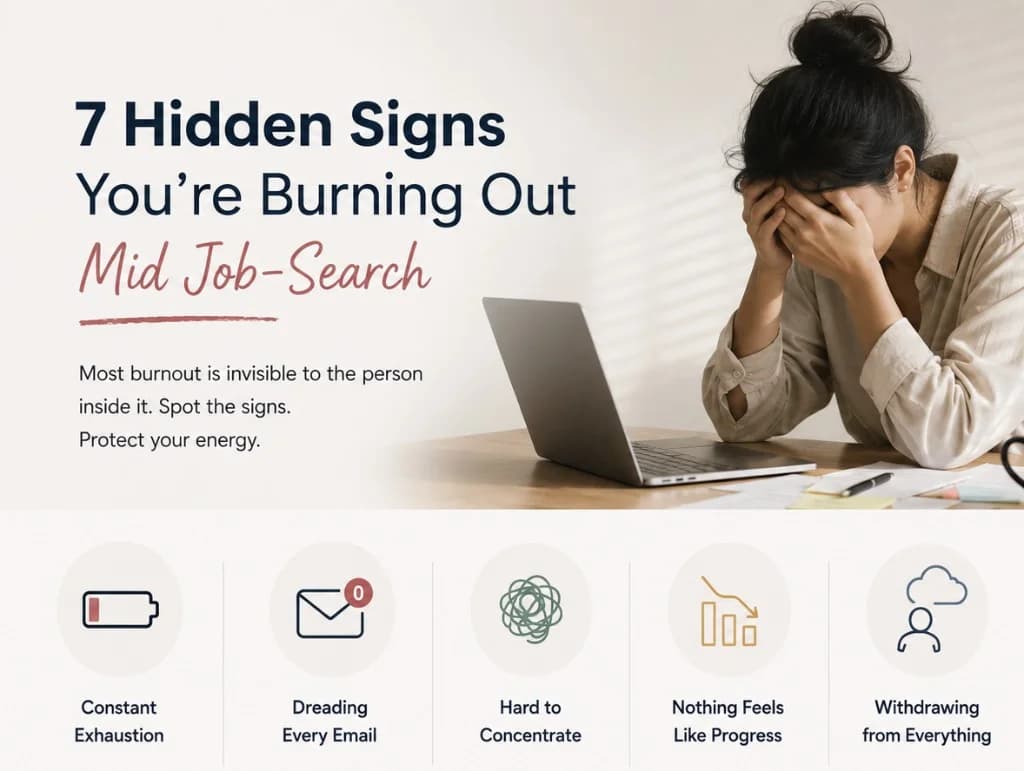
Overview: Most job search burnout is invisible to the person inside it. Here are the seven hidden signs to watch for — and what to do about each one.

Introduction
Most burnout is invisible to the person inside it.
By the time it announces itself, it has usually been building for weeks.
Here are the seven signs that show up earliest — and what each one is actually telling you.
1. Your application volume is climbing while your reflection is falling
You sent 30 applications last week. You cannot name the three you most want from that list.
That gap is a sign. You are submitting, not applying. The two are different activities. Recruiters can tell which is which.
2. You have stopped reading the JD before applying
Two months ago you would not have applied without reading carefully. Now you scan, upload, click submit.
Each unread JD becomes an application without role-fit signal. The screening systems are good at detecting this.
3. Your resume has not changed in three weeks
Even for roles that are noticeably different from each other.
The same resume going to 30 different roles is the same resume being filtered out by 30 different screening passes — for the same reasons.
4. Small rejections feel disproportionately heavy
A polite "we have moved forward with other candidates" hits harder than it used to.
Your nervous system is using more energy per rejection than it should — because it is depleted. The rejection itself has not changed. Your capacity to absorb it has.
5. You have stopped tracking your applications
The spreadsheet started feeling like evidence of failure. So you stopped opening it.
Now you do not know which applications are pending, which need follow-up, which roles you have already applied to. You apply to the same company twice without realizing.
6. You have lost a clear answer to "what role am I looking for"
Three months ago you would have said "data analyst at a product company" without hesitation.
Now you say "anything in data" or "anything that pays."
The drift toward vagueness is a signal of energy depletion, not strategic flexibility.
7. You avoid people who ask
Family. Close friends. Mentors. The check-ins that used to feel like support now feel like pressure.
When honest answers feel impossible, you start ducking the question. Eventually you start ducking the people.
What to do when you recognize these signs
Stop the application clock for 72 hours.
Sleep properly. Spend time on something that has nothing to do with job search.
When you come back, do not return to the volume you were at. Return to a smaller number of well-tailored applications. Re-establish the habit of reading each JD. Get back the reflection between applications.
Burnout signals are not a failure of effort. They are a signal that effort, applied in this direction, is no longer working. That is information, not a verdict.
Related reading on GyanBatua
Continue with:
- Job Search Burnout and the Real Cost of Pushing Through Harder
- Why Job Search Burnout Happens and Why Pushing Harder Fails
- What to Do in the First Week After a Major Job Rejection
- When to Ask for Help vs When to Keep Going in Your Search
- How to Match Your Resume to a Job Description Before You Apply
- Career Path Clarity: Choosing the Right Role for Your Profile
Resume guides
Related Resume Guides
About the Author
Talent Acquisition Manager at Mobiloitte
Talent Acquisition Manager at Mobiloitte, crafting beautiful recruitment workflows and sourcing technical talent.
Pricing
Choose your plan and get started faster
Compare features, pricing, and usage clearly, then pick the plan that fits your goal.
Next step
Check your resume against a real job description
See JD match, keyword visibility, and skill gaps before you apply.
Related reading
10Recent articles
6