

How to Ask for a Job Referral Without Burning Bridges Ever
Overview: Most candidates ask for referrals badly. Here is the script that works — and the common mistakes that cost relationships and offers.

Introduction
Most candidates ask for referrals badly.
Either too vague, too aggressive, or too dependent on the recipient figuring out what you need.
Done well, a referral request is one of the highest-leverage messages you will send during a job search. Done poorly, it costs the relationship you were trying to use.
What a good referral request does
Three things.
- Tells the recipient what you need — specifically.
- Makes it easy for them to help — by giving them what they would need to forward your case internally.
- Gives them cover to decline — without awkwardness or pressure.
The structure
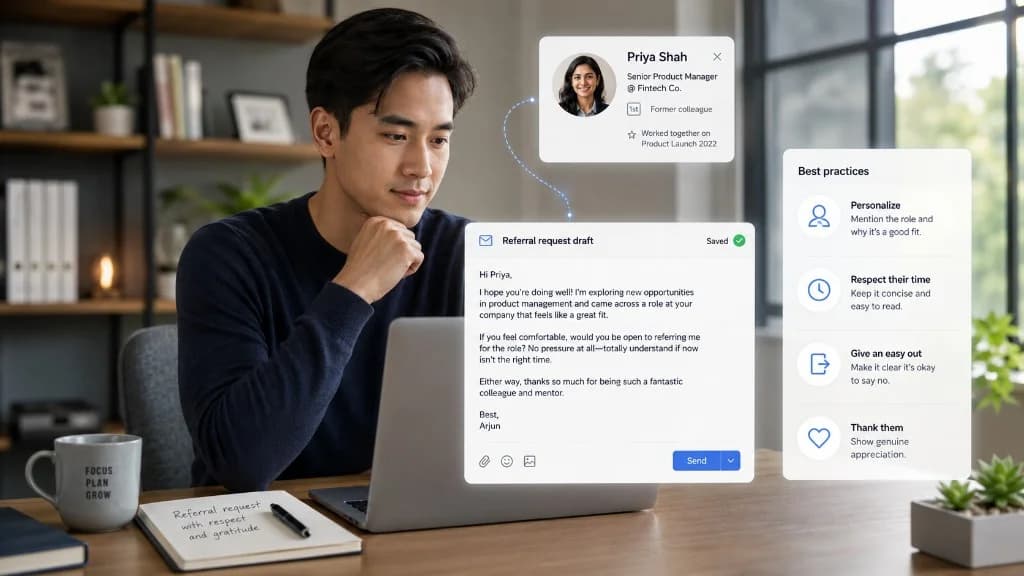
Four short paragraphs. Total under 150 words.
Paragraph 1 — opening with a specific personal note (if there is genuine context) or a clean direct opening if not. Avoid manufactured warmth.
Paragraph 2 — the role and why you are a fit. Link to the role. One sentence on why your work matches it.
Paragraph 3 — the actual ask. Specific. Easy to act on.
Paragraph 4 — the easy out. Acknowledge they may not be in a position to help. Make that okay.
Example
Hi [name] — hope you are doing well. Saw you posted about the new launch — congratulations on shipping that.
I came across the [Senior PM, Growth] role at [company] and wanted to reach out. I have been leading similar growth work at [my company] — specifically [one specific outcome]. I think there is genuine fit, but I know better than to guess from the outside.
If it feels appropriate, would you be open to passing my resume internally or pointing me toward the right person? Happy to send a short blurb you could paste in if helpful.
Completely understand if it is not the right time or fit on your end — no expectation either way. Thanks for considering.
Under 130 words. Specific. Clean ask. Easy out.
What to send with it
- Your resume — clean, tailored to the role, current within the last week.
- Optional — a short blurb (3 to 4 sentences) the referrer could paste into an internal Slack or referral form. Saves them the work of writing one.
- Optional — a brief reminder of relevant work you did with or around them, if it has been a while.
Common mistakes
Asking too vaguely
"Let me know if you hear of anything" puts the work on the referrer. They have to figure out what kind of role, what level, what company, what fit.
Specific roles get specific responses. Vague asks get no response.
Asking too aggressively
Following up three times in a week. Long emotional explanations of why you need this. Implying obligation.
Most senior people in your network want to help — but not under pressure. Pressure reduces response, it does not increase it.
Asking too many people at the same company
Internal referral programs often have visibility — multiple referrals for the same candidate look engineered. Pick the one or two strongest contacts at any given company. Save the others for the future.
Disappearing after the referral
Once someone has referred you, close the loop. Tell them what happened — interview scheduled, did not hear back, ended up choosing another role. The follow-through matters for the relationship, regardless of the outcome.
Asking without warmup at all
If you have been out of touch for years, a cold referral request is awkward at best. Better — send a short reconnection note, exchange one or two messages, then ask. The reconnection does not need to be heavy — a few sentences is enough.
When not to ask for a referral
- When you genuinely cannot do the job. Asking your contact to put their reputation behind a clear mismatch costs the relationship and rarely produces an outcome.
- When the contact does not actually know your work. Loose acquaintances can recommend you for an introduction or a chat — they cannot credibly refer you for a specific role.
- When you are asking everyone at the same company at the same time. Pick the right person and ask them well.
The shift to make
Stop treating referrals as favors you ask for.
Start treating them as moments where you give your contact enough information and confidence to put their name behind yours.
Done well, the message is short. The specifics are clear. The easy out is there. The relationship survives whether the answer is yes or no.
Related reading on GyanBatua
Continue with:
Is your resume good enough?
Drop your resume here or . PDF & DOCX only. Max 5MB file size.
Resume guides
Related Resume Guides
About the Author
Full Stack Software Engineer at Mobiloitte
Full Stack Software Engineer at Mobiloitte, specializing in backend architectures and application workflows.
Pricing
Choose your plan and get started faster
Compare features, pricing, and usage clearly, then pick the plan that fits your goal.
Next step
Check your resume against a real job description
See JD match, keyword visibility, and skill gaps before you apply.
Related reading
3Recent articles
6