
How to Use LinkedIn as a Powerful Job Search Asset — Guide
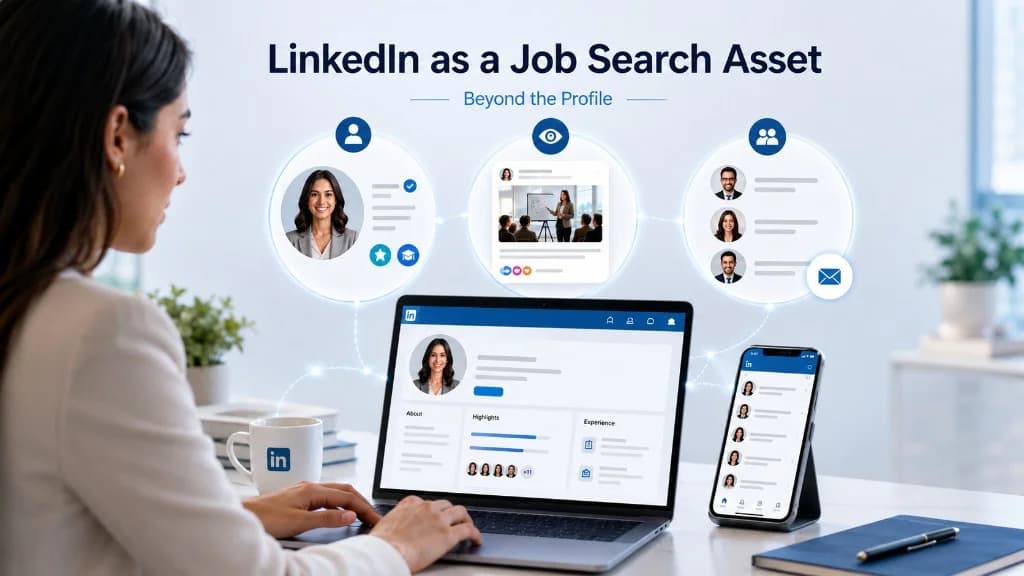
Overview: Most candidates treat LinkedIn as a resume that lives online. Used well, it works for you while you sleep. Here are the three layers that matter.

Introduction
Most candidates treat LinkedIn as a resume that lives online.
They write the profile, optimize the headline, add the experience, and move on.
Used well, LinkedIn is a job-search asset that works for you while you are asleep. The profile is the foundation, but the real value comes from three other layers.
Layer 1 — Profile basics that move applications
Headline
Most candidates make their headline their current title at their current company. That is the LinkedIn default — and it is rarely the best choice if you are job-searching.
Better — your headline matches your target role, not your current one. "Senior Product Manager focused on growth at consumer marketplaces" is much more findable than "Product Manager at Company X."
If you cannot fully change to a target role because you are employed and visible — frame the headline around the function and specialization rather than the title alone.
Featured section
Underused on most profiles. Put your strongest 2 to 3 projects, articles, or talks here. This is what visitors see before they scroll.
About section
Written in first person. Specific. Written for a reader who knows nothing about you yet.
Avoid — generic phrases ("passionate about driving impact"), buzzwords ("results-driven self-starter"), or summaries that read like every other About section.
Include — your specialization, your strongest accomplishments with numbers, what you are looking for next (if open about searching), how to reach you.
Open-to-work signal
Two versions. Public badge — visible to everyone, sometimes interpreted as desperation by hiring managers. Recruiter-only signal — only visible to logged-in recruiters using LinkedIn Recruiter, safer for senior candidates.
Use the recruiter-only signal first. The public one only if you are clearly between roles and want the visible signal.
Layer 2 — Content and engagement
This is where most candidates leave the most value on the table.
Posting genuinely useful content in your space — even occasionally — creates a surface that recruiters and hiring managers stumble onto. Over time, it builds a reputation that opens doors before you ask for them.
You do not need to be a creator
1 to 2 substantive posts per month is enough to be visible without being a content machine. The posts should show how you think — not vague motivational content.
What works — and what does not
- What works — a specific lesson from your work. A short take on a development in your industry. A useful framework or resource. A non-obvious observation.
- What does not — generic motivational content, life lessons unconnected to your work, anything that could be written by anyone.
Comment more than you post
Thoughtful comments on other people's posts in your space — especially on the posts of people you would like to know — produce visibility and relationships.
5 to 10 substantive comments per week, in your space, on relevant posts. Higher leverage than posting more often.
Build a recognizable signal
Over time, you become the person known for thinking about [your specialization]. Recruiters and hiring managers find you because they are looking for that signal.
Layer 3 — Search visibility
Recruiters search LinkedIn with keywords. Your profile either matches their searches or it does not.
Skills section
Populated with the terms recruiters would search for. Specific tool names. Specific role names. The vocabulary of your target function.
Most candidates have generic skills like "Project Management" and "Communication." These do not surface in recruiter searches. Specific skills like "AWS Lambda," "BigQuery," "product-led growth," "design systems" do.
Experience descriptions
Each role's description should include the keywords for that role naturally. "Led growth team that increased activation 40% through onboarding redesign and product-led growth experimentation" surfaces in searches for "growth," "activation," "product-led," "experimentation."
Location and openness
Recruiters filter heavily by location. Make sure yours is set correctly. If you are open to remote, signal that explicitly in the About section.
The compounding effect
All three layers compound.
A well-optimized profile surfaces in more recruiter searches.
Visible content in your space builds reputation that improves the quality of inbound inquiries.
Quality inbound inquiries reduce the need for outbound applications — which means less time on job boards, more time on the work that further compounds the profile.
The candidates who run this cycle for 12 to 24 months end up with consistent inbound interest, often without actively job-searching.
The shift to make
Stop treating LinkedIn as a resume that lives online.
Start treating it as a job-search asset that works for you while you sleep — with three layers that each compound.
Profile basics. Content and engagement. Search visibility.
Invest in all three. The platform will start producing roles for you instead of being a place you go to find them.
Is your resume good enough?
Drop your resume here or . PDF & DOCX only. Max 5MB file size.
Resume guides
Related Resume Guides
About the Author
Full Stack Software Engineer at Mobiloitte
Full Stack Software Engineer at Mobiloitte, specializing in backend architectures and application workflows.
Pricing
Choose your plan and get started faster
Compare features, pricing, and usage clearly, then pick the plan that fits your goal.
Next step
Check your resume against a real job description
See JD match, keyword visibility, and skill gaps before you apply.
Related reading
3Recent articles
6