
Cold Outreach That Actually Gets Replies — Proven Approach
Overview: AI-written outreach has flooded inboxes. Here is what still works for cold messages in 2026 — and the specific structure that gets responses.

Introduction
Cold outreach has gotten harder.
Everyone is doing it. AI-written messages have flooded inboxes. Recipients have learned to skim past anything that looks templated within a second.
Some patterns still work. They share specific features.
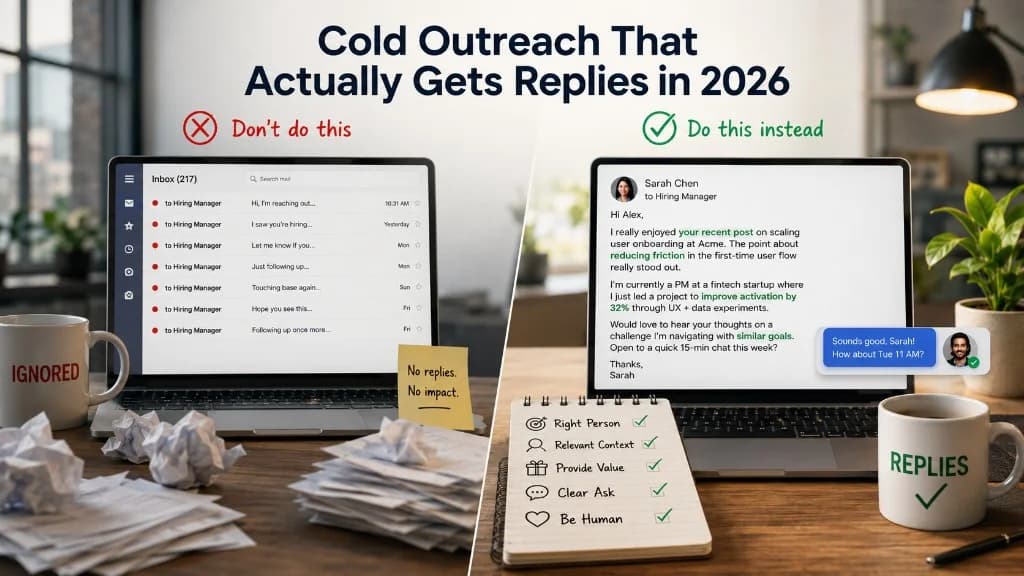
The 4-line cold message
The structure that consistently gets responses in 2026.
- Line 1 — a specific reference to the recipient. Something you read, something they shipped, a recent talk, a specific thing in their work history. Has to be specific enough that it could not have been auto-generated.
- Line 2 — who you are, in one short sentence. Role, function, a concrete capability signal. Not your full bio.
- Line 3 — why you are reaching out. Specific. Not "to learn more about your work" but "to ask whether your team is hiring for [role]" or "to ask one specific question about [topic]."
- Line 4 — a clear, easy ask. "Would you be open to a 15-minute conversation next week?" Specific. Bounded. Easy to say yes to.
Total under 80 words. Reply rates consistently higher than 300-word essays. Every channel, every audience.
Why the structure works
The recipient has to make three decisions to reply, in this order — is this real, does it deserve attention, is it actionable.
Line 1 answers "is this real." If the specific reference is genuine, the message is not a template.
Line 2 answers "does this deserve attention." One sentence is enough for the recipient to decide whether your signal matches their interest.
Lines 3 and 4 answer "is this actionable." A clear ask with a clear bound is much easier to act on than a vague invitation to talk.
Channel choices
Default channel for professional outreach. Reply rates are moderate.
Note — InMail to non-connections often goes to a different inbox than messages between connections. If you can connect first (with a personal note in the connection request), the eventual message has higher reply rates.
Reply rates often higher than LinkedIn for senior recipients — if you can find the address.
Tools — Hunter, RocketReach, Apollo. Email finders increasingly include verification, which matters because bouncing emails hurt your sender reputation.
X / Twitter
Works for specific communities — tech, design, AI, media. DM reply rates for engaged users in these communities are sometimes higher than LinkedIn.
Less effective for traditional industries or for recipients who do not use X actively.
Specialized communities
Hacker News, Reddit, niche Slack and Discord communities, professional WhatsApp groups.
These have higher reply rates when used right — because the community context creates implicit trust. They have near-zero reply rates when used as cold-message dumps.
Common mistakes
Mass-templating
If you can send the same message to 200 people, it will read as if you did. Reply rates near zero.
Better — fewer, more specific messages. 10 well-crafted messages outperform 200 templated ones, almost always.
Over-explaining
Long messages that try to communicate your full background up front. The reader does not have time. The link to your profile or a single specific example does the work.
Vague asks
"I would love to hear your thoughts on my career" is unanswerable. The recipient does not know what to do with it.
"Are you hiring for X?" or "Would you be open to 15 minutes on Y specific question?" gets clear yes-or-no responses.
AI-generated specifics
The personal reference in Line 1 has to be genuine. AI can generate sentences that read as specific but are vague on inspection. Recipients notice.
Better — actually read the recipient's recent work or posts and reference something real. Two minutes per message. Massively higher reply rate.
What to do when there is no reply
Wait 7 to 10 days. Send one polite follow-up. "In case my last note got buried — wanted to follow up briefly."
If no response after that, move on. Most non-replies are not about you. Inbox volume, life events, simple forgetting. None of which reflect poorly on the message.
Pushing harder after two messages mostly damages the relationship for the future. Better — leave it cleanly and revisit in 6 to 12 months if there is a new reason.
The shift to make
Stop trying to write the perfect outreach message.
Start writing the shortest specific message that respects the recipient's time, references something real, and makes a clear ask.
Under 80 words. One genuine specific. One clear ask. The message that gets the reply is rarely the longest one.
Related reading on GyanBatua
Continue with:
Is your resume good enough?
Drop your resume here or . PDF & DOCX only. Max 5MB file size.
Resume guides
Related Resume Guides
About the Author
Senior Project Delivery Manager at Mobiloitte
Senior Project Delivery Manager at Mobiloitte, guiding graduates through placement preparation and corporate transition.
Pricing
Choose your plan and get started faster
Compare features, pricing, and usage clearly, then pick the plan that fits your goal.
Next step
Check your resume against a real job description
See JD match, keyword visibility, and skill gaps before you apply.
Related reading
3Recent articles
6