
How to Answer "Tell Me About Yourself" as a Fresher — Without Losing the Room
Overview: "Tell me about yourself" is the opening question in almost every Indian placement interview. Most freshers lose the room in the first 30 seconds. Here's the structure that doesn't.

Introduction
Every placement interview in India opens with the same question. "Tell me about yourself."
It sounds easy. It isn't. This question is where most freshers lose the interview before it starts — not because they lack substance, but because they structure their answer wrong.
The interviewer doesn't want your biography. They don't want your family background. They don't want "ever since childhood, I've been passionate about technology." They want a 60-to-90-second answer that tells them three things: what you can do, what you've done, and why you're here.
This guide gives you the exact structure, three worked examples, and the common mistakes that cost freshers the opening minute.
Why this question matters more than you think
"Tell me about yourself" is not an icebreaker. It's a screening tool.
In the first 60 seconds of your answer, the interviewer is deciding the trajectory of the entire conversation. A strong opening means they spend the next 25 minutes asking about your projects and skills — territory where you're prepared. A weak opening means they spend it asking generic questions to fill time — territory where you can't differentiate yourself.
The question also sets the frame for everything that follows. If you mention a project in your opening, expect the next question to be about that project. Your opening answer is a menu — the interviewer picks from it. Choose what's on the menu.
The structure that works
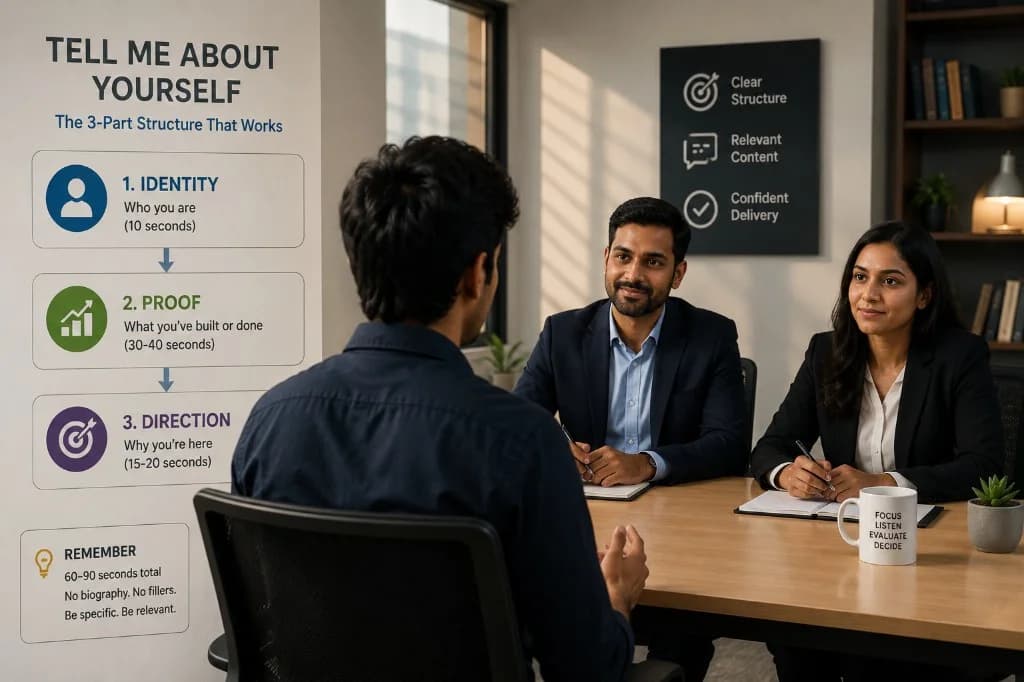
Three parts. Sixty to ninety seconds total. No more.
- Part 1 — Identity (10 seconds). Who you are academically. Your name, degree, college, year. One sentence.
- Part 2 — Proof (30–40 seconds). What you've built or done. Your strongest project, primary technical area, one metric or specific detail.
- Part 3 — Direction (15–20 seconds). Why you're here. Something specific about the role or company — not "grow professionally."
That's it. No hobbies (unless directly relevant). No school history. No personality adjectives.
Three worked examples for Indian placement interviews
Example 1 — For a TCS Systems Engineer role
I'm [Name], a final-year B.Tech Computer Science student at [College]. My primary technical area is Java and backend development. I built a task management API using Spring Boot and MySQL that handles concurrent users and role-based access — it's deployed on Railway and the code is on my GitHub. I've also solved around 180 DSA problems on LeetCode, mostly in Java. I'm interviewing for the Systems Engineer role at TCS because I'm interested in how TCS applies technology at enterprise scale, and the PACE program is something I'd like to grow through.
Why it works: Names the role and company with a specific reference (PACE). Leads with a real project. Gives a quantifiable proof point. Under 90 seconds.
Example 2 — For an Infosys Associate Software Engineer role
I'm [Name], B.Tech IT, final year at [College], with a CGPA of 8.2. I'm strongest in Python and data — my final year project is a sentiment analysis tool for customer reviews that uses scikit-learn and NLTK, trained on 10,000 product reviews from an open dataset. I've also done a three-month internship at a local SaaS startup where I wrote Python scripts for data cleaning and reporting. I'm applying to Infosys because the Associate Software Engineer role aligns with my interest in data-driven systems, and the Mysore training program is something I'd value early in my career.
Why it works: CGPA upfront. Internship mentioned briefly. Project with specifics. Ends with a company-specific reason.
Example 3 — For a startup / product company role
I'm [Name], CS undergrad at [College]. I'm a full-stack developer — I've built three projects end-to-end with React, Node.js, and PostgreSQL, and two of them are live. The most recent is a real-time collaborative notes app that uses WebSockets for sync and has about 40 weekly active users among classmates. I contribute to one open-source project on GitHub — a documentation fix and one feature PR merged. I'm interviewing here because your product is in the collaboration space and I've spent the last year thinking about exactly these problems.
Why it works: No filler. Projects with live users and metrics. Open-source contribution. Direct connection to the company's product.
The five mistakes that kill the first minute
Mistake 1 — Starting with biography
"I'm [Name], from [Hometown]. I was born and brought up in a small town. My father is a government employee..." The interviewer has already stopped listening. Start with your technical identity.
Mistake 2 — Listing skills without proof
A list of twelve technologies with no context is noise. Pick two or three you know well and back each with a project or problem count.
Mistake 3 — Being too long
If your answer takes more than two minutes, you've lost the room. Most interviewers decide within 60 seconds. Every second after 90 works against you.
Mistake 4 — Not mentioning the company
Ending with "I'm looking for opportunities to grow and learn" tells the interviewer you'd say the same thing anywhere. A specific reference to their company shows you prepared.
Mistake 5 — Using personality adjectives
"I am hardworking, passionate, and a quick learner." Replace adjectives with evidence: "I learned React in three weeks to rebuild my college project frontend" proves quick learning better than claiming it.
How to practise this answer
- Record yourself. If it sounds like a speech, it's too rehearsed. If it sounds like a conversation with structure, you're close.
- Time it. Set a 90-second timer. If you're not done, cut.
- Vary it slightly each time. Memorise the three-part structure and key points, not word-for-word scripts.
- Do a mock interview. A full 20-minute mock where this is the opening shows how your answer sets up the rest of the conversation.
Your opening answer should match the role you're targeting
The same structure works for every company, but the content should shift. Your answer for TCS should emphasise different projects than one for a product company. The company reference at the end must be specific to where you're sitting.
GyanBatua's AI interview prep starts with exactly this: building role-specific versions of your key interview answers around the JD you're targeting. Practice rounds follow the same role context. 21 for text, ₹51 for voice with delivery feedback.
Is your resume good enough?
Drop your resume here or . PDF & DOCX only. Max 5MB file size.
Resume guides
Related Resume Guides
About the Author
Software Engineer at Mobiloitte
Software Engineer at Mobiloitte, specializing in scalable AI architectures for resume optimization and interview assessment.
Pricing
Choose your plan and get started faster
Compare features, pricing, and usage clearly, then pick the plan that fits your goal.
Next step
Check your resume against a real job description
See JD match, keyword visibility, and skill gaps before you apply.
Related reading
13Recent articles
6