

GyanBatua AI logoGyanBatua AI logo
HomePricingResume OptimizerBlogFor InstitutionsContact Us
LoginGet Started
GyanBatua AI logo

GyanBatua.ai helps students, freshers, internship seekers, and professionals prepare for real interview opportunities through role-specific AI Tutors, structured assessments, instant feedback, and Voice Mock practice.

  • ›About Us
  • ›Career Blog
  • ›Pricing
  • ›Contact Us
  • ›Safety & Trust
  • ›Community Guidelines
  • ›Responsible AI
  • ›Fair Use Policy
  • ›Security Overview
  • ›Terms & Conditions
  • ›Privacy Policy
  • ›Cookie Policy
  • ›Refund Policy
  • ›Sub-processors
  • ›Grievance Redressal
  • ›Resume by Job Role
  • ›Parent & Guardian Guide
  • ›Recording Notice
  • ›WhatsApp/SMS Policy
  • ›Media
  • ›Compare GyanBatua

Contact Us

Email

support [at] gyanbatua.ai

Subscribe to our newsletter

Email

MatrixSecure

All trademarks are the property of their respective owners

All rights reserved © 2026 Matrix Secure Applications (OPC) Private Limited

A Mobiloitte Group Initiative
BlogHow to Practice Interview Answers Without Sounding Scripted
Job Readiness

How to Practice Interview Answers Without Sounding Scripted

Overview: Learn how to practice interview answers naturally without sounding memorized. Improve confidence, structure, and fluency while staying human and role-relevant.

GyanBatua TeamApr 13, 20267 min read
Practice interview answers without sounding scripted
On this page10
Jump to the sections that matter.
On this page10
Jump to the sections that matter.
IntroductionWhy candidates sound scriptedWhat to practice instead of exact scriptsA better way to practice interview answersPractice out loud, not only in your headRecord yourself at least a few timesHow to sound naturalThe right goal of practiceFinal thoughtRelated reading on GyanBatua

On this page

10

Jump to the sections that matter.

IntroductionWhy candidates sound scriptedWhat to practice instead of exact scriptsA better way to practice interview answersPractice out loud, not only in your headRecord yourself at least a few timesHow to sound naturalThe right goal of practiceFinal thoughtRelated reading on GyanBatua

Introduction

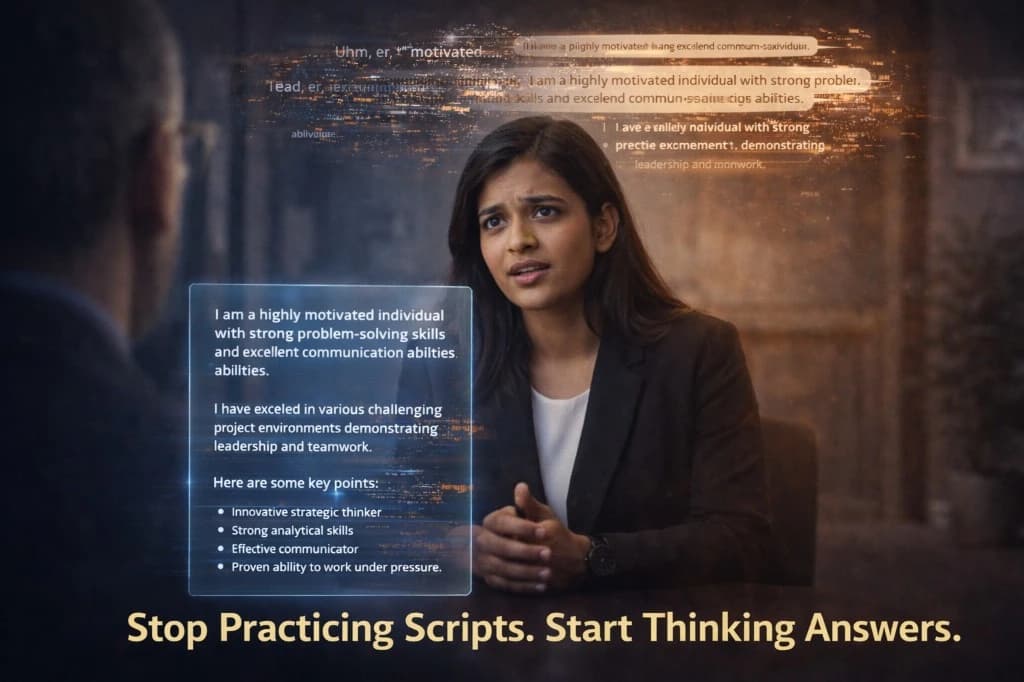
A lot of candidates are told to “practice answers.” That is good advice. But the way many people practice creates a new problem: they start sounding robotic.

You can hear it in the answer. The words are polished. The delivery is stiff. The tone feels memorized. The candidate sounds like they are reading from an invisible script.

That hurts trust. Because interviewers usually prefer:

  • clarity over perfection
  • relevance over drama
  • natural confidence over memorized polish

So yes, you should practice. But you should practice in a way that improves fluency, not artificial delivery.

Why candidates sound scripted

Usually for one of these reasons:

  • they memorize exact sentences
  • they repeat the same answer too many times word for word
  • they try to sound too formal
  • they focus on perfect wording instead of clear meaning
  • they do not understand their own example deeply
  • they are afraid to pause and think

This creates a performance feeling, not a conversation feeling. And interviewers notice that quickly.

What to practice instead of exact scripts

Do not memorize full paragraphs. Practice these things:

1. Answer structure

Know how your answer will flow.

2. Key proof points

Know the example, project, or story you want to use.

3. Role relevance

Know how the example connects to the role.

4. Clear language

Know how to explain the idea simply.

This makes answers much more flexible.

A better way to practice interview answers

Use this pattern:

Visual framework

  1. 1

    Opening

    Start directly.

  2. 2

    Example / proof

    Use a real situation, project, or experience.

  3. 3

    Outcome / learning

    Say what happened or what you learned.

  4. 4

    Role connection

    Show why this matters for the job.

This gives your answer structure without making it sound memorized.

Practice out loud, not only in your head

This is a big one. Many candidates “prepare” mentally. But speaking out loud is different. You need to hear:

  • your clarity
  • your speed
  • your confidence
  • where you ramble
  • where you freeze
  • where your wording sounds unnatural

Oral practice matters much more than silent preparation.

Record yourself at least a few times

You do not need to do this forever. But recording your answers helps you notice:

  • filler words
  • fake confidence tone
  • low energy
  • poor structure
  • rushed delivery
  • overly long answers

This helps a lot.

How to sound natural

1. Use your own words

Do not use language that you never use in real life.

2. Keep answers clear, not over-polished

You do not need perfect English or perfect phrasing.

3. Pause when needed

Pausing is better than rushing into a memorized line.

4. Speak from proof

Real examples sound more natural than generic claims.

5. Practice multiple versions

If you practice only one version, you become rigid. If you practice 2–3 natural versions, you become flexible.

The right goal of practice

The goal is not: “sound impressive” The goal is: sound clear sound relevant sound believable sound prepared sound human That is what strong interview answers do.

Final thought

Practicing interview answers is important. But memorizing every line is not. The best answers feel prepared without feeling artificial. That is the balance you want.

So do not practice for performance only. Practice for: structure clarity fluency relevance confidence That is how you sound strong without sounding scripted.

Recommended tool

Practice smarter, not robotically.

Upload your resume, paste the job description, and see:

  • role-specific interview answer themes
  • mock guidance from your resume and JD
  • clearer structure and proof direction
  • more natural delivery preparation
Practice My Interview Answers

Related reading on GyanBatua

Keep building interview readiness with:

  • How to Prepare for Interviews Role-by-Role
  • Technical vs HR Interview Preparation: What Actually Changes
  • Fresher Interview Prep: What to Prepare When You Have Low Experience

Closing section

FAQ

Pricing

Choose your plan and get started faster

Compare features, pricing, and usage clearly, then pick the plan that fits your goal.

View Pricing

Next step

Check your resume against a real job description

See JD match, keyword visibility, and skill gaps before you apply.

Check Resume–JD Match

Related reading

9
How to Crack Placement Interviews From a Tier 3 College in IndiaPlacement Preparation Tips for Engineering Students in India — The Structured ApproachJob Application Strategy for India 2025 — Quality Over Spray-and-PrayHow to Write a Cover Letter in India — When You Need One and When You Don'tSalary Negotiation Tips for India — A Practical Guide for Freshers and ProfessionalsHow to Prepare for Interviews Role-by-RoleHow to Prepare for an Interview Using the Job DescriptionTechnical vs HR Interview Preparation: What Actually Changes25 Interview Mistakes That Quietly Hurt Strong Candidates

Recent articles

6
How to Build a Job Search That Doesn't Burn You OutGive Your Job Search a Boundary — Why a Finite Time Budget Changes EverythingFewer, Better Applications — Why Targeting Beats Volume in a Job SearchMeasure the Job Search Progress You Control — Not Just the OfferWhat a Sustainable Job Search Week Actually Looks LikeResume for TCS NQT Fresher — What iCIMS Actually Scans For

For you

Related and recent articles to keep you moving.

Pricing

Choose your plan and get started faster

Compare features, pricing, and usage clearly, then pick the plan that fits your goal.

View Pricing

Next step

Check your resume against a real job description

See JD match, keyword visibility, and skill gaps before you apply.

Check Resume–JD Match

Related reading

9
How to Crack Placement Interviews From a Tier 3 College in IndiaPlacement Preparation Tips for Engineering Students in India — The Structured ApproachJob Application Strategy for India 2025 — Quality Over Spray-and-PrayHow to Write a Cover Letter in India — When You Need One and When You Don'tSalary Negotiation Tips for India — A Practical Guide for Freshers and ProfessionalsHow to Prepare for Interviews Role-by-RoleHow to Prepare for an Interview Using the Job DescriptionTechnical vs HR Interview Preparation: What Actually Changes25 Interview Mistakes That Quietly Hurt Strong Candidates

Recent articles

6
How to Build a Job Search That Doesn't Burn You OutGive Your Job Search a Boundary — Why a Finite Time Budget Changes EverythingFewer, Better Applications — Why Targeting Beats Volume in a Job SearchMeasure the Job Search Progress You Control — Not Just the OfferWhat a Sustainable Job Search Week Actually Looks LikeResume for TCS NQT Fresher — What iCIMS Actually Scans For

Recommended

2
Breaking Into PM, Data, Design, AI — A Realistic RoadmapHow to Match Your Resume to a Job Description Before You Apply
Check My Resume–JD Match