

Job Application Tips for India — Quality Over High Volume
Overview: The Indian job application playbook. Why applying to fewer roles with better targeting beats mass-applying — and the exact system for doing it.

Introduction
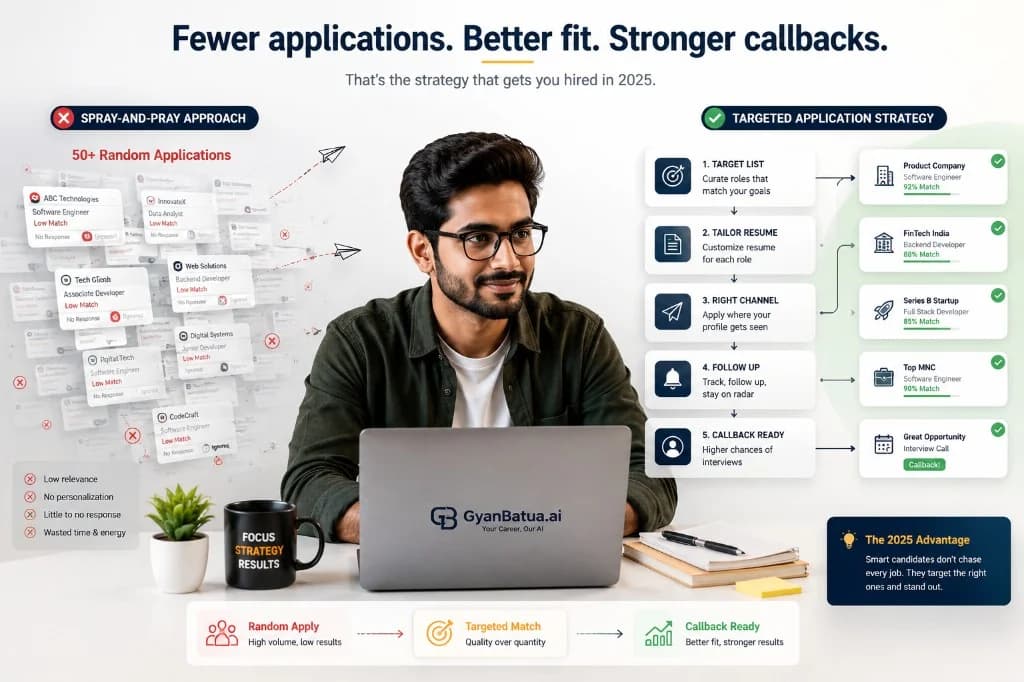
The default job search strategy in India is volume: apply to every opening on Naukri, Internshala, and LinkedIn, send the same resume to all of them, and hope for callbacks. Most candidates apply to 50–100 roles and hear back from three to five.
That's not a strategy. That's a lottery ticket with bad odds.
The strategy that works is the opposite: apply to fewer roles, target each one specifically, and make every application competitive. Here's the system.
Step 1 — Build a target list, not a spray list
Pick 15–20 companies maximum. For each, identify the specific role you're targeting and find the exact JD. This means going beyond Naukri listings to company career pages, LinkedIn postings, and off-campus drive announcements.
Your target list should include a mix: 5–8 "reach" companies (your top choices), 5–8 "match" companies (strong fit for your profile), and 3–5 "safety" companies (roles you're very likely to clear).
Step 2 — Tailor each application
For each company on your list, create a tailored resume version. This means: adjusting the summary to name the role, reordering skills to match the JD's priorities, and rewording project bullets to use the JD's vocabulary.
This takes 30–45 minutes per company. For 15 companies, that's 8–12 hours total. Compare that to 50 hours of mass-applying — the targeted approach takes less time and produces more results.
Step 3 — Apply through the right channel
The channel matters as much as the resume. Priority order:
- Employee referral — highest conversion rate. If you know anyone at the company, ask for a referral.
- Direct company portal — apply through the company's career page. Your application enters their ATS directly.
- Job board (Naukri, LinkedIn, Internshala) — widest reach but lowest per-application conversion. Use for discovery.
- Off-campus drives — for fresher hiring at TCS, Infosys, Wipro, Cognizant, and Capgemini, register early.
Step 4 — Track and follow up
Maintain a simple tracker: company, role, date applied, channel, status, next action. Google Sheets works fine. Review weekly.
If you haven't heard back in two weeks after a portal application, a polite follow-up on LinkedIn to the recruiter or hiring manager is appropriate. One follow-up. Not three.
Step 5 — Iterate after rejections
Every rejection contains information. If you're cleared for assessments but failing technical rounds: your DSA or fundamentals need work. If you're clearing technical but failing HR: your communication or company research needs work. If you're not getting shortlisted at all: your resume isn't matching the JDs.
Track the pattern across multiple applications. Fix the bottleneck, not everything at once.
The math behind targeted vs. mass applications
10 targeted applications with 80% JD match → approximately 3–4 shortlists → 1–2 offers.
50 untargeted applications with 40% JD match → approximately 3–5 shortlists → 1 offer (maybe).
Same outcome, five times less work, better companies, and you enter each interview actually prepared for that specific role.
GyanBatua's JD Match makes the targeting step fast: paste the JD, see your match score, fix the gaps, submit a stronger application.
Is your resume good enough?
Drop your resume here or . PDF & DOCX only. Max 5MB file size.
Resume guides
Related Resume Guides
About the Author
Senior Project Delivery Manager at Mobiloitte
Senior Project Delivery Manager at Mobiloitte, guiding graduates through placement preparation and corporate transition.
Pricing
Choose your plan and get started faster
Compare features, pricing, and usage clearly, then pick the plan that fits your goal.
Next step
Check your resume against a real job description
See JD match, keyword visibility, and skill gaps before you apply.
Related reading
8Recent articles
6