GyanBatua AI logoGyanBatua AI logo
HomePricingResume OptimizerBlogContact Us
LoginGet Started
GyanBatua AI logo

GyanBatua.ai helps students, freshers, internship seekers, and professionals prepare for real interview opportunities through role-specific AI Tutors, structured assessments, instant feedback, and Voice Mock practice.

  • ›About Us
  • ›Career Blog
  • ›Pricing
  • ›Contact Us
  • ›Safety & Trust
  • ›Community Guidelines
  • ›Responsible AI
  • ›Fair Use Policy
  • ›Security Overview
  • ›Terms & Conditions
  • ›Privacy Policy
  • ›Cookie Policy
  • ›Refund Policy
  • ›Sub-processors
  • ›Grievance Redressal
  • ›Parent & Guardian Guide
  • ›Recording Notice
  • ›WhatsApp/SMS Policy
  • ›Media

Contact Us

Email

support@gyanbatua.ai

Subscribe to our newsletter

Email

MatrixSecure

All trademarks are the property of their respective owners

All rights reserved © 2026 Matrix Secure Applications (OPC) Private Limited

A Mobiloitte Group Initiative
BlogThe Portfolio That Actually Helps You Break In (and the One That Doesn't)
Breaking Into Tech

The Portfolio That Actually Helps You Break In (and the One That Doesn't)

Overview: Most portfolios candidates build for career transitions do not move hiring managers. Here is what does — across PM, data, design, and AI/ML.

GyanBatua TeamMay 20, 20267 min read
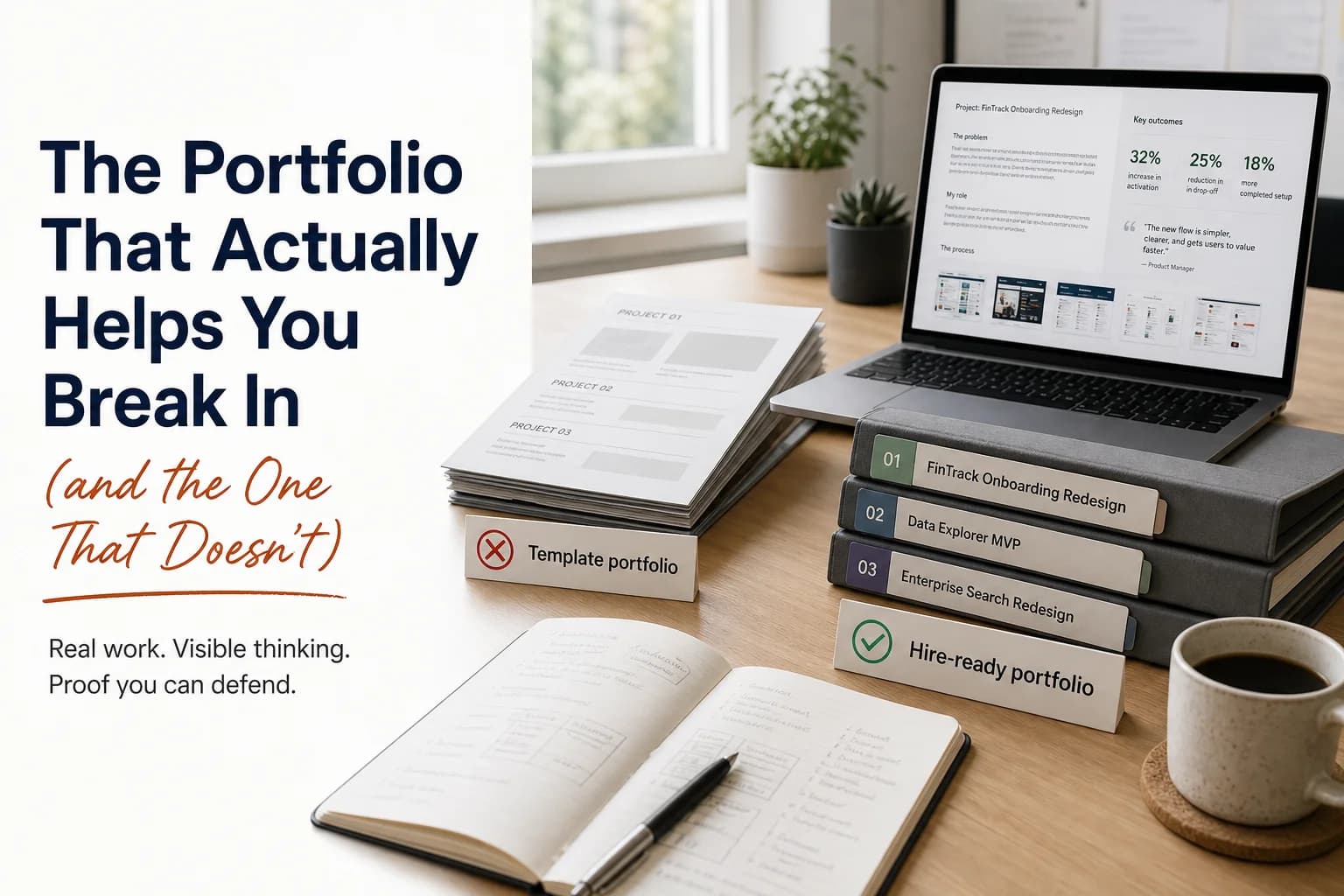
Blog hero comparing portfolios that help you break in versus template work: editorial headline beside a desk showing hire-ready case studies versus faded generic template projects.
On this page5
Jump to the sections that matter.
On this page5
Jump to the sections that matter.
What hiring managers actually look atWhat a strong portfolio sharesWhat a weak portfolio sharesHow to find real-or-realistic work to build onThe shift to make

On this page

5

Jump to the sections that matter.

What hiring managers actually look atWhat a strong portfolio sharesWhat a weak portfolio sharesHow to find real-or-realistic work to build onThe shift to make

Introduction

Most career-transition candidates spend months building portfolios that do not move hiring managers.

It is not because effort was lacking. It is because the portfolio was optimized for the wrong audience — often other candidates or online communities, not the people actually hiring.

Here is what actually helps.

Recommended tool

Build portfolio proof, then align your resume with the exact role you are targeting.

Upload your resume, paste the job description, and see:

  • resume–JD gap visibility
  • keywords and skill signals hiring teams scan
  • priority fixes before applications
Check Resume–JD Match

What hiring managers actually look at

Across PM, data, design, and AI/ML, three signals carry disproportionate weight.

  • Is this real work or styled work? Real problems with real constraints beat template projects with fictional users.
  • Is the thinking visible? Process, trade-offs, iterations, and decision rationale matter more than final output alone.
  • Can the candidate defend it? Interviews probe portfolio work in depth. If you cannot explain it clearly, trust drops fast.

What a strong portfolio shares

1) Three to five deep pieces, not ten shallow ones

Three deep case studies outperform ten thin ones. Hiring managers usually read only a few pieces before forming an opinion.

2) A clear specialization or theme

"Designer" portfolios often lose to "designer focused on B2B SaaS dashboards" portfolios. The same principle applies to PM, data, and AI. Pick a specialization and let your work prove it.

3) Visible process, not just outputs

Show rough versions, pivots, rejected options, and decision logic. Final-output-only portfolios often read as luck rather than repeatable skill.

4) Honest framing of outcomes

If a project worked, explain what changed and how you measured it. If it failed, explain what you learned and what you would do differently.

Honest framing reads as maturity. Overclaiming reads as a red flag.

5) Defensible specifics

Every claim should be something you can discuss deeply: dataset choices, research method, decision criteria, implementation constraints, and limitations.

Sparse but honest portfolios beat dense but unverifiable portfolios.

What a weak portfolio shares

  • Templates that look like every other bootcamp submission.
  • Fictional projects with no constraints, users, or measurable outcomes.
  • Pixel-only or notebook-only outputs with no narrative or decision rationale.
  • Surface effort over depth: too many shallow projects.
  • Certificates presented as portfolio artifacts. Certificates are vocabulary, not proof of execution.

How to find real-or-realistic work to build on

Three sources work consistently.

  • Products you use every day. Pick one with real problems and document the improvement path, research plan, trade-offs, and measurable outcomes.
  • Volunteer or pro-bono work for non-profits, friend startups, or student organizations. Real users and constraints increase credibility.
  • Small commissioned work. Even low-scope projects can become strong portfolio artifacts when documented with process and outcomes.

The shift to make

Stop building portfolios for other candidates to admire.

Start building portfolios for hiring managers to read in ten minutes and recognize as real work.

Three deep pieces, in a specialization, on real-or-realistic problems, with visible process and honest outcomes, beats almost everything else self-taught and transitioning candidates produce.

Related reading on GyanBatua

Use this with the full transition roadmap and role-specific guides:

  • Breaking Into PM, Data, Design, AI — A Realistic Roadmap
  • How to Break Into Product Management (Without an MBA or PM Experience)
  • How to Break Into Data — Analyst vs Engineer vs Scientist (and Which Path Suits You)
  • How to Break Into UX/Product Design (When You're Self-Taught)
  • How to Break Into AI/ML Roles in 2026 (and What Has Changed Since 2023)

Pricing

Choose your plan and get started faster

Compare features, pricing, and usage clearly, then pick the plan that fits your goal.

View Pricing

Next step

Check your resume against a real job description

See JD match, keyword visibility, and skill gaps before you apply.

Check Resume–JD Match

Related reading

5
Breaking Into PM, Data, Design, AI — A Realistic RoadmapHow to Break Into Product Management (Without an MBA or PM Experience)How to Break Into Data — Analyst vs Engineer vs Scientist (and Which Path Suits You)How to Break Into UX/Product Design (When You're Self-Taught)How to Break Into AI/ML Roles in 2026 (and What Has Changed Since 2023)

Recent articles

6
7 Hidden Signs You're Burning Out Mid-Job-SearchWhat to Do in the First Week After a Big RejectionHow Many Job Applications Per Week Actually Make SenseWhen to Ask for Help vs When to Keep GoingThe Hidden Job Market: Referrals, Cold Outreach, and Recruiter RelationshipsWhy the Best Jobs Never Get Posted Publicly

For you

Related and recent articles to keep you moving.

Pricing

Choose your plan and get started faster

Compare features, pricing, and usage clearly, then pick the plan that fits your goal.

View Pricing

Next step

Check your resume against a real job description

See JD match, keyword visibility, and skill gaps before you apply.

Check Resume–JD Match

Related reading

5
Breaking Into PM, Data, Design, AI — A Realistic RoadmapHow to Break Into Product Management (Without an MBA or PM Experience)How to Break Into Data — Analyst vs Engineer vs Scientist (and Which Path Suits You)How to Break Into UX/Product Design (When You're Self-Taught)How to Break Into AI/ML Roles in 2026 (and What Has Changed Since 2023)

Recent articles

6
7 Hidden Signs You're Burning Out Mid-Job-SearchWhat to Do in the First Week After a Big RejectionHow Many Job Applications Per Week Actually Make SenseWhen to Ask for Help vs When to Keep GoingThe Hidden Job Market: Referrals, Cold Outreach, and Recruiter RelationshipsWhy the Best Jobs Never Get Posted Publicly

Recommended

2
Breaking Into PM, Data, Design, AI — A Realistic RoadmapHow to Match Your Resume to a Job Description Before You Apply
Check My Resume–JD Match