
Break Into UX and Product Design as a Self-Taught Designer
Overview: Self-taught UX transitions work — but only with the right portfolio. Here is what hiring managers actually look for, and what kills your chances.

Introduction
Design hiring is more portfolio-driven than any other function in tech.
That cuts both ways for self-taught designers.
On one hand, credentials matter less. Nobody is checking your design school transcript. On the other hand, your portfolio is doing nearly all of the work. A weak portfolio means a closed door, regardless of how hard you have studied.
Here is what actually works for self-taught transitions.
What hiring managers look at
Three things, in this order.
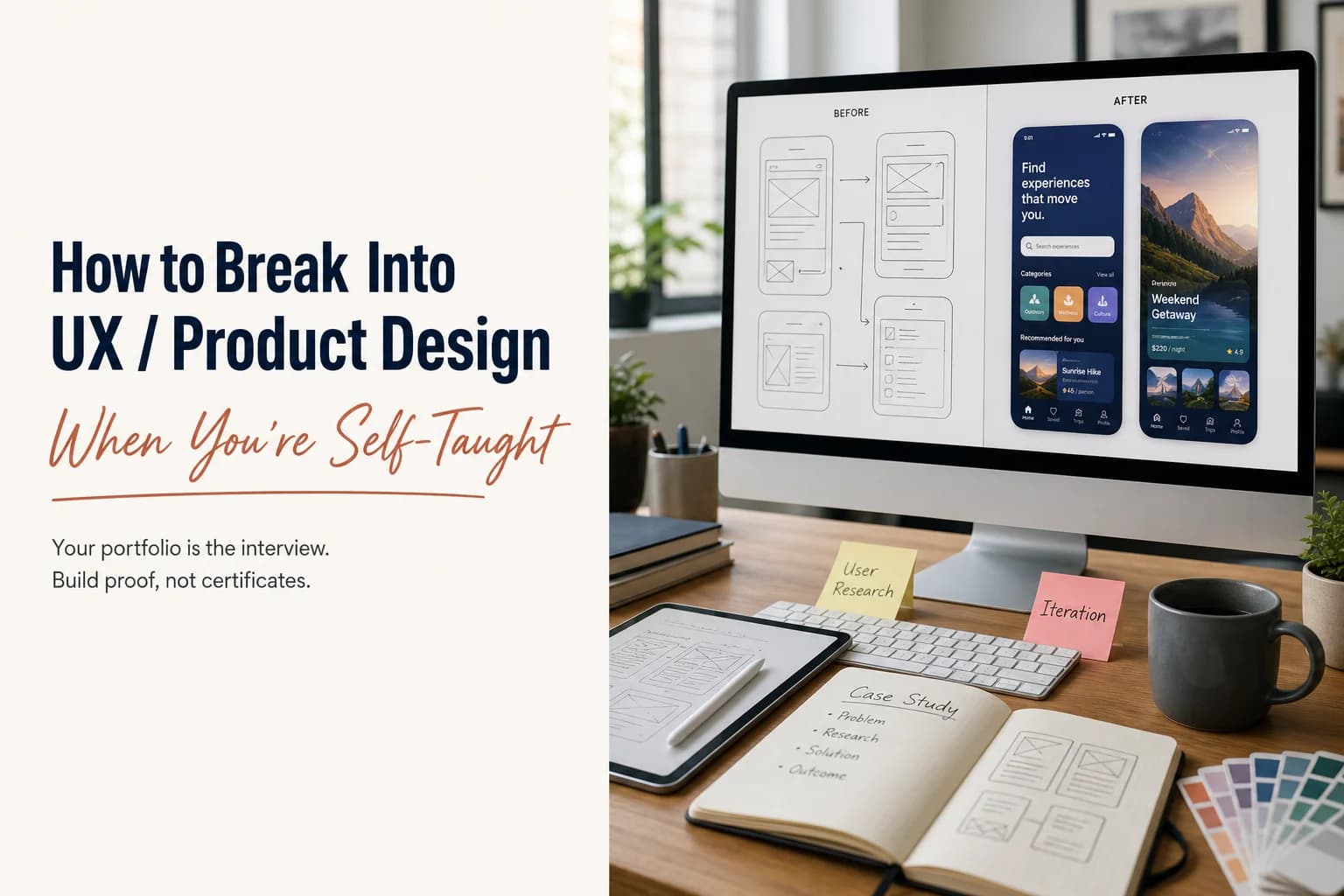
- Process. Can you frame a problem, do user research, generate options, evaluate them against criteria, and iterate? Process artifacts — research notes, sketches, iterations, and decision rationale — matter more than final pixels.
- Product thinking. Did you design something that solved a real user problem in a real context, or did you just style an interface? Hiring managers spot the difference quickly.
- Visual execution. Yes, this matters — but it matters as the surface of the first two. A beautifully styled interface that ignores user needs is not a strong portfolio piece.
What a strong portfolio looks like
Three to five case studies, each one a long-form write-up that shows your process — not just final screens.
Each case study should include the problem you were solving, the user research you did (or would have done), constraints, options considered, trade-offs, final design, and how you would measure success.
Real product context wherever possible. A redesign of an existing product you use, a volunteer project for a non-profit, or a real (or realistic) startup brief. Fictional projects can work, but real context is stronger.
What a weak portfolio looks like
- Polished Dribbble mockups with no underlying problem statement. Visually beautiful, hiring-irrelevant.
- Bootcamp portfolio templates. The formats are too recognizable in 2026, and recruiters have seen the same structure hundreds of times.
- Fictional projects with no constraint. "Designed a meditation app" without user research, real audience, or business context reads as styling exercise, not design work.
- Projects without iteration. Final screens with no early versions and no explanation of what changed and why.
Specialization that helps
"UX designer" is broad and harder to hire. "UX designer focused on B2B SaaS dashboards" is specific and easier to hire because managers can match it to immediate needs.
Specialization options that work: B2B SaaS, fintech, healthcare, EdTech, dev tools, e-commerce, marketplaces, consumer mobile, dashboards and analytics, and design systems.
Pick one or two. Build case studies in that space. Become the obvious match for the next opening in that specialization.
What about Figma and the tools
Tools are necessary but not sufficient. Figma fluency is baseline now.
Tools that matter beyond Figma include Notion (or similar) for documentation, analytics or research tools, prototyping, basic front-end constraints awareness, and emerging fluency with AI design tools.
Tool depth without process and product thinking does not move applications.
Realistic timeline
Self-taught transitions can succeed in 6 to 12 months — but only with a portfolio that demonstrates real product thinking, in a specialization, on real-or-realistic work.
Faster than 6 months is rare. Slower than 12 months often means portfolio strategy needs adjustment — usually more specialization, more real context, or longer-form write-ups.
The shift to make
Stop building portfolios that look like every other bootcamp graduate's.
Start building 3 to 5 deep, specific case studies in a clear specialization, on real-or-realistic work, with the full process visible.
For self-taught UX transitions, the portfolio is the resume. Most other resume work is secondary.
Related reading on GyanBatua
Pair this with role clarity and transition positioning:
Is your resume good enough?
Drop your resume here or . PDF & DOCX only. Max 5MB file size.
Resume guides
Related Resume Guides
About the Author
Senior Project Delivery Manager at Mobiloitte
Senior Project Delivery Manager at Mobiloitte, guiding graduates through placement preparation and corporate transition.
Pricing
Choose your plan and get started faster
Compare features, pricing, and usage clearly, then pick the plan that fits your goal.
Next step
Check your resume against a real job description
See JD match, keyword visibility, and skill gaps before you apply.
Related reading
5Recent articles
6