

How to Break Into AI and ML Roles in 2026 — Career Roadmap
Overview: The AI/ML entry path has changed substantially in three years. Here is what works in 2026 — and what advice from 2023 is now misleading.

Introduction
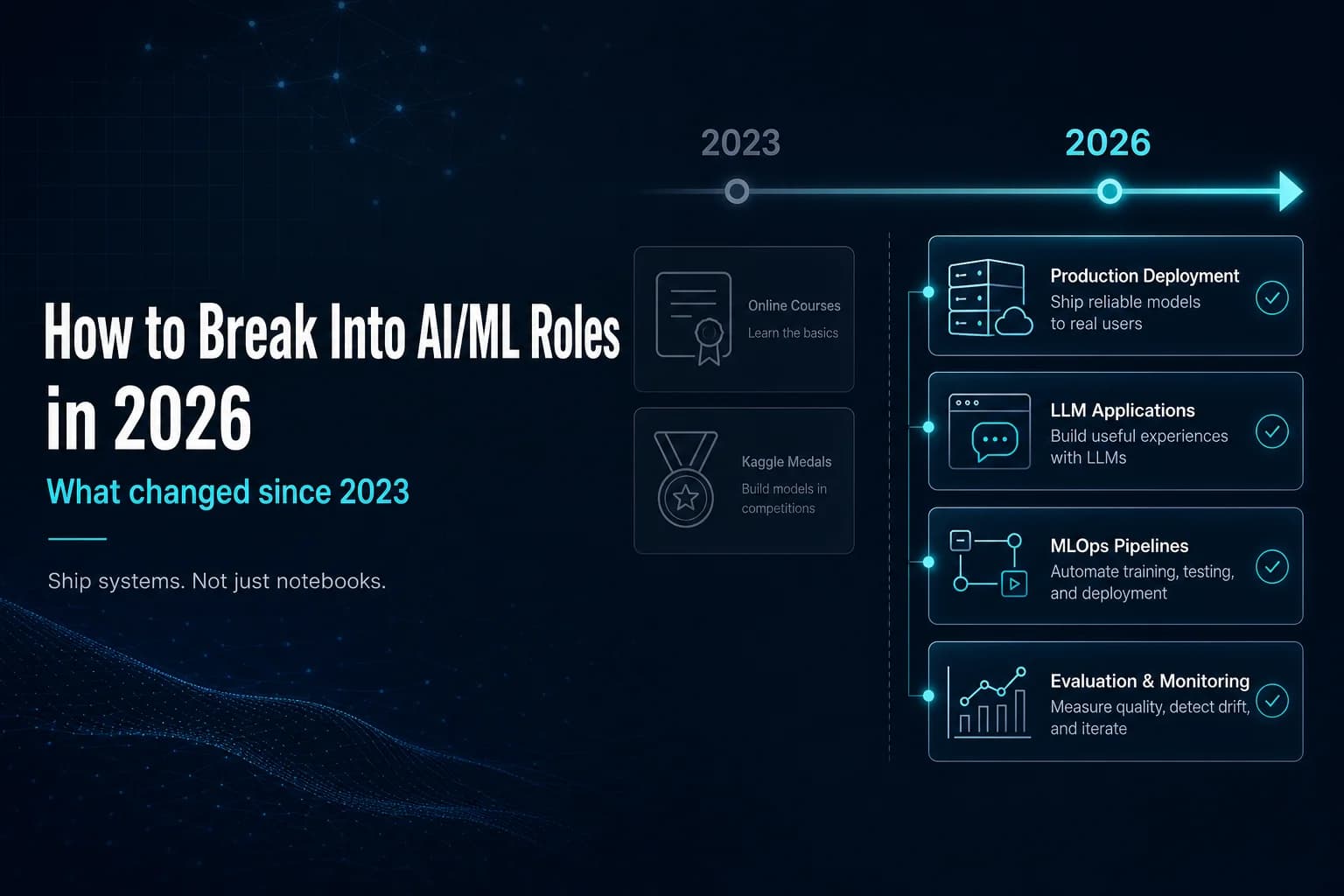
Three years ago, breaking into AI/ML had a clearer formula: strong math, a few Kaggle competitions, and a couple of online ML courses.
That combination once put candidates in real contention. The market has shifted.
Foundation models, LLMs, agents, and AI applications have created a different set of jobs — and a different set of expectations from candidates. Here is what changed and what works now.
What changed since 2023
- ML engineer roles have grown faster than ML research roles. Companies need people who can ship ML systems, not just train models.
- Engineering depth matters more than it used to. The bar on software engineering, infrastructure, and deployment is now closer to a backend engineer's than to a pure researcher's.
- Foundation model fluency is now table stakes. Understanding LLMs, fine-tuning, RAG, and agent design is expected, not novelty.
- The pure ML research path is harder. Top labs hire fewer people, more selectively, and the bar at entry has risen substantially.
- Domain specialization matters more. AI for healthcare, finance, legal, climate, and operations all hire on top of general ML knowledge — and specialization can shorten entry paths.
Three paths that work
Path 1 — Software engineer to ML engineer
For software engineers with strong programming and system-design fundamentals, moving into ML engineering can be a practical transition because many existing engineering skills remain relevant.
Software engineers with strong fundamentals may be able to transition into ML engineering after developing practical knowledge of machine learning, data workflows, model evaluation and deployment. The timeline varies considerably depending on prior experience, learning intensity, project quality and the requirements of the target role.
What to build — fine-tuned models with measurable improvements over baselines, LLM applications with real users, and ML pipelines from data ingestion through serving.
Path 2 — Quantitative background through a structured program
Mathematics, statistics, physics, or economics graduates often transition through part-time master's programs in computer science or ML, combined with serious project work.
Realistic timeline — 18 to 24 months including the program and project portfolio.
Path 3 — Domain expertise plus applied ML
Doctors building healthcare AI, lawyers building legal AI, and finance professionals building trading or risk AI.
Domain expertise is the differentiator. ML knowledge must be real but does not have to exceed what the domain context requires.
Realistic timeline varies, but domain expertise compounds quickly because fewer candidates have both skill sets.
What rarely works in 2026
- Online courses alone. Coursera, fast.ai, and deeplearning.ai are useful as project starters, not primary credentials.
- Generic Kaggle portfolios that follow standard templates. The bar has risen.
- "Prompt engineering" as a standalone specialization without underlying ML or engineering depth.
- Career transitions into pure ML research without quantitative graduate background. Possible, but usually very long timelines.
What a portfolio looks like in 2026
Three to five substantive projects, each with:
- a clear problem statement (what you are predicting, classifying, or generating)
- a real or realistic dataset, not only toy benchmarks
- documented model, baseline, and evaluation choices
- measurable results compared honestly against baselines
- deployment or productionization context where possible
- an honest limitations section and what you would improve next
One genuinely deployed project, even at small scale, usually outweighs five notebook-only projects.
The LLM and agent layer
In 2026, most ML engineering roles touch LLMs in some way.
Useful to learn: fine-tuning open-source models, RAG architectures, agent frameworks, and evaluation methods for LLM systems, plus prompt engineering depth beyond templates.
Less useful: conceptual understanding without shipping anything that uses these techniques.
The shift to make
Stop optimizing for the ML research path unless your academic profile supports it.
Start optimizing for ML engineering — where shipping, scale, and reliability matter more than theoretical depth in most hiring pipelines.
Engineering plus ML knowledge beats deep ML knowledge alone across much of the 2026 market. The bar keeps rising, so starting now matters.
Related reading on GyanBatua
Use these to choose a role path and position your transition clearly:
Resume guides
Related Resume Guides
About the Author
Talent Acquisition Manager at Mobiloitte
Talent Acquisition Manager at Mobiloitte, crafting beautiful recruitment workflows and sourcing technical talent.
Pricing
Choose your plan and get started faster
Compare features, pricing, and usage clearly, then pick the plan that fits your goal.
Next step
Check your resume against a real job description
See JD match, keyword visibility, and skill gaps before you apply.
Related reading
5Recent articles
6