

Break Into Data: Analyst vs Engineer vs Scientist Explained
Overview: Most candidates conflate three different data roles that hire on different things. Here is how each one actually works — and which fits your background.

Introduction
"I want to break into data."
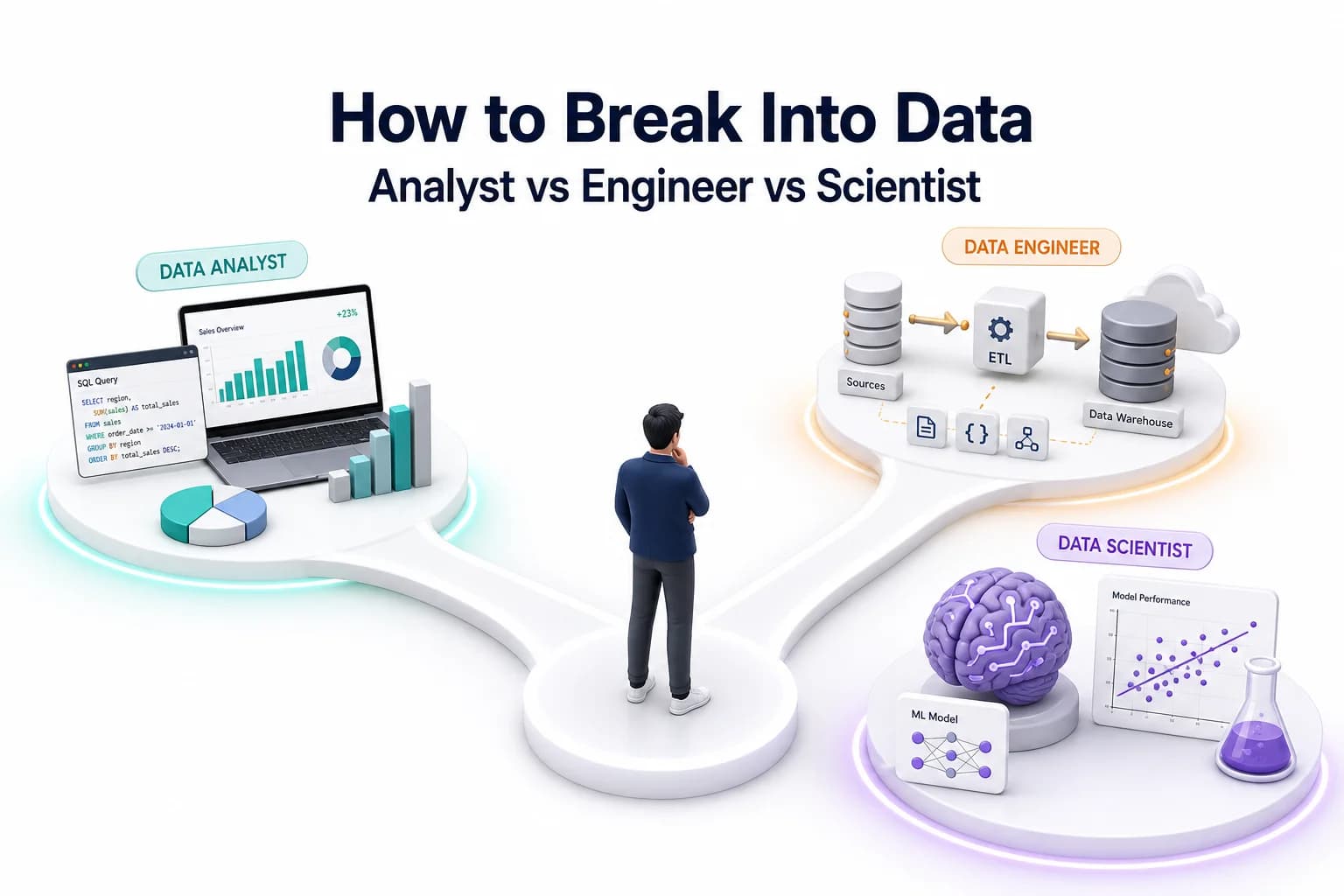
Most candidates use this phrase to mean one of three very different roles: Data Analyst, Data Scientist, and Data Engineer.
These hire on different signals, take different time to break into, and reward different backgrounds. Picking the wrong one usually means months of preparation for the wrong target.
Data Analyst — the most accessible entry
Job — turn business questions into structured data analyses. Build dashboards. Run experiments. Inform decisions.
Skills — SQL (non-negotiable), Excel, basic Python or R, a visualization tool (Tableau or Power BI), enough statistics for hypothesis testing and significance.
Realistic timeline — 4 to 8 months of focused study, plus 3 to 5 substantive projects on real public datasets.
Best transitions — operations, business analyst, BI-adjacent roles, marketing analytics, finance with reporting work.
What works in the portfolio — public Tableau dashboards, GitHub-hosted SQL queries on real datasets, write-ups that show analytical reasoning. Not raw notebooks with no explanation.
Data Scientist — significantly harder entry
Job — build statistical and machine learning models to predict, classify, or optimize. Often deeper into ML than "analyst" implies.
Skills — strong statistics and probability, Python with ML libraries (scikit-learn, pandas, increasingly PyTorch or TensorFlow), feature engineering, experimental design, sometimes deep learning depending on the role.
Realistic timeline — 12 to 24 months for candidates without a quantitative background. Faster for those with one.
Best transitions — quantitative degrees (statistics, mathematics, economics, computer science), data analysts who have built ML depth, software engineers who have invested in ML.
What works in the portfolio — Kaggle competitions with strong write-ups, public ML projects with real datasets and measurable outcomes, contributions to open-source ML libraries.
What does not — generic Kaggle entries that follow templates, MOOC certificates without project work, theoretical knowledge without practical model deployment experience.
Data Engineer — hires like software engineering
Job — build the pipelines and infrastructure that move data from source to warehouse to consumer. Less statistics. More software engineering.
Skills — SQL is necessary but nowhere near sufficient. Python or Scala for pipelines. Workflow tools (Airflow, Prefect, Dagster). Data warehouses (BigQuery, Snowflake, Redshift). Cloud platforms (AWS, GCP, Azure). Modern data stack tools (dbt, Fivetran). Increasingly streaming (Kafka).
Realistic timeline — 6 to 12 months for software engineers transitioning in. 18 to 36 months for non-engineers.
Best transitions — software engineers, especially backend. Database administrators. Analytics engineers.
How to choose
Which role suits your background and inclinations?
- Business background, like solving problems with data, prefer the application side — Data Analyst.
- Quantitative background or strong inclination toward modeling — Data Scientist.
- Software engineering background, like building infrastructure — Data Engineer.
Choosing one and committing to it is more important than the choice itself. Candidates who spread effort across all three rarely break into any of them.
What hurts more than helps
- Stacking certificates from MOOC platforms without building real projects. Coursera and Udemy certificates have lost most of their signal in 2026.
- Claiming all three roles on your resume. Recruiters read this as "qualified for none."
- Applying for data scientist roles with only data analyst depth. Wastes everyone's time.
- Not having any public work. In a function where portfolio matters, no portfolio is a signal.
The shift to make
Stop saying "data." Start saying which of the three roles.
Pick one. Build the specific portfolio for that one. Apply selectively when the portfolio justifies the application.
Generic data candidates lose to specific candidates. Every time.
Related reading on GyanBatua
Use these to tighten role clarity and transition positioning:
Resume guides
Related Resume Guides
About the Author
Software Engineer at Mobiloitte
Software Engineer at Mobiloitte, specializing in scalable AI architectures for resume optimization and interview assessment.
Pricing
Choose your plan and get started faster
Compare features, pricing, and usage clearly, then pick the plan that fits your goal.
Next step
Check your resume against a real job description
See JD match, keyword visibility, and skill gaps before you apply.
Related reading
5Recent articles
6