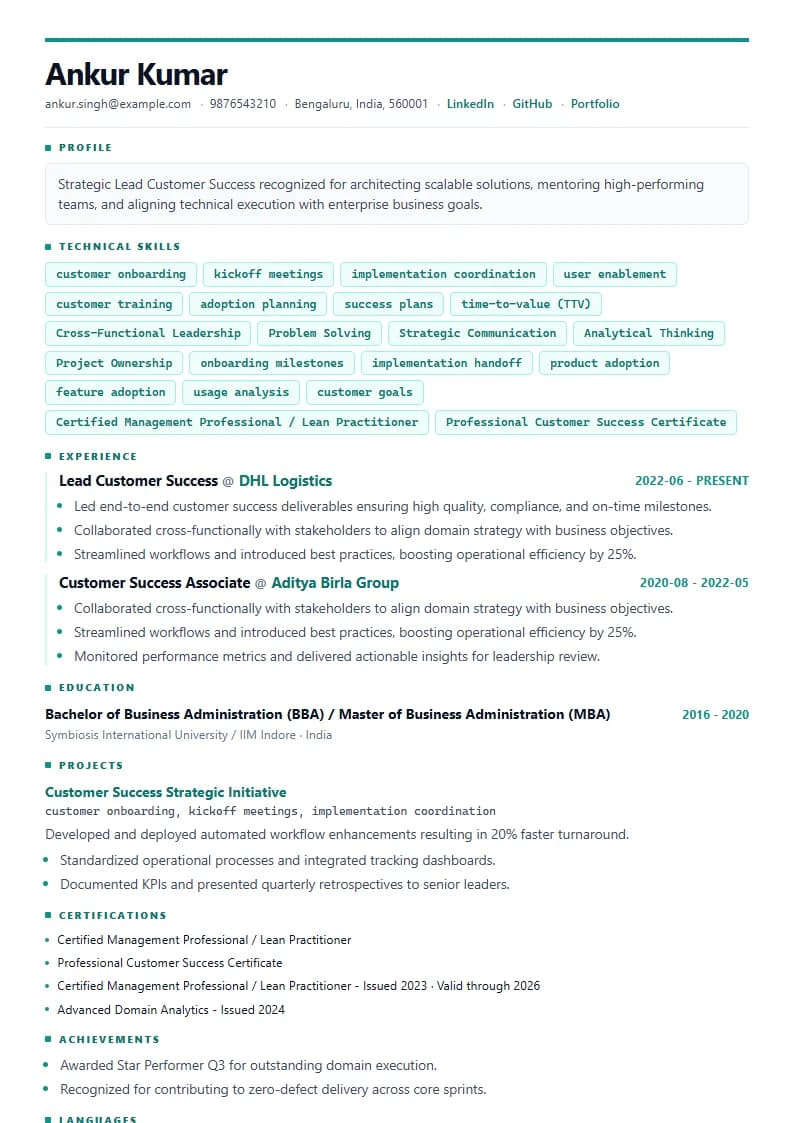

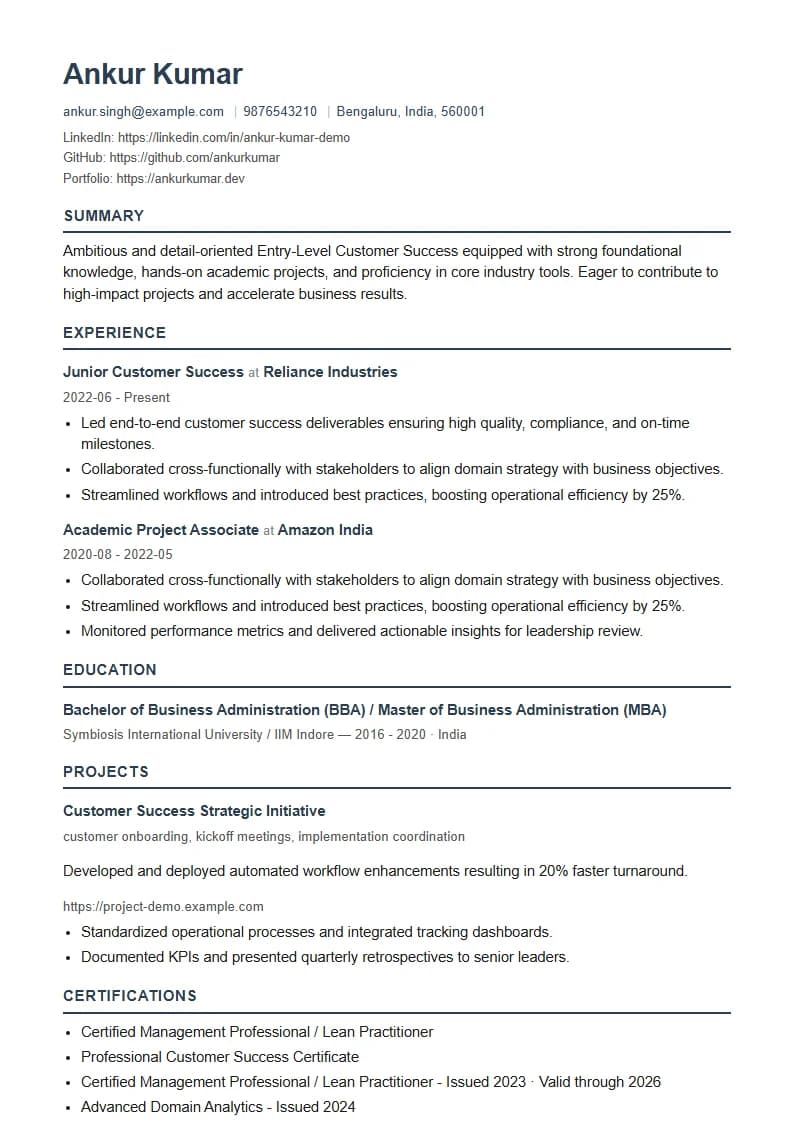
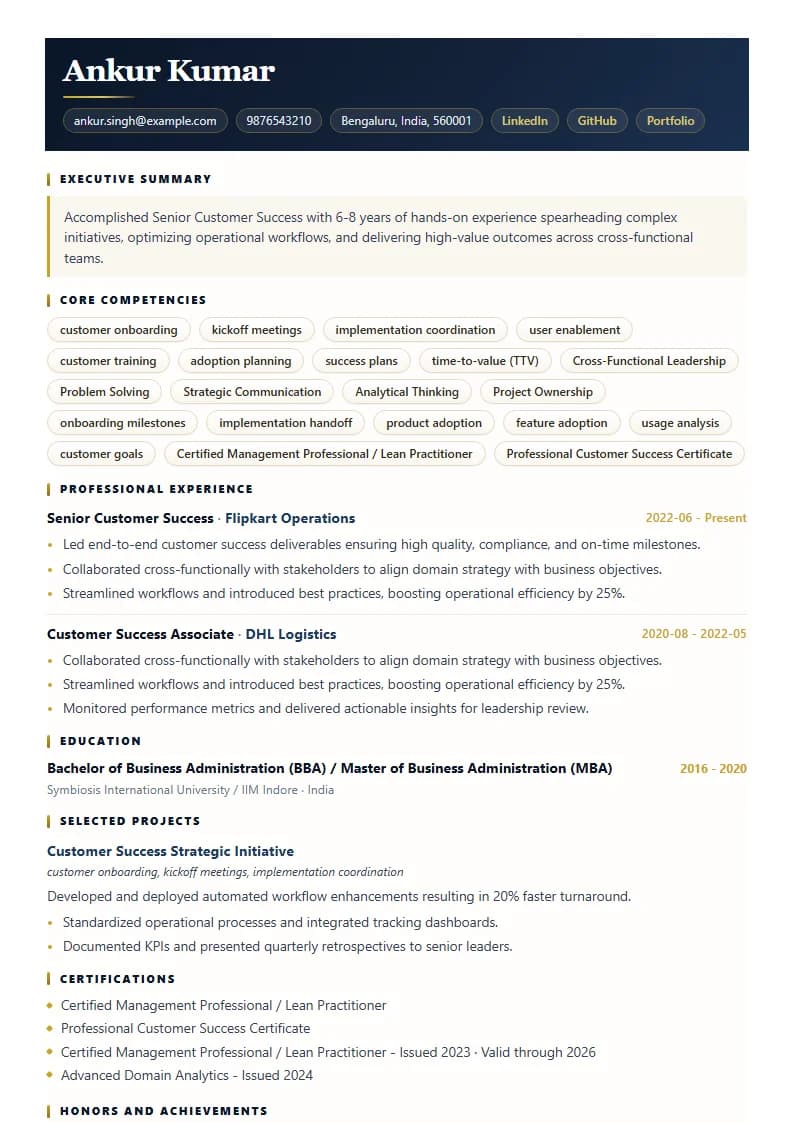
Senior Customer Success Resume Example using Executive Onyx Gold template layout
Featured Example

Customer Success Resume Examples & ATS Guide for 2026

Create a Customer Success resume that clearly demonstrates onboarding, product adoption, customer relationships, account health, retention, renewals and measurable customer outcomes. Review examples across Customer Success Associate, CSM, Enterprise CSM, CS Operations and Implementation roles, then compare your resume with a real Customer Success job description using GyanBatua.
Updated August 2026·6 min read·Reviewed by Deepti Sahni · Director - HR & Corporate Relations, Corporate Talent & Placement Strategy
Core Focus & HighlightsVerified August 2026

What Should a Customer Success Resume Highlight?

A strong Customer Success resume should show the customers or accounts you supported, how you onboarded and guided them toward value, how you monitored adoption or account health, how you managed risks and renewals, and the outcomes of your work. Where genuinely measured, include metrics such as retention, gross or net revenue retention, churn, product adoption, time-to-value, renewal rate, expansion, CSAT, NPS or portfolio ARR. Tailor the emphasis to the target Customer Success role.

Resume Sample

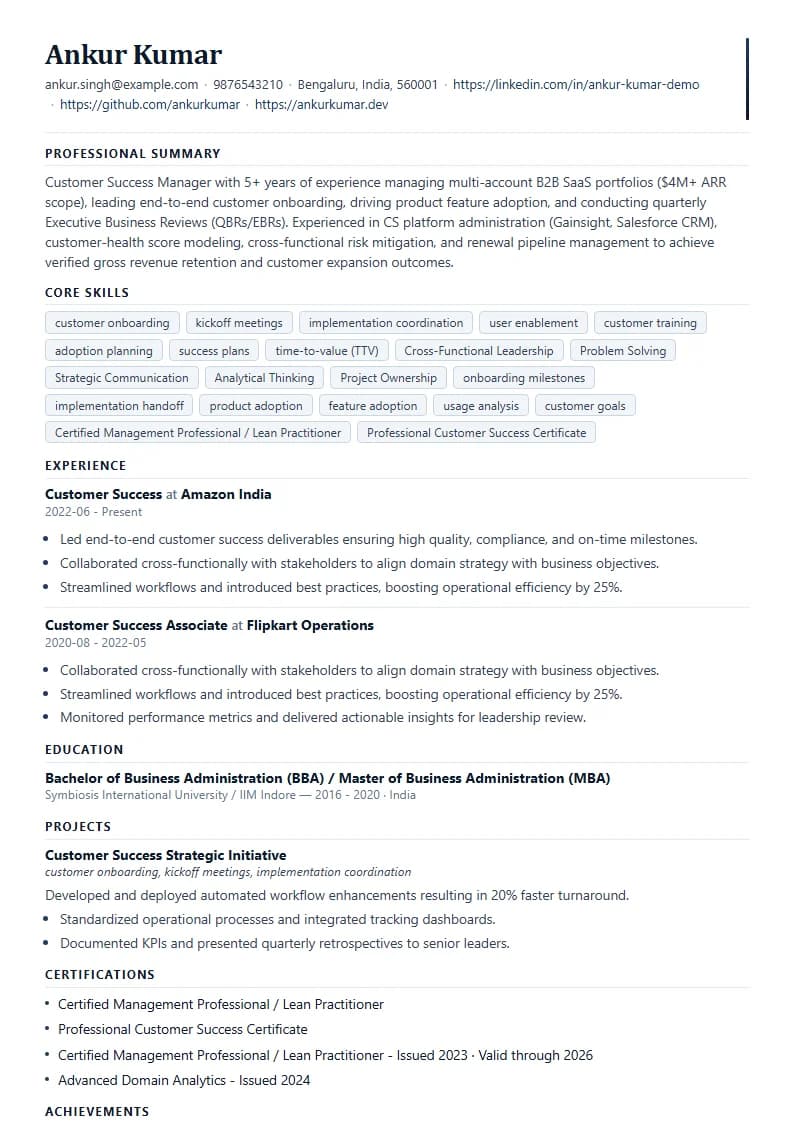
Customer Success Resume Sample

Usable resume sample showing summary structure, categorized skills, and effective experience bullets.

Professional Summary Example

Customer Success Manager with 5+ years of experience managing multi-account B2B SaaS portfolios ($4M+ ARR scope), leading end-to-end customer onboarding, driving product feature adoption, and conducting quarterly Executive Business Reviews (QBRs/EBRs). Experienced in CS platform administration (Gainsight, Salesforce CRM), customer-health score modeling, cross-functional risk mitigation, and renewal pipeline management to achieve verified gross revenue retention and customer expansion outcomes.

Experience Bullet Examples

  • Managed end-to-end customer onboarding for a portfolio of 40+ mid-market B2B SaaS accounts, designing structured kickoff playbooks and user training milestones that accelerated customer time-to-value ([illustrative: 25% reduction in onboarding cycle time — replace with your verified result]).
  • Monitored account health scores and platform usage signals across a $4.2M ARR portfolio in Gainsight and Salesforce, proactively flagging at-risk accounts and executing remediation save plans to maintain high gross revenue retention ([illustrative: 94% GRR — replace with your verified result]).
  • Led 50+ Quarterly and Executive Business Reviews (QBRs/EBRs) with C-suite and VP-level client stakeholders, delivering product adoption insights, aligning product capabilities with customer business objectives, and identifying verified expansion opportunities.
  • Partnered cross-functionally with Product, Engineering, and Support teams to triage critical escalations, channel voice-of-customer feedback into roadmap priorities, and collaborate with Account Executives on renewal and expansion initiatives.
Impact Guidance: Replace all sample account counts, ARR values, retention percentages, churn rates, renewal rates, adoption improvements, CSAT/NPS figures and expansion outcomes with your own verified information. Never invent Customer Success metrics. When exact financial figures or customer names are confidential, describe account tiers (e.g., mid-market, enterprise healthcare), portfolio size, lifecycle stages, platforms used, or retention outcomes truthfully without disclosing non-public business data.

Customer Success Projects: How to Present Lifecycle Initiatives & Case Studies on a Resume

Customer Success playbooks, onboarding overhauls, health-score redesigns, and churn-mitigation programs provide powerful proof of proactive relationship management. Structure project entries using: Customer Challenge / Goal → Portfolio Scope & Baseline → Methodology & CS Platform (Gainsight, Salesforce, ChurnZero) → Cross-Functional Execution (Product, Support, Sales) → Verified Customer Outcome. For early-career candidates or career changers, academic customer journey maps, internship onboarding workflows, and simulated SaaS success plans are valid when clearly labeled as non-commercial.

Customer Onboarding Redesign & Time-to-Value Initiative | Goal: Reduce onboarding drop-off and accelerate user activation. Scope: 60+ mid-market SaaS accounts. Methodology: Audited user milestone data in Gainsight, created standardized 30-60-90 day success milestones, and established weekly kickoff cadences. Tools: Gainsight, Salesforce, Loom, Google Sheets. Outcome: Shortened average customer time-to-launch and increased 90-day product feature adoption.

Competencies

Key Skills & Technical Keywords

Essential domain skills, frameworks and technologies commonly requested for customer success positions.

Customer Onboarding & Time-to-Value
customer onboardingkickoff meetingsimplementation coordinationuser enablementcustomer trainingadoption planningsuccess planstime-to-value (TTV)onboarding milestonesimplementation handoff
Adoption & Customer Outcomes
product adoptionfeature adoptionusage analysiscustomer goalsvalue realizationsuccess planscustomer journey mappingcustomer engagementoutcome trackinguser activation
Retention, Renewals & Account Health
customer retentionrenewal managementchurn risk mitigationaccount health monitoringhealth scoringrisk identificationsave plansrenewal forecastingescalation managementat-risk intervention
Expansion & Commercial Collaboration
account expansionupsell identificationcross-sell identificationexpansion opportunitiescommercial handoffgross revenue retention (GRR)net revenue retention (NRR)pipeline collaboration
Customer Communication & Executive Engagement
relationship managementexecutive stakeholder managementQuarterly Business Reviews (QBR)Executive Business Reviews (EBR)customer educationexecutive presentationsstakeholder alignmentcustomer advocacyVoice of Customer (VoC)
Customer Analytics & CS Platforms
GainsightSalesforce CRMChurnZeroTotangoHubSpot CRMZendeskcustomer health analysisusage analyticsaccount segmentationcohort analysisretention reporting
Education & Certifications: Customer Success professionals come from diverse academic backgrounds including Business Administration, Communications, Marketing, Computer Science, Psychology, or related disciplines. For experienced CSMs, verified customer lifecycle outcomes and retention results carry far greater weight than extensive coursework. Recognized professional credentials include Gainsight Certified Administrator/CSM, Salesforce Certified Administrator, SuccessHACKER Certified Customer Success Manager (CCSM), or Pragmatic Institute certifications. Only list credentials you have genuinely earned.

Career Stages

Customer Success Resume by Experience Level

Target key expectations based on your current career stage and technical range.

1Onboarding Support, Customer Communication & CRM Hygiene

Entry-Level / Customer Success Associate

Focus on customer communication, user enablement sessions, onboarding coordination, account follow-ups, CRM updates (Salesforce, HubSpot), support ticket triaging, product documentation, and adoption tracking. Highlight customer-facing internships, academic projects, or support experience without claiming unverified portfolio ARR ownership.

2Usage Analytics, Health Scoring & Churn Signal Modeling

Customer Success Analyst

Highlight customer health data modeling, usage pattern tracking, account segmentation, churn risk telemetry, customer satisfaction reporting (CSAT, NPS), and executive dashboard creation in Excel, Tableau, Power BI, or Gainsight.

3Portfolio Ownership, Adoption Tracking & Renewal Management

Customer Success Manager (Mid-Level)

Demonstrate multi-account portfolio management, structured customer onboarding, feature adoption campaigns, health score monitoring, Quarterly Business Reviews (QBRs), proactive risk mitigation save plans, and renewal forecasting.

4Enterprise Stakeholder Management, Strategic EBRs & High ARR Scope

Senior / Enterprise Customer Success Manager

Emphasize large enterprise account portfolios, C-suite and VP stakeholder relationship governance, complex multi-department rollouts, joint success planning, multi-year renewal execution, cross-functional escalation management, and expansion collaboration.

5CS Tech Stack Architecture, Playbook Design & Lifecycle Metrics

Customer Success Operations Manager

Focus on CS system administration (Gainsight, ChurnZero, Totango, Salesforce), automated customer journey workflows, health-score algorithm design, capacity and account assignment modeling, playbook standardization, and lifecycle analytics.

6Kickoff Coordination, System Configuration & Time-to-Value

Implementation / Onboarding Manager

Showcase customer kickoff meetings, technical workflow configuration, integration coordination with technical teams, milestone tracking, customer change management, training delivery, go-live execution, and seamless handoffs to designated CSMs.

Tailoring Steps

How to Tailor a Customer Success Resume to a Job Description

Follow these structured steps to align your resume with target job descriptions accurately.

1

Identify Customer Segment & Lifecycle Scope

Determine whether the target role focuses on SMB, mid-market, or enterprise accounts, and whether primary responsibilities center on onboarding, user adoption, retention, renewals, expansion, implementation, or CS operations.

2

Match Genuine Tools, Metrics & Responsibilities

Align your resume with the employer's specific CRM, CS platform (Gainsight, ChurnZero, Salesforce), health-score methodologies, and retention KPIs (GRR, NRR, churn) that you have genuinely managed.

3

Refine Evidence & Compare with GyanBatua

Highlight your strongest customer outcomes and lifecycle accomplishments first. Compare your resume against the target job description using GyanBatua to identify areas that may benefit from clearer emphasis.

Compliance & Formatting

ATS-Friendly Resume Checklist

Checklist4 items
Structure headings clearly using standard labels such as Summary, Skills, Experience, Projects, and Education.
Reflect genuine customer lifecycle terms (onboarding, adoption, retention, renewals, health scoring, QBRs) and tools (Salesforce, Gainsight, ChurnZero, Zendesk).
Ground accomplishments in verified customer outcomes and portfolio context rather than unsupported commercial claims.
Avoid keyword stuffing and maintain clean, readable formatting compatible with modern ATS parsers.

Want to know if your resume is ATS-friendly? Check it with our free AI tool below!

Is your resume good enough?

Drop your resume here or . PDF & DOCX only. Max 5MB file size.

🔒We never share your data with 3rd parties or use it for AI model training.

Help & FAQ

Frequently Asked Questions About Customer Success Resumes

Customer Success Resume FAQ

What should a Customer Success resume include?
A Customer Success resume should clearly highlight your account portfolio scope (e.g., SMB, mid-market, enterprise), customer onboarding and user adoption experience, health-score monitoring, QBR/EBR executive engagements, renewal and retention outcomes, and proficiency with CS platforms like Gainsight, ChurnZero, and Salesforce. Where measured, include verified metrics such as gross revenue retention (GRR), churn reduction, time-to-value, and CSAT.
What skills should I put on a Customer Success resume?
Core skills include customer onboarding, product adoption, time-to-value optimization, account health scoring, churn risk mitigation, renewal management, Quarterly Business Reviews (QBRs), executive stakeholder management, Voice of Customer (VoC), customer education, and familiarity with CRM and CS platforms (Salesforce, Gainsight, HubSpot, Zendesk).
How do I write a Customer Success resume with no direct CSM experience?
Highlight transferable customer-facing experience from roles in customer support, customer service, account management, sales, implementation, consulting, training, or hospitality. Emphasize relationship building, active listening, user training, problem resolution, product walkthroughs, and customer advocacy. Present academic projects or simulated onboarding playbooks without inventing portfolio numbers or ARR.
What makes a strong Customer Success resume summary?
A strong summary follows the formula: Role Title + Customer/Product Context (e.g., B2B SaaS, enterprise tech) + Portfolio Scope (e.g., $3M+ ARR, mid-market accounts) + Core CS Capabilities (onboarding, QBRs, health scoring, renewals) + Verified Business Impact. Avoid generic statements and focus on your demonstrated ability to drive customer value realization.
What metrics should I include on a Customer Success resume?
Include metrics you have genuinely measured or contributed to, such as Gross Revenue Retention (GRR), Net Revenue Retention (NRR), logo retention rate, churn reduction, customer onboarding time-to-value (TTV), product feature adoption rates, renewal rate, CSAT, or NPS. Label any sample figures as illustrative and never fabricate commercial performance data.
What Customer Success tools should I list on my resume?
List platforms you have genuinely used in real workflows, grouped by category: CRM platforms (Salesforce, HubSpot), Dedicated CS platforms (Gainsight, ChurnZero, Totango, Planhat, Vitally), Support & Ticketing tools (Zendesk, Freshdesk, Intercom), and Analytics/Collaboration tools (Excel, Power BI, Tableau, Slack, Jira).
What is the difference between Customer Success and Customer Support?
Customer Success is proactive and relationship-driven, focusing on long-term onboarding, product adoption, value realization, account health, renewals, and revenue retention. Customer Support is reactive and issue-driven, focusing on troubleshooting technical issues, resolving tickets, answering customer inquiries, and meeting service-level agreements (SLAs).
How should I describe onboarding and product adoption on my resume?
Describe onboarding and adoption by specifying the account tier, kickoff milestones, customer training delivered, time-to-value improvements, and feature adoption campaigns executed. For example, explain how you guided new accounts through 30-60-90 day milestone plans, tracked activation metrics, and resolved initial setup roadblocks.
How do I show retention, renewals and churn reduction on a resume?
Distinguish between outcomes you directly owned versus those you supported cross-functionally. Use clear framing: 'Monitored health scores to identify at-risk accounts, executed remediation save plans with technical teams, and contributed to maintaining a high gross renewal rate.' Avoid claiming entire organizational revenue growth without context.
What is the difference between a CSM and Customer Success Operations resume?
A CSM resume emphasizes direct client relationship management, onboarding, QBRs, customer health, and renewals. A CS Operations resume emphasizes the underlying infrastructure: CS platform administration (Gainsight/Salesforce), automated customer journey workflows, health-score algorithm design, lifecycle telemetry, capacity modeling, and reporting dashboards.
How do I tailor a Customer Success resume to a job description?
Review the target job description to determine the customer segment (SMB vs. Enterprise), primary role focus (onboarding vs. retention vs. expansion vs. operations), required CS tools (Gainsight, Salesforce), and key metrics. Reorder your summary, skills, and experience bullets so your most relevant customer outcomes appear first.
What Customer Success keywords are useful for ATS?
Useful ATS keywords include customer onboarding, product adoption, time-to-value, account health scoring, gross revenue retention (GRR), churn mitigation, Quarterly Business Reviews (QBR), Executive Business Reviews (EBR), customer journey mapping, Gainsight, Salesforce CRM, Zendesk, customer advocacy, and Voice of Customer (VoC). Only include keywords that match your authentic experience.

Resume Diagnostic

Check Your Customer Success Resume Against a Real Job Description

Verify customer lifecycle alignment, onboarding signals, retention metrics, and CS platform keywords against the target job description with GyanBatua.

ATS OptimizedJD-TunedDiagnostic Assessment
Your resume data is private, secure, and used solely for diagnostic matching.