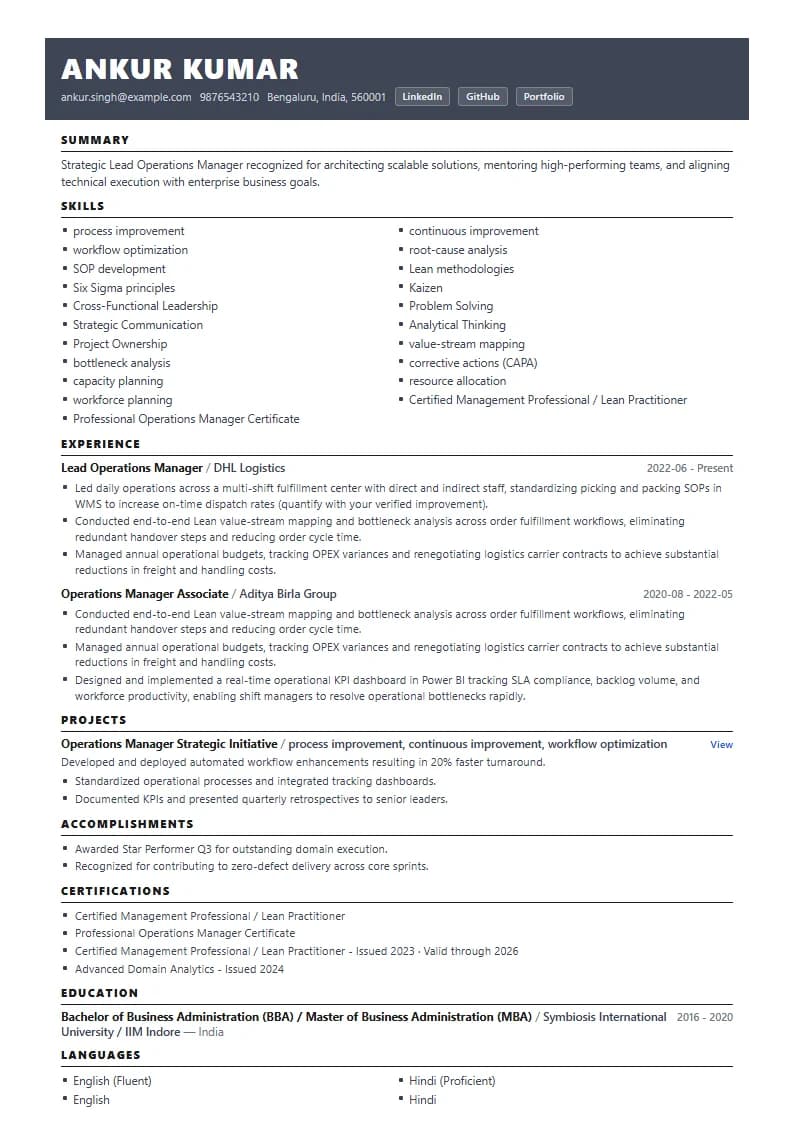

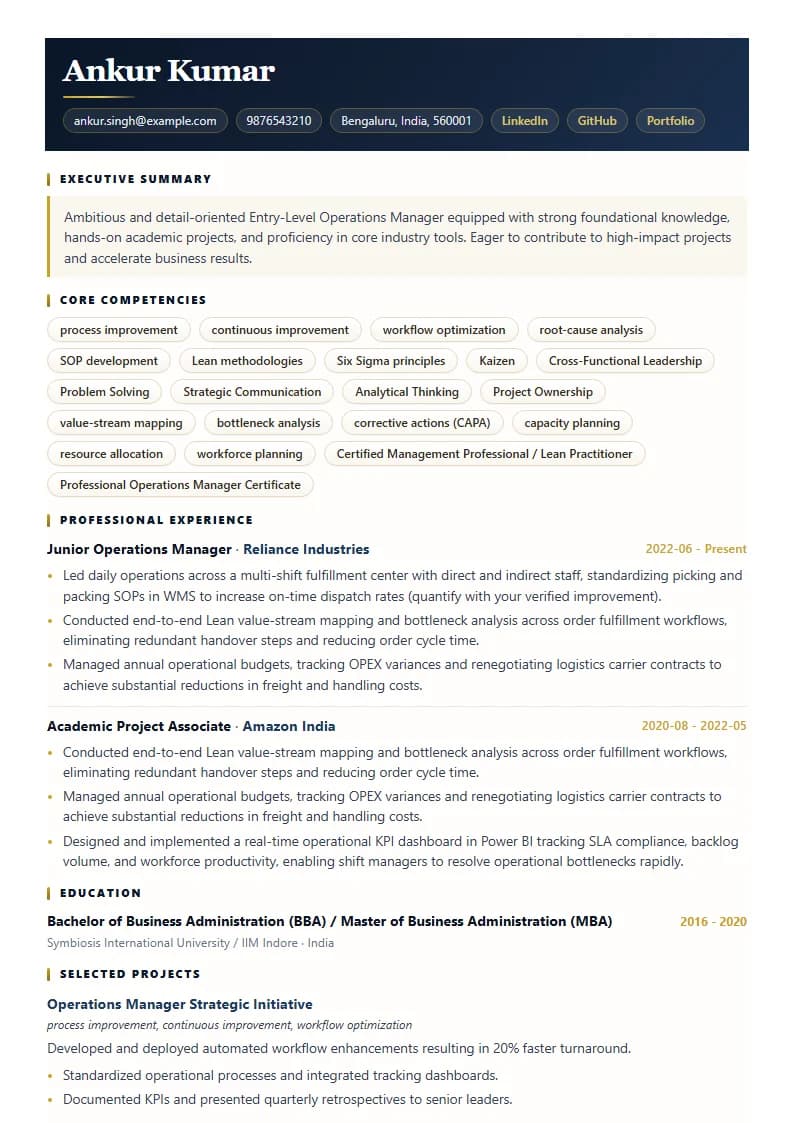
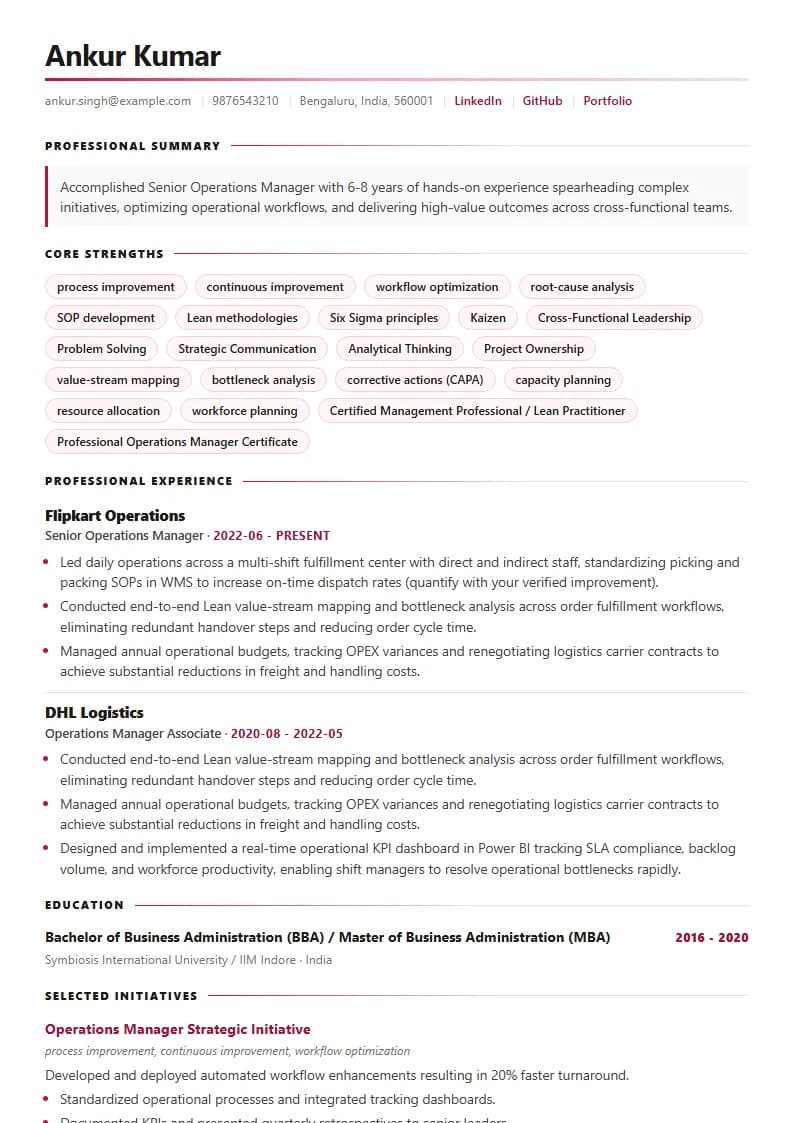
Senior Operations Manager Resume Example using Timeless Serif Classic template layout
Featured Example

Operations Manager Resume Examples & ATS Guide for 2026

Create an Operations Manager resume that clearly demonstrates process improvement, operational leadership, team and resource management, systems expertise, KPI ownership and measurable business outcomes. Review examples across business, logistics, manufacturing, service and technical operations, then compare your resume with a real Operations Manager job description using GyanBatua.
Updated August 2026·6 min read·Reviewed by Arvind Tyagi · Senior Project Delivery Manager, Operational Excellence & Delivery
Core Focus & HighlightsVerified August 2026

What Should an Operations Manager Resume Highlight?

A strong Operations Manager resume should show the operating environment you managed, the people, processes, budgets or resources within your scope, the systems and methods you used, and the measurable outcomes of your decisions. Where genuine, demonstrate improvements in cost, productivity, quality, cycle time, service levels, inventory, delivery or capacity. Tailor the emphasis to the employer's industry because operations responsibilities vary considerably across business, manufacturing, logistics, retail and technology environments.

Resume Sample

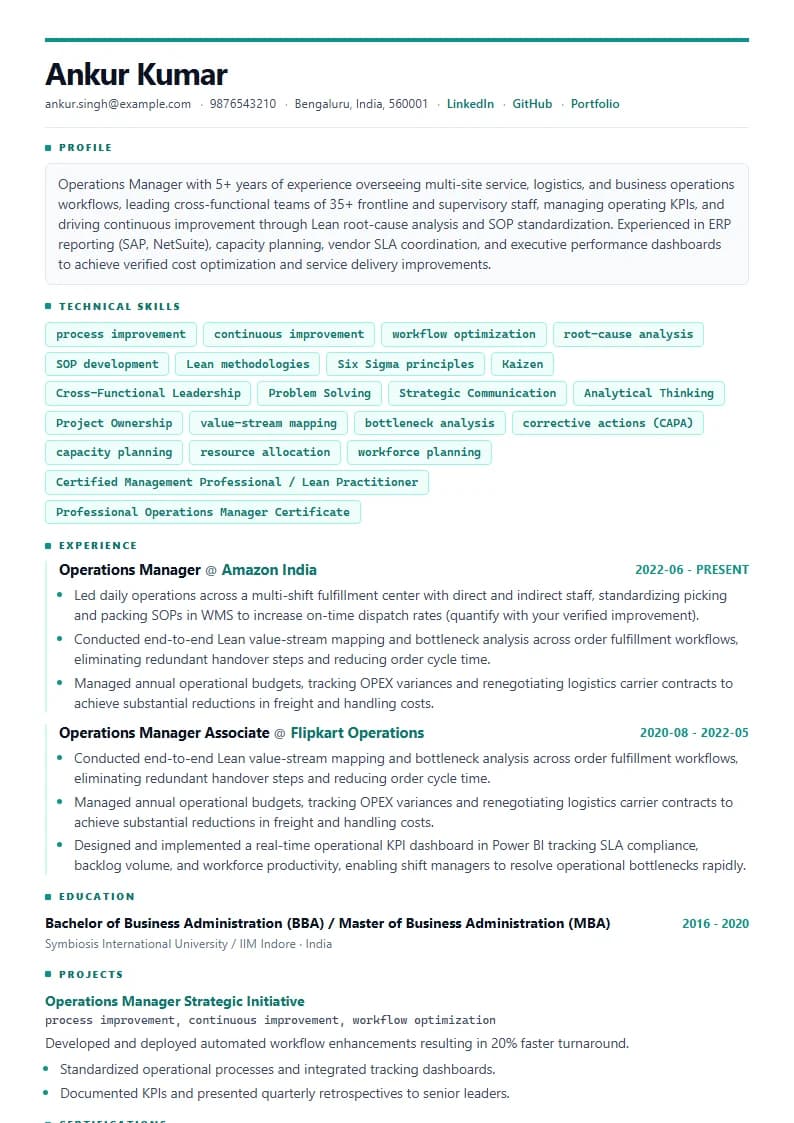
Operations Manager Resume Sample

Usable resume sample showing summary structure, categorized skills, and effective experience bullets.

Professional Summary Example

Operations Manager with 5+ years of experience overseeing multi-site service, logistics, and business operations workflows, leading cross-functional teams of 35+ frontline and supervisory staff, managing operating KPIs, and driving continuous improvement through Lean root-cause analysis and SOP standardization. Experienced in ERP reporting (SAP, NetSuite), capacity planning, vendor SLA coordination, and executive performance dashboards to achieve verified cost optimization and service delivery improvements.

Experience Bullet Examples

  • Led daily operations across a multi-shift fulfillment center with direct and indirect staff, standardizing picking and packing SOPs in WMS to increase on-time dispatch rates (quantify with your verified improvement).
  • Conducted end-to-end Lean value-stream mapping and bottleneck analysis across order fulfillment workflows, eliminating redundant handover steps and reducing order cycle time.
  • Managed annual operational budgets, tracking OPEX variances and renegotiating logistics carrier contracts to achieve substantial reductions in freight and handling costs.
  • Designed and implemented a real-time operational KPI dashboard in Power BI tracking SLA compliance, backlog volume, and workforce productivity, enabling shift managers to resolve operational bottlenecks rapidly.
Impact Guidance: Replace all sample operational metrics, savings, productivity gains, SLA results, inventory improvements, quality figures, budgets and team-size examples with your own verified information. Never invent operational performance data. When exact figures are confidential, describe team size, shift coverage, sites managed, vendor count, process volume, budget ranges, or operational scope truthfully.

Operations Projects: How to Present Process Improvements & Operational Initiatives on a Resume

Process improvement initiatives, SOP redesigns, warehouse reorganizations, and system implementations provide powerful proof of operational capability. Structure project entries using: Operational Challenge → Scope & Baseline → Methodology/System (Lean, Six Sigma, WMS, ERP) → Execution & Stakeholder Coordination → Documented Outcome. For early-career professionals or career changers, academic case studies, internship workflows, and volunteer coordination projects are valid when clearly labeled as non-commercial.

Fulfillment Workflow Standardization Initiative | Challenge: High order backlog and dispatch delays during peak volume. Scope: 30-person fulfillment facility. Methodology: Conducted 5-Why root-cause analysis, redesigned packing stations, and drafted revised SOPs. Tools: WMS tracking & Excel workflow model. Outcome: Streamlined order dispatch turnaround and significantly reduced backlog during peak fulfillment.

Competencies

Key Skills & Technical Keywords

Essential domain skills, frameworks and technologies commonly requested for operations manager positions.

Process Improvement & Operational Excellence
process improvementcontinuous improvementworkflow optimizationroot-cause analysisSOP developmentLean methodologiesSix Sigma principlesKaizenvalue-stream mappingbottleneck analysiscorrective actions (CAPA)
Operations Planning & Capacity
capacity planningresource allocationworkforce planningshift schedulingdemand planningoperational forecastingworkload balancingheadcount modeling
Team & Stakeholder Leadership
team leadershipsupervisor coachingcross-functional coordinationstakeholder managementescalation managementvendor managementchange managementconflict resolution
KPI, Financial & Performance Management
KPI managementoperational dashboardscost optimizationproductivity trackingbudget managementvariance analysisSLA performanceOPEX management
Supply Chain, Inventory & Service Operations
inventory managementwarehouse operationslogistics coordinationprocurement supportsupplier performanceorder fulfillmentservice deliverydispatch tracking
Systems, ERP & Operational Analytics
ERP systemsSAPOracle NetSuiteMicrosoft DynamicsWMSTMSMicrosoft Excel (advanced)Power BITableauJira workflows
Education & Certifications: Relevant education may include degrees in Business Administration, Operations Management, Supply Chain Management, Industrial Engineering, Commerce, or related disciplines. Relevant professional certifications include ASCM credentials (CPIM, CSCP), Lean Six Sigma Green/Black Belt, PMI Project Management Professional (PMP), or recognized supply chain/logistics certificates. Only list credentials you have genuinely earned.

Career Stages

Operations Manager Resume by Experience Level

Target key expectations based on your current career stage and technical range.

1Coordination, Scheduling & Process Support

Entry-Level / Operations Associate

Focus on operations internships, shift coordination, scheduling support, order processing, inventory audits, customer service operations, logistics tracking, SOP documentation, and analytical reporting in Excel. Highlight practical process improvement and academic/volunteer coordination projects without claiming unverified management authority.

2Daily Operations, Team Leadership & KPI Ownership

Mid-Level Operations Manager

Focus on end-to-end daily operations management, team leadership (supervisors and frontline teams), KPI and SLA ownership, workflow optimization, Lean continuous improvement, vendor coordination, and ERP/WMS system execution.

3Multi-Site Governance, Strategy & Budget Management

Senior Operations Manager

Focus on multi-site or regional operations governance, strategic capacity planning, large-scale budget/OPEX ownership, operational transformation, cross-functional stakeholder leadership, leadership coaching, and organizational scalability.

4Cross-Functional Processes, Strategy & Analytics

Business Operations Manager

Focus on internal business processes, cross-functional execution across sales, product, and finance, strategic initiative delivery, operational analytics (Power BI, SQL, advanced modeling), workflow automation, and enterprise efficiency.

5Inventory Control, WMS & Fulfillment Logistics

Logistics & Warehouse Operations Manager

Focus on warehouse flows, inventory accuracy, receiving/storage/dispatch, WMS administration, transportation coordination, labor planning, shift management, freight cost control, and on-time delivery SLAs.

6Plant Operations, Lean Production & Quality Control

Manufacturing & Production Operations Manager

Focus on plant operations, production planning, throughput optimization, Lean manufacturing (Kaizen, 5S, DMAIC), equipment uptime/maintenance workflows, safety SOP compliance, and quality control systems.

JD Tailoring Steps

How to Tailor an Operations Manager Resume to a Job Description

Follow these structured steps to align your resume with target job descriptions accurately.

1

Analyze Operating Model & Scale

Identify whether the JD targets business, manufacturing, logistics, retail, or service operations. Note team size, shift coverage, facility scope, and budget expectations.

2

Align Systems, Methodologies & KPIs

Compare required tools like SAP, WMS, Power BI, Lean, Six Sigma, and operational KPIs against your verified background, highlighting direct matches without inflating responsibility.

3

Refine Bullets & Compare with GyanBatua

Structure achievements using Action → Problem → Method/Tool → Outcome. Compare your tailored resume with the real operations JD using GyanBatua to verify competency alignment and identify keyword focus areas before submitting.

Compliance & Formatting

ATS-Friendly Resume Checklist

Checklist6 items
Use clean, standard section headings: Professional Summary, Core Competencies, Work Experience, Process Improvement Projects, Education, and Certifications.
Align operational terminology with the target job description—whether the role emphasizes business operations (cross-functional workflows, analytics) or warehouse logistics (WMS, inventory accuracy, dispatch).
Connect enterprise systems (SAP, NetSuite, WMS, TMS, Power BI) directly to experience bullets showing how you utilized data to drive operational decisions.
Structure experience bullets using Action → Operational Challenge → Method/System → Context/Scale → Verified Outcome.
Present operational metrics (cost optimization, SLA attainment, cycle time reduction, throughput) with explicit context and include only verified data.
Avoid keyword stuffing and complex multi-column layouts or graphics that can hinder automated document parsing.

Want to know if your resume is ATS-friendly? Check it with our free AI tool below!

Is your resume good enough?

Drop your resume here or . PDF & DOCX only. Max 5MB file size.

🔒We never share your data with 3rd parties or use it for AI model training.

Help & FAQ

Operations Manager resume: frequently asked questions

Direct answers to common Operations Manager resume questions

What should an Operations Manager resume include?
An Operations Manager resume should include: a clean header with contact details and LinkedIn profile link; a focused professional summary highlighting your operating environment, scale of leadership, and verified impact; grouped skills covering process improvement, capacity planning, team leadership, KPI/financial management, and ERP/operations systems; work experience bullets structured in the Action → Problem → Method/Tool → Outcome format with quantified metrics; a process improvement projects section; and education with relevant certifications (e.g., Lean Six Sigma, CPIM, PMP). Ensure the resume directly addresses the operating context of the target job description.
What skills should I put on an Operations Manager resume?
Group operations skills into clear functional categories: Process Improvement (continuous improvement, Lean, Six Sigma, root-cause analysis, SOP development, value-stream mapping); Operations Planning (capacity planning, workforce scheduling, resource allocation, demand forecasting); Leadership (team leadership, supervisor coaching, cross-functional alignment, vendor management); Financial & Performance Management (KPI tracking, cost optimization, budget management, SLA management); and Systems & Analytics (ERP platforms like SAP or NetSuite, WMS, TMS, Excel, Power BI). Prioritize the specific competencies emphasized in the target job description.
How do I write an Operations Manager resume with no direct management experience?
If you have not held a formal Operations Manager title, highlight transferable operational competencies: Operations Associate, team lead, project coordinator, logistics coordinator, or customer support operations experience. Detail shift scheduling, process documentation, inventory audits, quality checks, data reporting in Excel, and workflow improvements you contributed to. Structure entries using: Objective → Role & Scope → Method Used → Documented Outcome. Transparently label academic case studies and volunteer coordination projects rather than claiming unverified managerial or budget authority.
What makes a strong Operations Manager resume summary?
A strong Operations Manager summary is concise (3–4 sentences) and follows the formula: Role Title & Experience + Operating Environment + Scope of Leadership/Budgets + Key Methodologies/Systems + Verified Impact. Avoid empty buzzwords like 'visionary leader' or 'results-driven professional'. Example: 'Operations Manager with 5+ years of experience overseeing multi-site fulfillment and service operations with 35+ frontline staff. Skilled in Lean continuous improvement, SOP standardization, SAP ERP, and Power BI dashboards, partnering with cross-functional leaders to reduce fulfillment cycle times and optimize operating costs.'
What metrics should I include on an Operations Manager resume?
Include verified metrics that reflect operational efficiency, cost management, quality, service delivery, and team scale: cycle time or turnaround time reduction, SLA attainment rate, on-time delivery percentage, cost savings, overtime reduction, inventory accuracy, scrap/defect rate improvement, team size led, facility square footage, and budget managed. When exact corporate metrics are confidential, describe scope truthfully: number of shifts, headcount, sites managed, vendor contracts overseen, or operating volume handled. Never invent operational performance figures.
How should I describe process improvement on my resume?
Describe process improvement using the Action → Problem → Method/System → Scope → Outcome structure. State the operational bottleneck or inefficiency identified, the analytical method used (such as 5-Why root-cause analysis, value-stream mapping, or Kaizen events), the solution implemented (SOP redesign, workstation re-layout, system automation), and the measurable result. Example: 'Analyzed picking workflow bottlenecks in WMS, redesigned packing station layouts, and updated operational SOPs, reducing average order processing time across a 30-person shift.'
What tools and systems should Operations Managers list?
List only platforms you have genuinely used and that align with the target role. Common operational tools include: Enterprise ERP (SAP, Oracle NetSuite, Microsoft Dynamics); Logistics & Supply Chain (WMS, TMS, inventory management systems); Maintenance & Quality (QMS, CAPA systems, CMMS); and Analytics & Reporting (Microsoft Excel advanced models, Power BI, Tableau). Connect tools directly to experience bullets showing how you used them to monitor KPIs and guide decisions.
What is the difference between Business Operations, Logistics Operations, and Manufacturing Operations?
Business Operations focuses on cross-functional alignment, internal workflows, operational analytics, strategic planning, and interdepartmental efficiency (sales, marketing, finance, product). Logistics and Warehouse Operations centers on inventory management, storage, order fulfillment, transportation, WMS execution, and delivery SLAs. Manufacturing Operations focuses on production scheduling, plant throughput, machine uptime, quality control, safety compliance, and Lean manufacturing principles. Because titles vary by employer, the job description is the most reliable guide to actual role expectations.
How do I write a Warehouse or Logistics Operations Manager resume?
A Warehouse or Logistics Operations Manager resume should emphasize inventory accuracy, warehouse layout optimization, shift workforce planning, picking/packing throughput, dock-to-stock turnaround, freight carrier management, WMS/TMS administration, and safety compliance. Highlight metrics such as on-time in-full (OTIF) delivery, pick accuracy, shrinkage reduction, and storage density improvements.
How do I tailor an Operations Manager resume to a job description?
To tailor your resume: 1) Identify the operating environment (business, manufacturing, warehouse, retail, service) and seniority level in the JD. 2) Match the specific ERP/WMS systems, Lean methodologies, and KPI frameworks mentioned. 3) Reorder your skills and experience bullets so the most relevant operational achievements appear first. 4) Align your professional summary with the employer's core operational challenges. 5) Use GyanBatua's ATS checker to compare your resume against the target JD to identify any overlooked operational keywords or process signals before submitting.
What Operations Manager keywords are useful for ATS?
Useful ATS keywords depend on the target job description. Common categories include: Operational Excellence (process improvement, continuous improvement, Lean, Six Sigma, SOP, root-cause analysis, Kaizen); Planning (capacity planning, workforce scheduling, resource allocation); Performance & KPIs (SLA management, cycle time, throughput, cost optimization, productivity); Leadership (team leadership, vendor management, stakeholder alignment); and Systems (ERP, SAP, NetSuite, WMS, TMS, Power BI, Excel). Always ensure listed keywords reflect genuine experience.
How long should an Operations Manager resume be?
For many early- and mid-career Operations professionals, one page may be sufficient when it clearly presents relevant scope, skills, and outcomes. Senior Operations Managers, plant heads, or regional directors with extensive multi-site, multi-shift, transformation, and large-team leadership experience may use two pages when the additional information is directly relevant. Prioritize recent operational scope, verified metrics, and core systems over exhaustive listings of older roles.

Resume Diagnostic

Check Your Operations Manager Resume Against a Real Job Description

Upload your resume and paste the Operations Manager job description you are targeting. GyanBatua helps you compare your experience against required operating environments, methodologies, ERP tools, metrics, and leadership scope to identify focus areas before applying.

ATS OptimizedJD-TunedDiagnostic Assessment
Your resume data is private, secure, and used solely for diagnostic matching.