

Use This Resume
Entry-LevelTimeless Serif Classic
Create a Supply Chain or Logistics resume that clearly demonstrates planning, procurement, inventory, warehousing, transportation, supplier coordination, systems expertise and measurable supply-chain outcomes. Review examples across planning, logistics, warehouse, procurement and manager-level roles, then compare your resume with a real job description using GyanBatua.
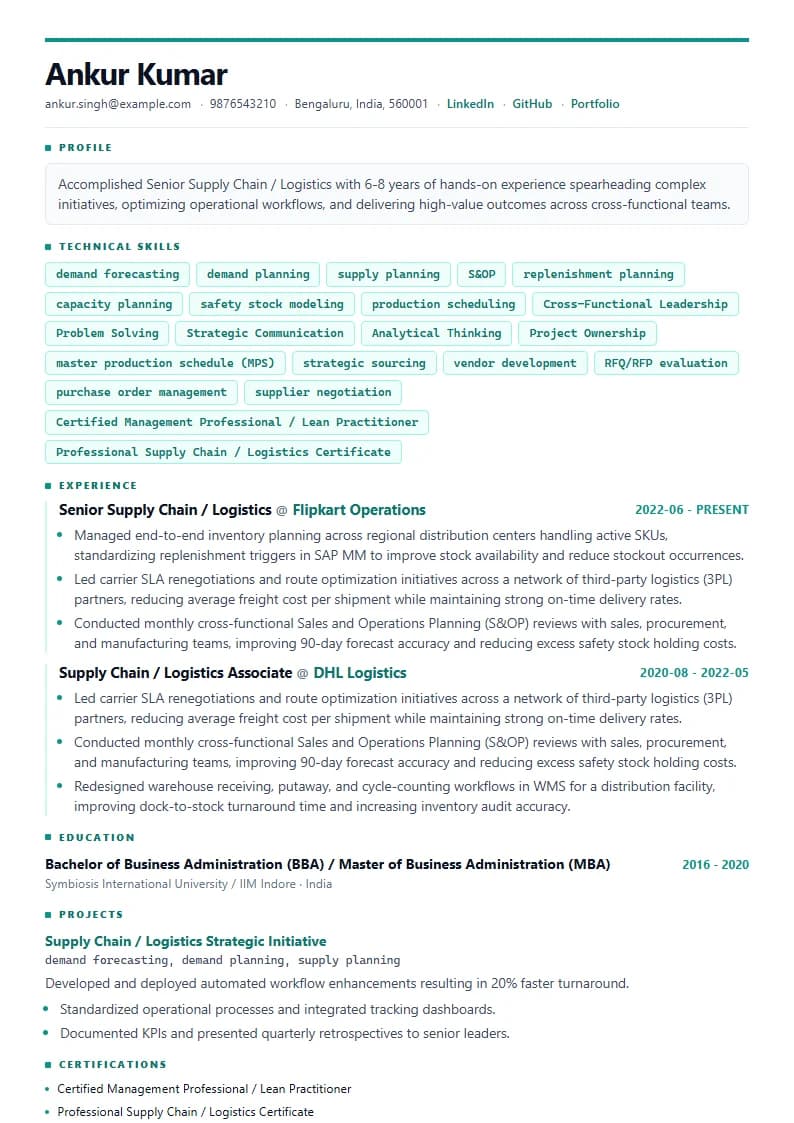
Recruiter-approved templates and real-world examples tailored for supply chain / logistics roles. Click any resume to customize in seconds.
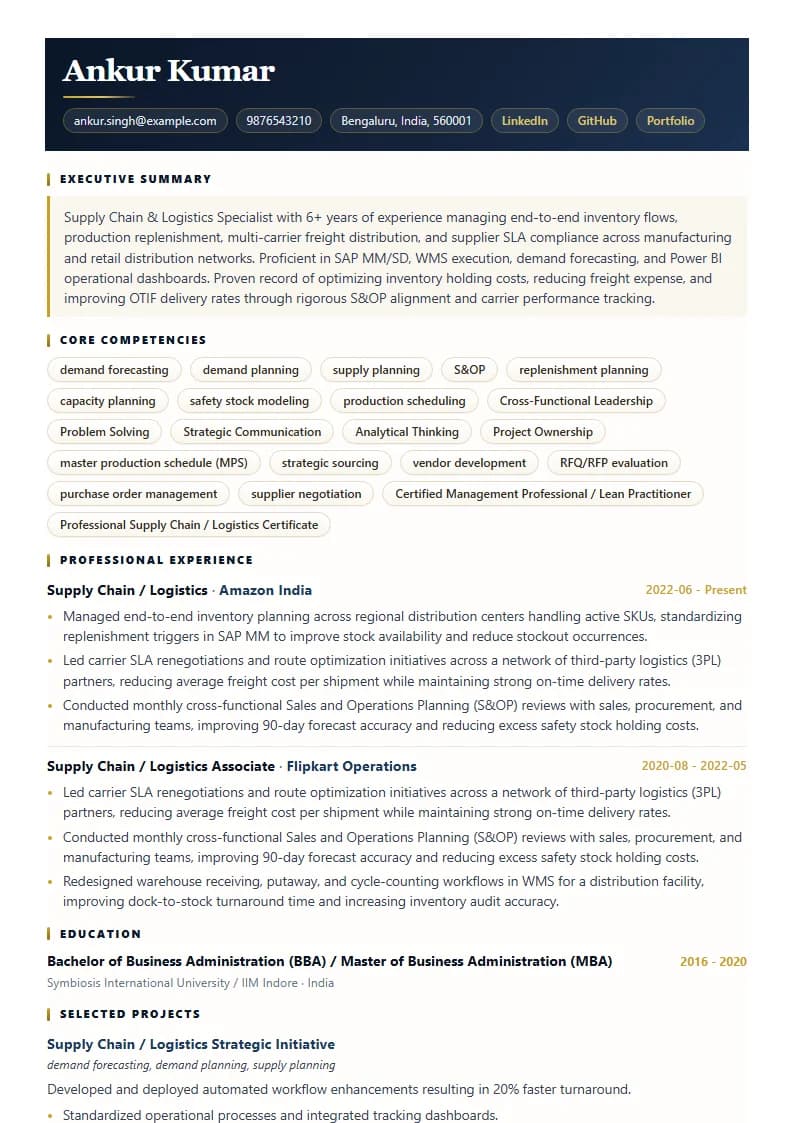
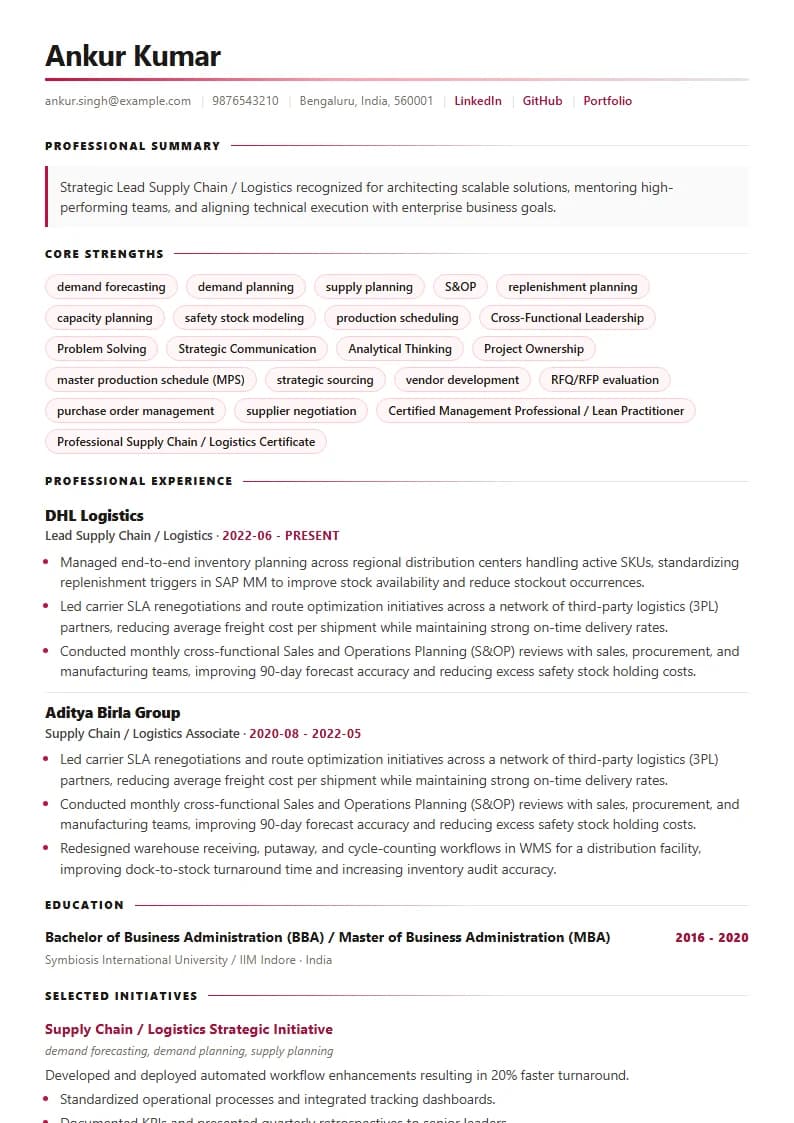
A strong Supply Chain or Logistics resume should show which parts of the supply chain you worked across, the scale of inventory or operations you supported, the suppliers, systems and transportation workflows you used, and the measurable outcomes of your decisions. Where genuine, demonstrate improvements in forecast accuracy, inventory turns, stock availability, lead time, freight cost, OTIF delivery, warehouse productivity or supplier performance. Tailor the emphasis to the target role.
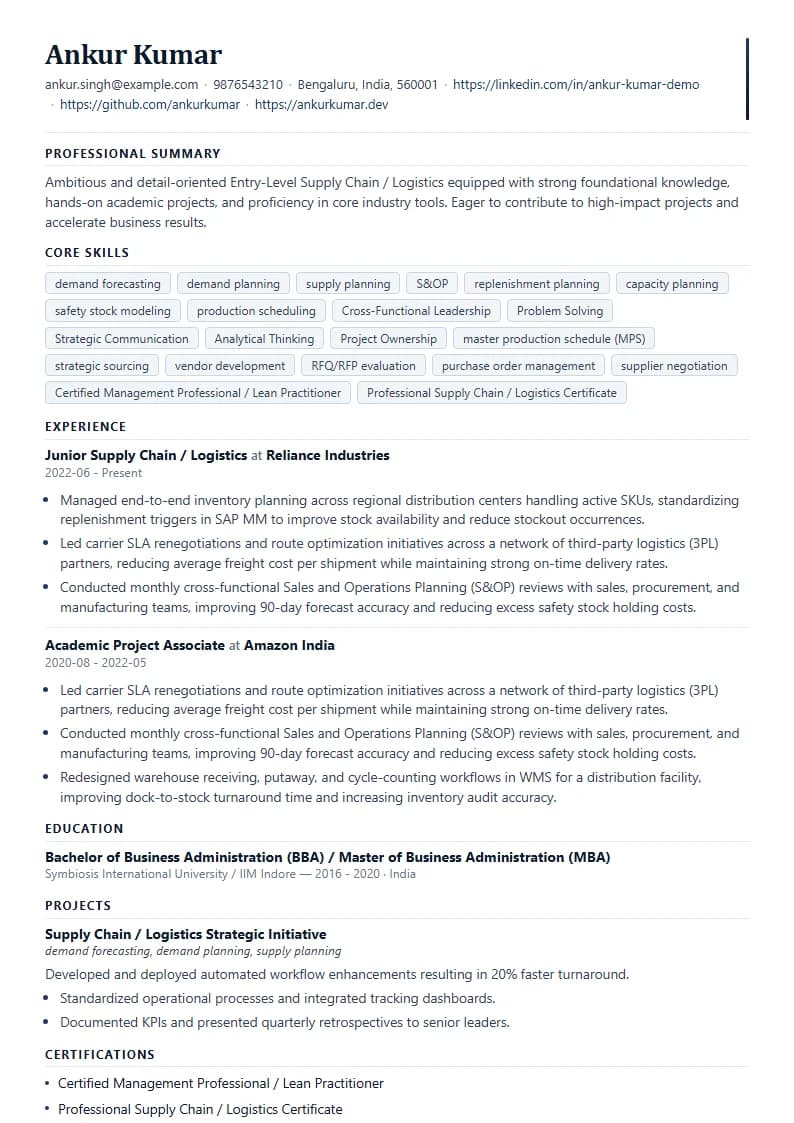
Usable resume sample showing summary structure, categorized skills, and effective experience bullets.
Supply Chain & Logistics Specialist with 6+ years of experience managing end-to-end inventory flows, production replenishment, multi-carrier freight distribution, and supplier SLA compliance across manufacturing and retail distribution networks. Proficient in SAP MM/SD, WMS execution, demand forecasting, and Power BI operational dashboards. Proven record of optimizing inventory holding costs, reducing freight expense, and improving OTIF delivery rates through rigorous S&OP alignment and carrier performance tracking.
Supply chain case studies, distribution network redesigns, inventory rationalizations, and ERP/WMS implementations provide tangible proof of supply chain capability. Structure project entries using: Supply Chain Challenge → Scope & Baseline → Methodology/System (SAP, WMS, TMS, S&OP, ABC Analysis) → Execution & Stakeholder Coordination → Documented Outcome. For early-career candidates, entry-level planners, or students, academic case studies, internship workflows, and simulation projects are valid when clearly labeled as non-commercial.
Distribution Network Freight Optimization Initiative | Challenge: Rising expedited shipping costs and sub-optimal regional carrier allocation. Scope: Regional fulfillment hubs shipping high-volume monthly consignments. Methodology: Analyzed 12-month freight rate data, consolidated LTL into FTL shipments, and integrated automated dispatch tracking in TMS. Tools: TMS, SAP SD & Power BI. Outcome: Successfully optimized regional freight spend and improved overall OTIF fulfillment rates.
Essential domain skills, frameworks and technologies commonly requested for supply chain / logistics positions.
Target key expectations based on your current career stage and technical range.
Audits, Order Tracking & Operational Support
Focus on supply-chain internships, inventory cycle counts, shipment tracking, purchase order processing, warehouse dispatch support, supplier follow-ups, and analytical reporting in Microsoft Excel. Highlight coursework in SCM, demand modeling, and academic case studies without claiming unverified vendor authority or budget ownership.
Forecasting, Inventory Modeling & BI Dashboards
Focus on demand and supply analysis, safety stock calculations, forecast variance modeling (MAPE), SKU rationalization, supplier OTIF scorecards, Power BI/Tableau reporting, and scenario planning across inventory and freight datasets.
End-to-End Coordination, S&OP & Inventory Governance
Focus on end-to-end material and information flow, monthly S&OP leadership, working capital optimization, multi-echelon inventory control, cross-functional alignment (sales, manufacturing, procurement), and enterprise ERP (SAP, Oracle) execution.
Carrier Management, Freight Optimization & 3PL SLAs
Focus on multi-modal freight operations, 3PL contract negotiations, carrier SLA compliance, route planning, fleet tracking, inbound/outbound logistics, freight cost per ton/pallet, customs clearance, and on-time delivery (OTD).
Facility Operations, WMS Execution & Inventory Accuracy
Focus on warehouse operations (receiving, putaway, picking, packing, dispatch), slotting optimization, WMS administration, labor shift planning, inventory audit accuracy, dock-to-stock cycle times, and facility safety SOPs.
Strategic Sourcing, Supplier Negotiation & Spend Management
Focus on category sourcing strategies, RFQ/RFP management, vendor price negotiations, supplier contract compliance, lead-time reduction, purchase price variance (PPV), vendor risk assessment, and procurement analytics.
Follow these structured steps to align your resume with target job descriptions accurately.
Determine whether the JD emphasizes demand planning, procurement, warehouse operations, freight logistics, or end-to-end supply chain leadership. Note SKU volume, facility footprint, geographic scope, and supplier scale.
Identify required platforms (SAP MM, Oracle SCM, WMS, TMS, Power BI) and metrics (OTIF, forecast accuracy, inventory turns, freight savings). Align your verified experience with these requirements without exaggerating ownership.
Structure experience bullets using Action → Problem → Tool/Method → Verified Outcome. Compare your resume against the target JD using GyanBatua to verify competency coverage and identify focus areas before applying.
Resume Diagnostic
Want to know if your resume is ATS-friendly? Check it with our free AI tool below!
Drop your resume here or . PDF & DOCX only. Max 5MB file size.
Direct answers to common Supply Chain and Logistics resume questions
Build yours next
Upload your resume and paste the Supply Chain or Logistics job description you are targeting. GyanBatua helps you compare your experience against required functions, methodologies, ERP/WMS tools, metrics, and operational scope to identify focus areas before applying.
Your resume data is private, secure, and used solely for diagnostic matching.