
Skill Gap Analysis for the Job You Actually Want
ઓવરવ્યૂ: Learn how to do skill gap analysis for the job you actually want. Find missing skills, proof gaps, and role-fit blockers before you apply.
Introduction
This article is the pillar for skill gap analysis: moving from vague worry to a clear picture of what is missing between you and the job you actually want. Supporting guides on resume–JD gaps, proof versus positioning, must-have skills by role, honest fresher proof, and a 30-day readiness sprint now extend this cluster on the blog.
A lot of candidates ask the wrong question during job search. They ask: Am I good enough? Should I apply anyway? Do I need another course? Is my resume the problem? Is the market just bad? These are understandable questions, but they are usually too emotional and too broad.
A much better question is: What exactly is missing between where I am now and the job I actually want? That is where skill gap analysis becomes useful.
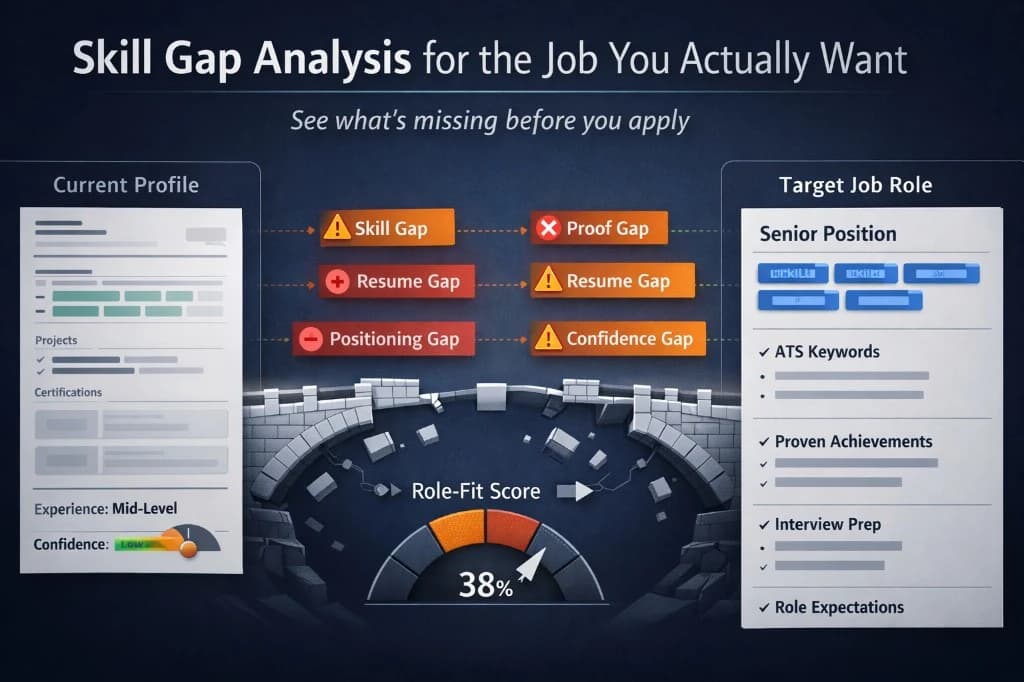
Because most job seekers are not dealing with one big problem. They are usually dealing with a mix of skill gaps, proof gaps, positioning gaps, resume gaps, confidence gaps, and targeting mistakes. If you do not separate those properly, you can waste a lot of time fixing the wrong thing.
- You may think you need another certification, but the real problem is weak project presentation.
- You may think your resume is weak, but the real problem is that you are targeting the wrong role.
- You may think you are not ready, but the real issue is not skill — it is visible proof.
- You may think you need to study everything, but the role may only require a few high-impact improvements.
That is why skill gap analysis matters. It helps you move from vague self-doubt to specific action. Instead of saying "I am not getting results," you can say "I am missing two tools, one proof layer, and better role-fit positioning." That is a much better place to operate from.
In this guide, we break down what skill gap analysis really means, why most candidates misdiagnose their problem, the difference between missing skills and missing proof, how to compare yourself with the role you want, how freshers should think about readiness, and what to fix before applying more widely.
What skill gap analysis actually means
Skill gap analysis means identifying the difference between what a target role expects and what your current profile currently shows. That profile includes actual skills, tools, experience, projects, certifications, communication of proof, and role-specific readiness.
This is important because a gap is not always about capability. Sometimes the gap is missing tool knowledge, weak project depth, poor resume wording, no role-specific examples, or not enough proof to create recruiter confidence. That means not every problem needs a course. Some problems need better project framing, better targeting, stronger portfolio proof, role-based resume tailoring, interview preparation, or skill visibility. If you call everything a skill gap, you will solve the wrong problems.
Why most candidates get this wrong
A lot of job seekers react to rejection in one of two ways. First, they panic and assume they know nothing, so they start collecting random courses and certifications. Second, they ignore all gaps and apply blindly, hoping something will work. Both are risky: the first creates overwhelm; the second creates repeated disappointment.
A smarter approach is diagnosis. Instead of reacting emotionally, you ask: what does this role actually require? What do I already have? What is partially there? What is truly missing? What can be improved quickly? What may take more time? That is how better job search decisions are made.
The 3 types of gaps candidates usually have
1. Real skill gaps
These are things you genuinely do not know or cannot do yet. Examples: a data role requires SQL, but you have never used it; a marketing role needs campaign reporting, but you have never worked with metrics; a software role needs APIs or Git, but you only know theory. These are actual capability gaps.
2. Proof gaps
You may know the skill, but your profile does not prove it well enough. Examples: you know Excel, but your resume does not show where you used it; you understand social media strategy, but your projects are described too vaguely; you know Power BI basics, but you have no project or dashboard to demonstrate it. These are proof problems, not always learning problems.
3. Positioning gaps
You may have the skill and some proof, but your profile is not aligned strongly enough to the role. Examples: your resume is too generic, your role direction is unclear, your skill order is weak, your experience bullets are too broad, or your project language is not role-aligned. This is where many capable candidates get stuck.
Why this matters so much before applying
If you do not know what gap you have, you will often apply to mismatched roles, over-learn and under-apply, keep changing the resume without fixing real readiness, take random courses, delay applying out of confusion, blame yourself too broadly, or blame ATS for everything. None of that creates strong momentum.
Skill gap analysis helps you focus. It tells you what to improve, what to stop overthinking, what to prove better, what to learn first, what role to target now, and what role may need more preparation. That is incredibly useful.
How to do skill gap analysis for a target job
Step 1: Choose one role, not five
Do not compare yourself to "jobs in general." Pick one role — for example data analyst intern, digital marketing executive, HR recruiter trainee, business development associate, operations coordinator, or frontend developer. The more specific the target, the more useful the analysis becomes.
Step 2: Study 5–10 JDs for that role
Do not rely on one JD. Look for patterns: repeated tools, responsibilities, skill terms, and business context. That helps you identify the actual market expectation.
Step 3: Create a skill map
Break the role into tools, functional skills, communication expectations, proof expectations, and domain context.
Step 4: Compare your current profile honestly
Divide what you find into strong match, partial match, real gap, proof gap, and positioning gap. This is the most important step.
Step 5: Prioritize what matters most
Do not try to fix everything at once. Usually, two to four improvements create most of the lift.
Example: skill gap analysis for a data analyst fresher
Suppose the role commonly asks for Excel, SQL, dashboards, reporting, data cleaning, and basic business insights. Your profile might look like: Excel yes; SQL partial; Power BI yes but basic; dashboards with one project; reporting with weak visibility; business insights with weak explanation.
Your gap may not be "I need to become an advanced data scientist." Your actual gaps may be stronger SQL basics, one better dashboard project, clearer reporting-related project wording, and stronger business interpretation in answers and on your resume. That is much more actionable.
Example: skill gap analysis for a marketing fresher
The role asks for social media execution, content planning, analytics, campaign support, and audience research. Your profile might be: content writing yes; social media handling yes; analytics weak; campaign examples weak; audience research partial.
Your next best moves may be: learn basic campaign metrics, build one campaign analysis project, improve resume project wording, and prepare role-specific interview examples. That is much better than randomly doing five unrelated courses.
What freshers should understand about skill gaps
Freshers often think: "I have no experience, so I must have a huge skill gap." That is not always true. Freshers may already have foundational tools, relevant coursework, useful projects, mini-internships, role-relevant certifications, practical assignments, or campus work that maps to job responsibilities.
The problem is often not zero readiness. The problem is unclear proof. Freshers should ask: which skills do I actually have? Which ones need stronger proof? Which ones need one good project? Which ones are true gaps? What role can I credibly target right now? That is a much more productive way to think.
The danger of fixing the wrong gap
A lot of candidates lose time here. They see poor results and respond by buying another course, rewriting the resume again and again, applying to more roles, watching motivational videos, or learning advanced topics too early. But if the real problem is a proof gap, those actions do not solve much. That is why diagnosis matters.
- If the problem is a skill gap → learn.
- If the problem is a proof gap → build a project, example, portfolio, or visible outcome.
- If the problem is a positioning gap → rewrite, reorder, and tailor.
- If the problem is a targeting gap → change the roles you apply for.
This is the logic strong candidates use.
A practical skill gap framework
Before your next applications, use this skill gap readiness framework.
Visual framework
- 1
Target one role
What exact job am I preparing for?
- 2
Identify market expectations
What do 5–10 JDs repeatedly ask for?
- 3
Map your current profile
What tools, skills, and proof do I already have?
- 4
Separate the gaps
Which are real skill gaps, proof gaps, or positioning gaps?
- 5
Prioritize highest-impact fixes
What 2–4 things will improve readiness fastest?
- 6
Fix before scaling applications
Improve conversion, then increase volume.
Final thought
Skill gap analysis is not about making you feel "not enough." It is supposed to do the opposite: turn confusion into clarity. Once you know what is actually missing, you stop wasting effort. You stop over-learning, over-applying, under-targeting, and guessing, and you start improving in a smarter way.
The best job search strategy is not "learn everything." It is: know what this role needs, know what you already have, and fix the highest-value gaps first. That is how real readiness gets built.
Related reading on GyanBatua
Pair this pillar with:
- How to Find the Skill Gaps Between Your Resume and the Job Description
- Skill Gap vs Positioning Problem: What Is Actually Blocking You?
- Must-Have Skills by Role: Marketing, Data, HR, Sales, Software, Operations
- How Freshers Can Build Missing Proof Without Faking Experience
- 30-Day Plan to Close Skill Gaps Before You Apply
- How to Match Your Resume to a Job Description Before You Apply
- Resume vs Role Fit: What Recruiters Notice First
- How to Prepare for Interviews Role-by-Role
Closing section
FAQ
Resume guides
Related Resume Guides
પ્રાઇસિંગ
તમારો પ્લાન પસંદ કરો અને ઝડપથી શરૂઆત કરો
ફીચર્સ, ભાવ અને ઉપયોગ સ્પષ્ટ રીતે સરખાવો, પછી તમારા લક્ષ્યને અનુરૂપ પ્લાન પસંદ કરો.
આગલું પગલું
તમારા રેઝ્યૂમેને સાચા જૉબ ડિસ્ક્રિપ્શન સામે ચકાસો
Apply પહેલાં JD match, keyword visibility અને skill gaps જુઓ.
સંબંધિત વાંચન
5તાજેતરના લેખો
6