
Why You’re Qualified but Still Not Getting Shortlisted
ઓવરવ્યૂ: Qualified but still not getting shortlisted? Learn the real reasons job applications fail and how to improve resume fit, ATS visibility, and interview chances.
Introduction
You know that feeling when you look at a job and think,
“I can actually do this.”
- You have the right degree.
- You have some projects.
- Maybe an internship.
- Maybe certifications.
- Maybe good academic performance.
- Maybe even decent communication and confidence.
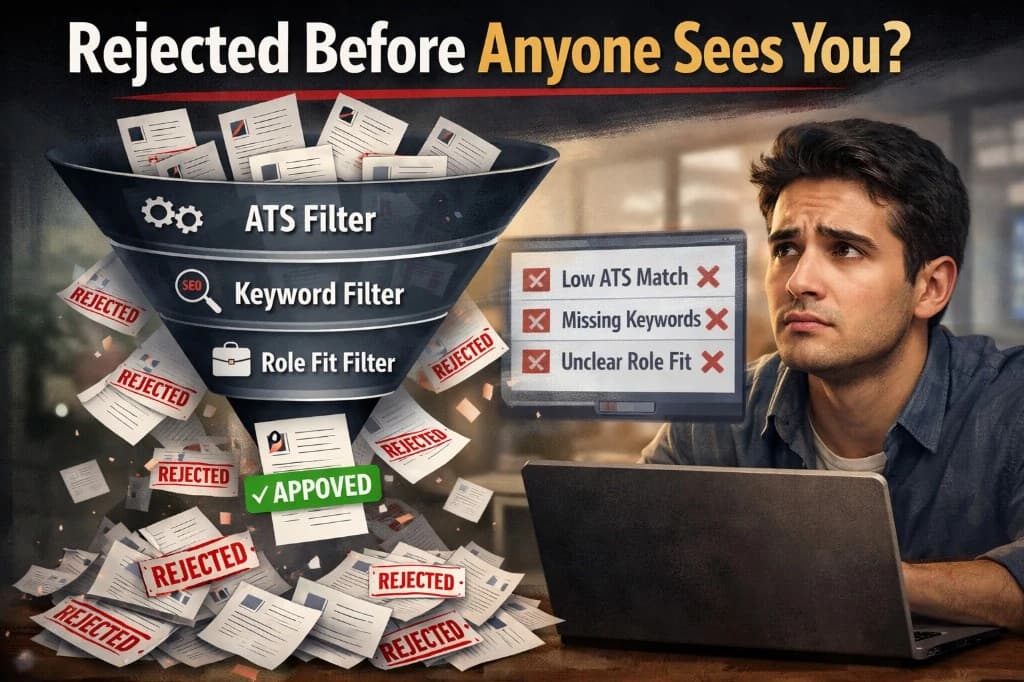
Still, no shortlist. No interview call. No recruiter response. Sometimes not even a rejection email.
That can be incredibly frustrating, especially when you know you are not randomly applying. You genuinely feel you are qualified.
But here is the hard truth: Being qualified is not always enough.
In hiring, it is not just about whether you can do the role. It is also about whether your resume and application make that fit visible quickly.
That is where many capable candidates lose. Not because they are weak. Not because they have no potential. But because their relevance is not being communicated clearly enough.
A recruiter does not meet your full personality first. They do not see your effort first. They do not see your learning attitude first. They see your application first.
And your application has one job: make your fit easy to understand.
In this guide, we will break down:
- why qualified candidates still get ignored
- what recruiters actually notice first
- why role-fit visibility matters more than people think
- what freshers and students usually get wrong
- what to fix before sending more applications
The biggest misunderstanding in job search
A lot of candidates think the hiring logic is simple: qualified person = shortlist
In reality, it often looks more like this: clear role-fit + visible proof + relevant language + easy-to-scan resume = shortlist chance
This is a very important difference. Because if your resume is generic, unclear, broad, or poorly structured, even a capable profile can get skipped.
That is why two candidates with similar ability can get very different results. One gets shortlisted. The other gets ignored. The gap is often not talent. The gap is fit visibility.
What “qualified” means to you vs what it means to hiring teams
This is where confusion begins.
As a candidate, when you say “I am qualified,” you may mean:
- I studied relevant subjects
- I understand the basics
- I have done similar work in projects
- I can learn quickly
- I have the potential to perform well
But when a recruiter checks your resume, they are usually asking:
- What role does this person fit?
- Do I see the expected tools or skills?
- Is there proof that supports the claim?
- Does this resume look relevant for this exact job?
- Is this candidate strong enough to move to the next stage?
That means your internal confidence and the recruiter’s external judgment are not based on the same thing.
You may know you can do the role. But if the resume does not make that visible enough, the recruiter cannot assume it.
Why qualified candidates still do not get shortlisted
There are a few common reasons.
1. The resume is too generic
This is one of the biggest problems.
A lot of candidates build one resume and use it everywhere:
- marketing roles
- operations roles
- HR roles
- analyst roles
- sales roles
- internships
- entry-level jobs
That feels efficient, but it usually weakens shortlisting. Because now the recruiter is looking at a profile that feels broad instead of specific. And broad often feels weaker than focused.
2. The top half of the resume is weak
The top half matters a lot. If the summary is vague, the skills are generic, and the strongest proof is buried lower, shortlist chances drop.
The recruiter should not have to search hard to understand:
- what role you want
- what skills you bring
- what proof supports that fit
3. Your projects or internships are written too vaguely
This happens a lot with students and freshers.
Weak version:
- did a project on marketing
- worked on data analysis
- helped with hiring
- made a dashboard
These lines sound small, even when the work behind them may have been useful.
4. Your wording is not aligned to the job description
Sometimes the capability exists, but the presentation is weak.
For example, a JD might mention:
- stakeholder coordination
- reporting
- campaign execution
- SQL
- lead generation
- customer onboarding
You may have done related work, but your resume describes it using weaker or less relevant language. That makes the fit harder to detect.
5. You are applying to roles where your current proof is weaker than the role requires
This also happens. Sometimes the issue is not just the resume. It is the role selection.
You may be qualified in a broad sense, but not yet strong enough on paper for that specific opening. That is not failure. It is just a signal that targeting may need to improve.
What recruiters actually do in the first scan
Many candidates imagine recruiters reading deeply line by line. Usually, that is not what happens first. The first pass is often a quick scan.
The recruiter is trying to answer:
- What role is this person suitable for?
- Do I see the expected tools or skills?
- Does this profile feel relevant enough?
- Is there enough trust to keep reading?
- Is this worth shortlisting?
This means your resume needs to work fast. Your resume is not only a background document. It is a decision-support document.
A good resume reduces decision effort. A weak resume increases confusion. And when recruiters are screening many profiles, confusion is expensive.
Why this problem is even more common for freshers
Freshers often think the reason is simple: “I am not getting shortlisted because I do not have enough experience.”
Sometimes that is partly true. But very often, the bigger problem is this: the fresher resume is not making the right signals visible enough
Recruiters do not expect freshers to have years of experience. But they do expect:
- role direction
- relevant skills
- useful project descriptions
- signs of seriousness
- practical proof of interest
- a clear match to the role
So the real fresher challenge is not “look senior.” It is: look relevant
That is where better positioning matters. Projects, internships, college work, campus leadership, volunteer work, certifications, case studies, and tool-based assignments can all help. But only if they are described properly.
7 signs you may be qualified but your fit is invisible
1. Your summary says almost nothing
A summary like this is weak: Motivated individual looking for a growth opportunity in a dynamic organization.
It sounds formal, but it says very little. It does not tell the recruiter:
- what role you want
- what relevant exposure you have
- why you fit this job
2. Your skills section is too random
A skill section should not be a dump of everything. It should highlight the skills that help the recruiter classify you for the role.
3. Your best proof is buried
If your strongest project, internship, or achievement is sitting too low, it loses power.
4. Your bullets show activity, not value
“Worked on social media” is weak. “Supported Instagram and LinkedIn content planning and campaign execution for engagement growth” is stronger.
5. Your resume does not reflect the JD enough
If the JD is asking for certain role signals and your resume does not surface them clearly, relevance drops.
6. You apply to too many different role types
That creates mixed positioning.
7. You are increasing application volume instead of fixing the application system
More applications do not fix weak conversion.
What to fix first
Fix 1: Choose one role family at a time
At minimum, build role-family versions such as:
- marketing
- data
- HR
- software
- operations
- sales
This alone improves clarity.
Fix 2: Rewrite the top half
The top half should quickly communicate:
- target role
- relevant skills
- strongest fit signals
- seriousness of application
Fix 3: Improve how projects are described
For example: Weak: Did a data project. Better: Built a data analysis project using Excel and Power BI to clean data, track trends, and present insights visually.
Fix 4: Match the resume to the JD
Before applying, identify:
- key skills
- tools
- core responsibilities
- role language
- outcome language
Then reflect those honestly where relevant.
Fix 5: Remove clutter
Every line should answer one question: Does this improve my fit for this role? If not, it may need to go.
A simple shortlist framework
Before your next application, check:
- Role clarity: Can the recruiter tell what role I fit?
- Skill visibility: Are the right skills easy to spot?
- Proof quality: Do projects, internships, or experience show tools, actions, and outputs?
- JD alignment: Does this resume match this role well enough?
- Top-half strength: Does the first screen look strong?
- Trust: Does the profile look credible and intentional?
- Relevance: If a recruiter scans this for 8 seconds, is the fit obvious?
That last question matters a lot. Because that is often the real test.
Final thought
If you are qualified but still not getting shortlisted, do not jump straight to the conclusion that you are not good enough.
Very often, the issue is not capability. It is communication of fit.
That is good news, because it means the problem is often fixable. A stronger job search is not just: more applications another template more keywords more random edits
A stronger job search is: clearer targeting better resume–JD alignment stronger project and internship descriptions better top-half clarity more visible proof of fit
Because in hiring, being capable matters. But being clearly relevant matters first.
Closing section
FAQ
Resume guides
Related Resume Guides
પ્રાઇસિંગ
તમારો પ્લાન પસંદ કરો અને ઝડપથી શરૂઆત કરો
ફીચર્સ, ભાવ અને ઉપયોગ સ્પષ્ટ રીતે સરખાવો, પછી તમારા લક્ષ્યને અનુરૂપ પ્લાન પસંદ કરો.
આગલું પગલું
તમારા રેઝ્યૂમેને સાચા જૉબ ડિસ્ક્રિપ્શન સામે ચકાસો
Apply પહેલાં JD match, keyword visibility અને skill gaps જુઓ.
સંબંધિત વાંચન
13તાજેતરના લેખો
6