

ATS Is Not the Only Reason You’re Not Getting Shortlisted
అవలోకనం: ATS matters, but it is not the only reason candidates miss shortlists. Learn what else hurts resume performance, including weak fit and vague proof.

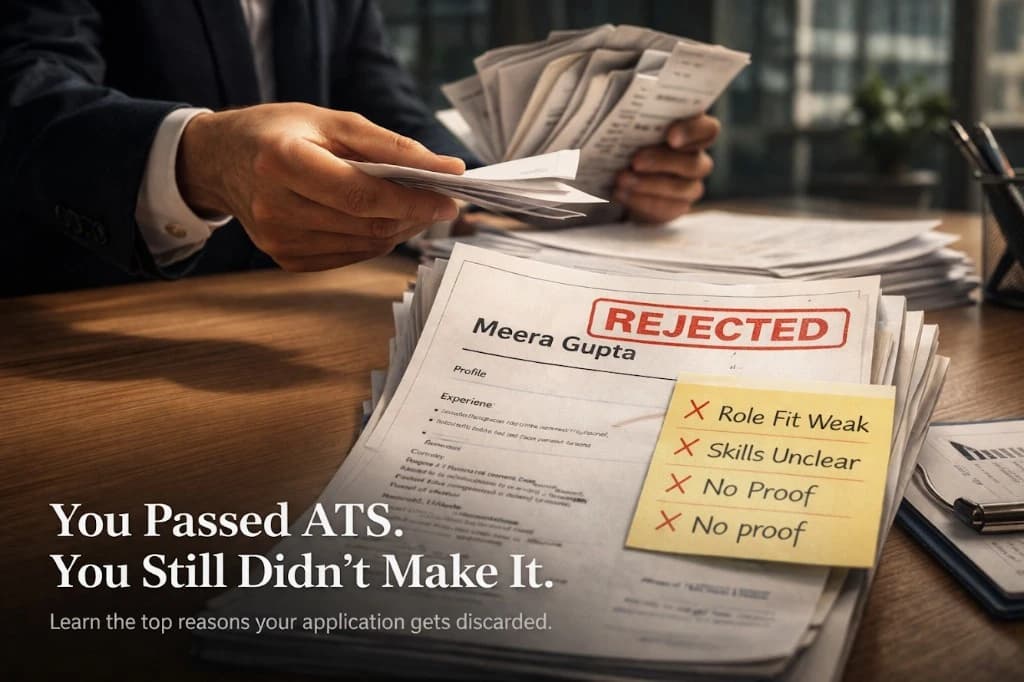
Introduction
A lot of candidates blame ATS for everything.
No interview call? ATS. No response? ATS. Resume rejected? ATS.
Yes, ATS can absolutely matter. But it is not the full story.
This is important because when you blame everything on ATS, you may miss the real reason your applications are failing.
Sometimes the real issue is:
- weak role targeting
- poor top-half clarity
- vague project descriptions
- generic wording
- low proof quality
- mixed role signals
- weak JD alignment
So yes, ATS matters. But it is not the only thing that decides whether your resume moves forward.
What ATS can affect
ATS can influence things like:
- keyword visibility
- resume parsing
- section recognition
- formatting readability
- consistency of structure
So if your resume uses:
- unusual formatting
- hard-to-read layouts
- image-heavy sections
- unclear labels
- weird structure
it may reduce readability for systems and screening workflows. That part is real.
But many candidates stop the diagnosis there. That is the mistake.
A resume can be ATS-friendly and still fail
This is the part many people ignore.
A resume can be technically readable and still perform badly because:
- it feels too generic
- it does not show the right role-fit
- the best proof is hidden
- projects sound weak
- the summary says nothing useful
- the profile looks broad instead of aligned
In other words: an ATS-friendly resume is not automatically a shortlist-friendly resume That distinction matters a lot.
What humans still notice after ATS
Even if your resume clears a system filter, a human still evaluates it. That human is asking:
- does this profile look relevant?
- is the role fit clear?
- do I trust this candidate enough to move forward?
- do I see the right tools or responsibilities?
- does this resume feel intentional or generic?
This is why two candidates with equally ATS-friendly resumes can get very different outcomes.
One feels aligned. The other feels broad.
One shows proof clearly. The other sounds vague.
One reduces recruiter doubt. The other increases it.
Common non-ATS reasons candidates do not get shortlisted
1. Weak summary
A vague summary does not help the recruiter place you.
2. Poor skill prioritization
The right skills are buried under low-value ones.
3. Generic project descriptions
This is especially damaging for freshers.
4. Mixed role targeting
The resume tries to fit too many different roles.
5. Weak bullets
The work may be good, but the writing hides it.
6. Low JD alignment
You may be relevant, but your resume does not make it visible enough for that role.
What students and freshers should understand
Freshers often hear “make your resume ATS-friendly” and think that is the whole game.
It is not.
A fresher resume also needs:
- role direction
- better project framing
- visible tools
- stronger summaries
- clearer internship relevance
- intentional ordering
A resume can be technically clean but still look weak if the content is not helping the recruiter understand the fit.
Better question to ask
Instead of only asking: “Is my resume ATS-friendly?”
Ask:
- Is my role-fit clear?
- Are the right skills visible?
- Are my projects written like proof?
- Does the resume match this JD well enough?
- Can a recruiter understand my relevance fast?
Those questions lead to better fixes.
Final thought
ATS matters. But ATS is not the only reason applications fail.
If your resume is readable but still not converting, the issue may be:
- weak role clarity
- weak project framing
- poor targeting
- vague proof
- low perceived fit
That is why better shortlisting comes from both: technical readability strategic relevance
You need both.
Closing section
FAQ
Resume guides
Related Resume Guides
About the Author
Vice President at Mobiloitte
Vice President at Mobiloitte, focusing on AI-first digital initiatives, resume optimization engines, and placement outcomes.
ప్రైసింగ్
మీ ప్లాన్ ఎంచుకుని త్వరగా ప్రారంభించండి
ఫీచర్లు, ధరలు, వినియోగం స్పష్టంగా పోల్చి, మీ లక్ష్యానికి సరిపడే ప్లాన్ ఎంచుకోండి.
తదుపరి దశ
మీ రెజ్యూమేను నిజమైన జాబ్ డిస్క్రిప్షన్తో చెక్ చేయండి
Apply చేయడానికి ముందు JD match, keyword visibility, మరియు skill gaps చూడండి.
సంబంధిత చదువు
13తాజా వ్యాసాలు
6