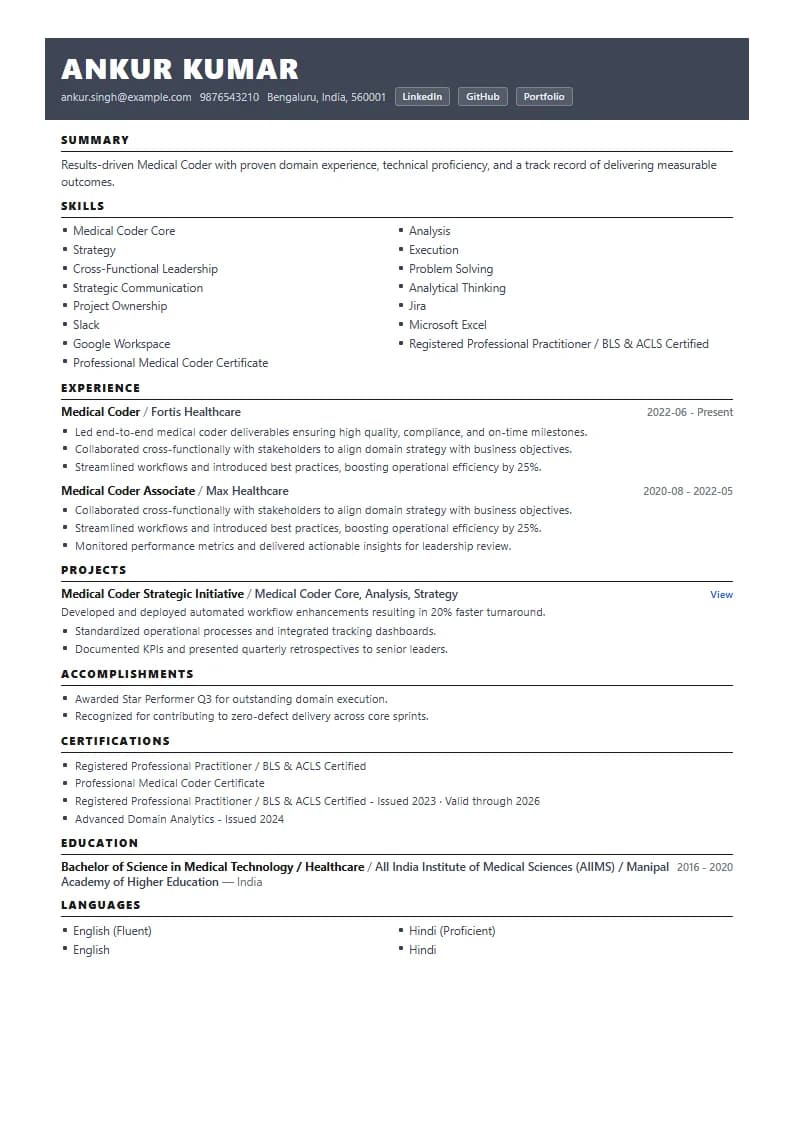

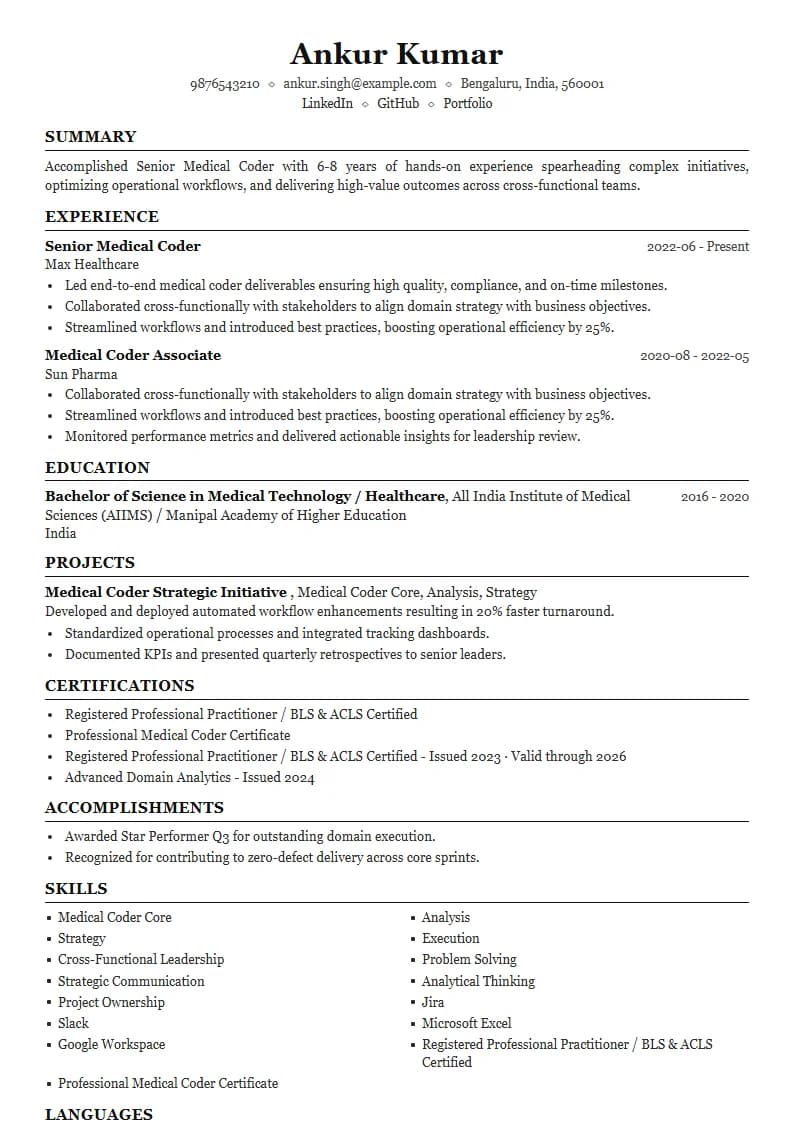
Senior Medical Coder Resume Example using Executive Onyx Gold template layout
Featured Example

Medical Coder Resume Examples & ATS Guide

Build a Medical Coder resume that demonstrates your medical classification expertise, coding accuracy rates, official AAPC / AHIMA credentials (CPC, CCS, CIC), chart auditing depth, and healthcare revenue cycle management (RCM) fluency. Align your coding experience with target healthcare BPO, hospital, or US healthcare provider job descriptions before applying.
Updated August 2026·6 min read·Reviewed by Deepti Sahni · Director - HR & Corporate Relations, Health Information & RCM Sourcing
Core Focus & HighlightsVerified August 2026

What Should a Medical Coder Resume Highlight?

A Medical Coder resume should clearly showcase your certified coding credentials (CPC, CCS, CIC, COC), medical coding classification systems (ICD-10-CM, CPT, HCPCS Level II, ICD-10-PCS, DRG), medical specialty depth (Inpatient, Outpatient, Emergency Department, Surgery, or Radiology), and verified coding accuracy rates (95%+). Highlight encoder tools (3M, Optum), medical chart auditing, and HIPAA compliance matching the target employer.

Resume Sample

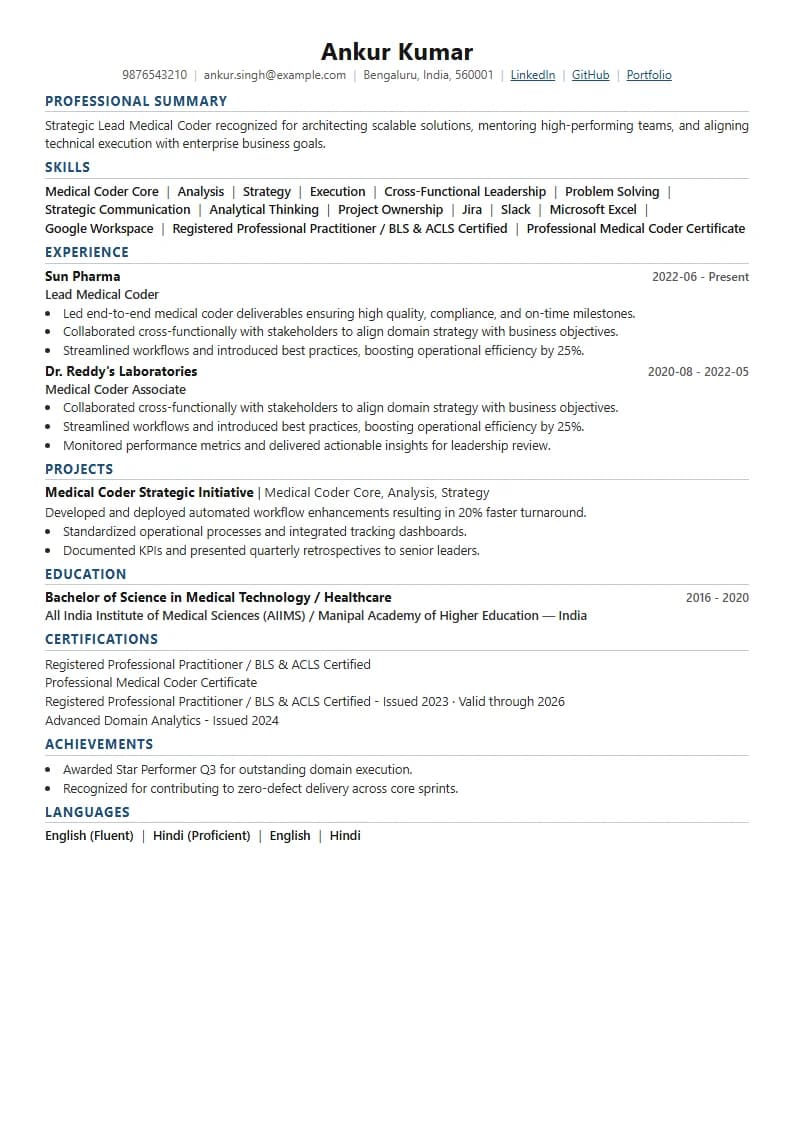
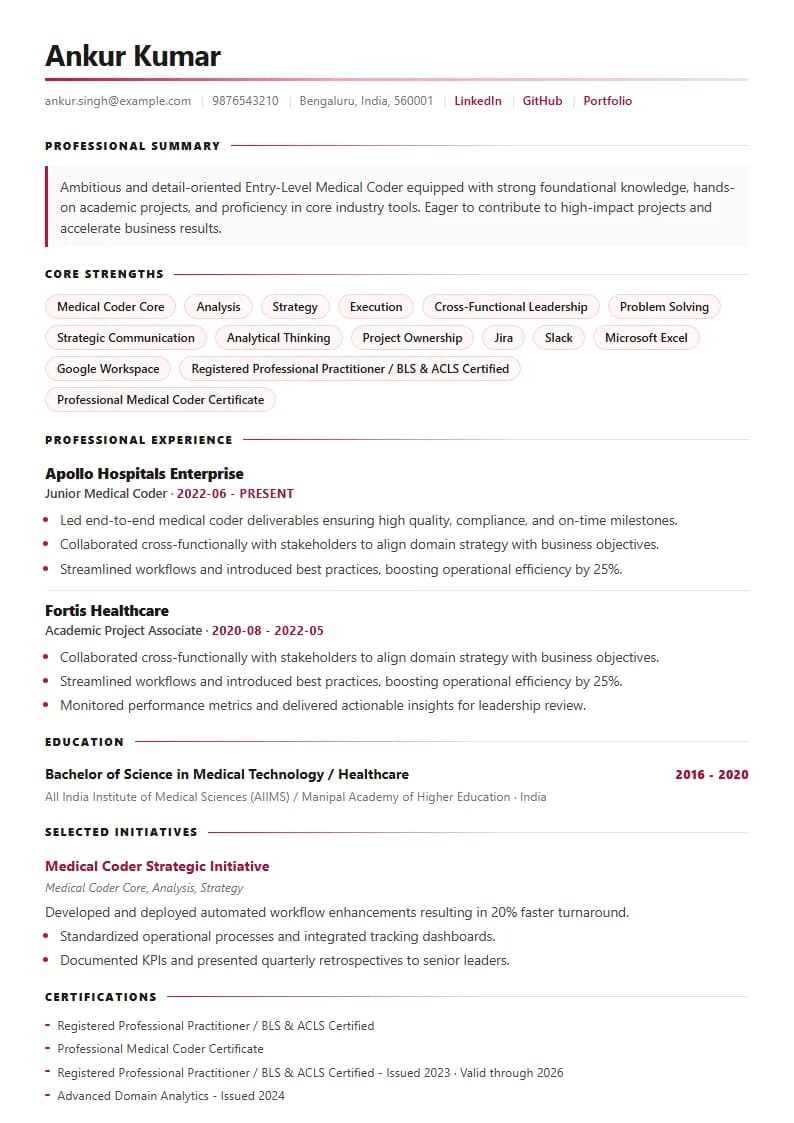
Medical Coder Resume Sample

Usable resume sample showing summary structure, categorized skills, and effective experience bullets.

Professional Summary Example

Certified Medical Coder (AAPC CPC / AHIMA CCS) with hands-on experience assigning accurate diagnosis and procedure codes for US healthcare providers across Outpatient, Inpatient (IP DRG), and Emergency Department (ED) medical charts. Proficient in ICD-10-CM, CPT, HCPCS Level II, 3M Encoder, claim denial management, and maintaining 98%+ coding accuracy under strict HIPAA compliance.

Experience Bullet Examples

  • Reviewed and assigned accurate ICD-10-CM, CPT, and HCPCS Level II codes for [X+ medical charts daily [illustrative sample — replace with your verified result]] across Emergency and Outpatient surgical specialties.
  • Maintained a verified coding quality and accuracy audit score of [98%+ [illustrative sample — replace with your verified result]], adhering to official CMS coding guidelines and NCCI edit rules.
  • Utilized 3M Encoder and Epic EHR systems to verify medical necessity documentation and resolve automated coding discrepancies before claim submission.
  • Collaborated with clinical documentation improvement (CDI) teams and drafted clear physician queries to clarify ambiguous clinical diagnoses and operative notes.
Impact Guidance: Quantify your daily chart production volume, quality audit percentage, claim denial reduction, or specialty case complexity with verified figures. Strictly protect patient health information (PHI).

Medical Chart Audit & Quality Framework

Structure medical coding achievements around chart volume, specialty complexity, accuracy audit results, and denial prevention.

Emergency Department E/M Coding Optimization | Scope: High-volume hospital ED chart backlog | Action: Audited physician documentation for medical decision making (MDM) leveling and trained junior coders on 2023 E/M guidelines | Outcome: Achieved 99% first-pass claim acceptance and reduced billing turnaround time.

Competencies

Key Skills & Technical Keywords

Essential domain skills, frameworks and technologies commonly requested for medical coder positions.

Coding Classification Systems & Manuals
ICD-10-CM (Diagnosis Coding)CPT (Current Procedural Terminology)HCPCS Level II (Supplies & Services)ICD-10-PCS (Inpatient Procedures)MS-DRG / APR-DRG GroupingE/M (Evaluation and Management) Coding
Clinical Specialties & Chart Types
Outpatient Hospital & Clinic CodingInpatient Chart AuditingEmergency Department (ED) CodingSame-Day Surgery (SDS)Radiology & Pathology CodingCardiology / Orthopedics Specialty Coding
Revenue Cycle & Billing Workflows
Claim Denial Root Cause AnalysisCorrect Coding Initiative (CCI) EditsLocal & National Coverage Determinations (LCD / NCD)Physician Query DraftingPayer Specific Guidelines
Encoder Software & EHR Systems
3M Coding & Reimbursement SystemOptum EncoderProEpic Systems (EHR)CernerTruCode EncoderMS Excel (Audit Tracking)
Quality, Privacy & Regulatory Standards
HIPAA Privacy & Security StandardsHITECH Act ComplianceInternal Quality Audit (QA) ReviewsCoding Accuracy SLA (95%+)AAPC / AHIMA Ethical Standards
Education & Certifications: Include Certified Professional Coder (CPC - AAPC), Certified Coding Specialist (CCS - AHIMA), Certified Inpatient Coder (CIC), or Certified Outpatient Coder (COC), alongside degrees in Life Sciences, Biotechnology, Nursing, or B.Sc/B.Com.

Career Stages

Medical Coder Resume by Experience Level

Target key expectations based on your current career stage and technical range.

1Basic Chart Review & Outpatient Coding

Trainee Medical Coder / Junior Coder

Focus on fundamental ICD-10-CM diagnosis assignment, basic CPT procedural coding, and medical terminology/anatomy fundamentals.

2Independent Specialty & Complex Chart Coding

Certified Medical Coder / Senior Coder (CPC / CCS)

Showcase independent coding across complex multi-specialty operative notes, Inpatient DRG grouping, or Emergency Department charts.

3Quality Governance & Denial Management

Medical Coding Quality Auditor / Team Lead

Detail overall quality auditing (QA) of coded charts, error root cause feedback, and coder mentoring.

Tailoring Steps

How to Tailor a Medical Coder Resume to a Job Description

Follow these structured steps to align your resume with target job descriptions accurately.

1

Identify Chart Specialty & Setting

Check whether the healthcare BPO or hospital requires Outpatient E/M, Inpatient DRG/PCS, Emergency Department, or Surgical specialty coding.

2

Align Systems & Accuracy Evidence

Highlight your hands-on experience with specific encoder platforms (3M, Optum), required code sets (ICD-10, CPT), and verified quality audit scores.

3

Review and Validate

Ensure your AAPC/AHIMA certification number, life sciences degree, and HIPAA compliance training are clearly visible before applying.

Compliance & Formatting

ATS-Friendly Resume Checklist

Checklist5 items
Use standard section headings: Professional Summary, Medical Coding Skills, Experience, and Certifications & Education.
Prominently state your AAPC or AHIMA certification (e.g. 'AAPC Certified Professional Coder - CPC #XXXX') in the header and summary.
List specific code sets (ICD-10-CM, CPT, HCPCS, DRG) and encoder platforms (3M, Optum, Epic).
Quantify your daily chart production volume and verified internal quality audit accuracy percentage.
Submit in standard, clean PDF format without non-standard graphics or complex tables.

Want to know if your resume is ATS-friendly? Check it with our free AI tool below!

Is your resume good enough?

Drop your resume here or . PDF & DOCX only. Max 5MB file size.

🔒We never share your data with 3rd parties or use it for AI model training.

Help & FAQ

Frequently Asked Questions About Medical Coder Resumes

FAQ Help

What should a Medical Coder resume highlight?
A Medical Coder resume should highlight your AAPC/AHIMA certifications (CPC, CCS, CIC), coding code sets (ICD-10-CM, CPT, HCPCS, DRG), medical specialty experience (Inpatient, Outpatient, ED, Surgery), encoder software (3M, Optum), daily chart production volume, and verified quality audit accuracy (95%+).
Where should I put my CPC or CCS certification number?
Place your certification credential right after your name or in your header (e.g. 'Jane Doe, CPC') and list full credential details with member number and validity under the Certifications section.
How do freshers with CPC-A (Apprentice) write a resume?
Highlight your AAPC CPC-A certification, life sciences or nursing degree, comprehensive training in human anatomy/physiology/pathology, hands-on chart practice during training, and familiarity with 3M Encoder.
What is the difference between Inpatient and Outpatient coding resumes?
Outpatient coding resumes emphasize CPT procedural codes, E/M leveling, HCPCS, and same-day surgeries. Inpatient coding resumes emphasize ICD-10-PCS procedural coding, MS-DRG grouping, principal diagnosis selection, and inpatient hospital records.
Which certifications are most demanded by US Healthcare BPOs in India?
The Certified Professional Coder (CPC) from AAPC is the most widely demanded credential in India, followed by the Certified Coding Specialist (CCS) from AHIMA for hospital inpatient roles.
How do I show coding accuracy on my resume?
Include verified metrics from supervisor QA audits, such as: 'Consistently achieved 98.5% quality audit score across 60+ daily multi-specialty outpatient charts.'
What makes a Medical Coder resume ATS-friendly?
Use clean standard typography, standard section headers, and include both acronyms and full terms (AAPC, CPC, ICD-10-CM, CPT, HCPCS, HIPAA, 3M Encoder, NCCI) matching the target job description.
How long should a Medical Coder resume be?
A one-page resume is optimal for coders with up to 5–7 years of experience. Senior coding quality auditors, trainers, and RCM managers with extensive multi-specialty backgrounds may use two pages.

Resume Diagnostic

Check Your Medical Coder Resume Against a Real Job Description

Compare your resume with the Medical Coder role you are targeting and verify code sets, encoder tools, and certification keywords before applying.

ATS OptimizedJD-TunedDiagnostic Assessment
Your resume data is private, secure, and used solely for diagnostic matching.