
CRA Matcher

Resume for a Clinical Research Associate: Match the Trial Phase, Therapeutic Area, and Regulatory Standards the JD Names

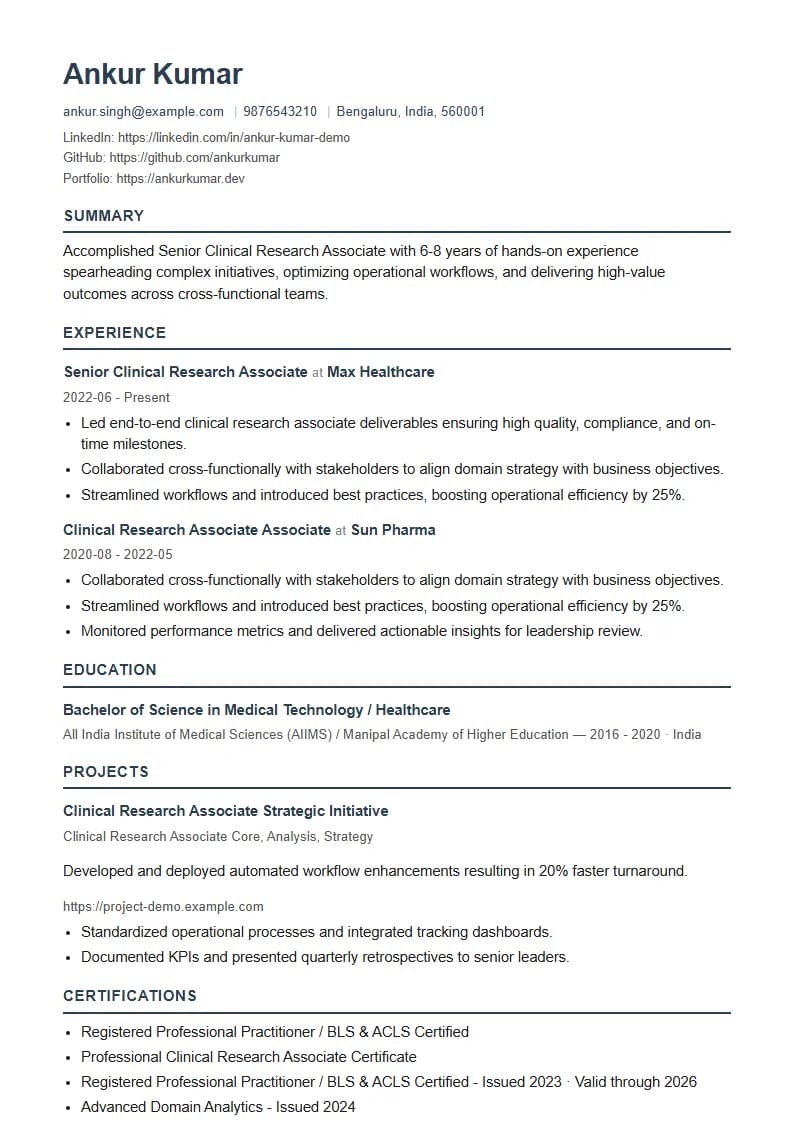
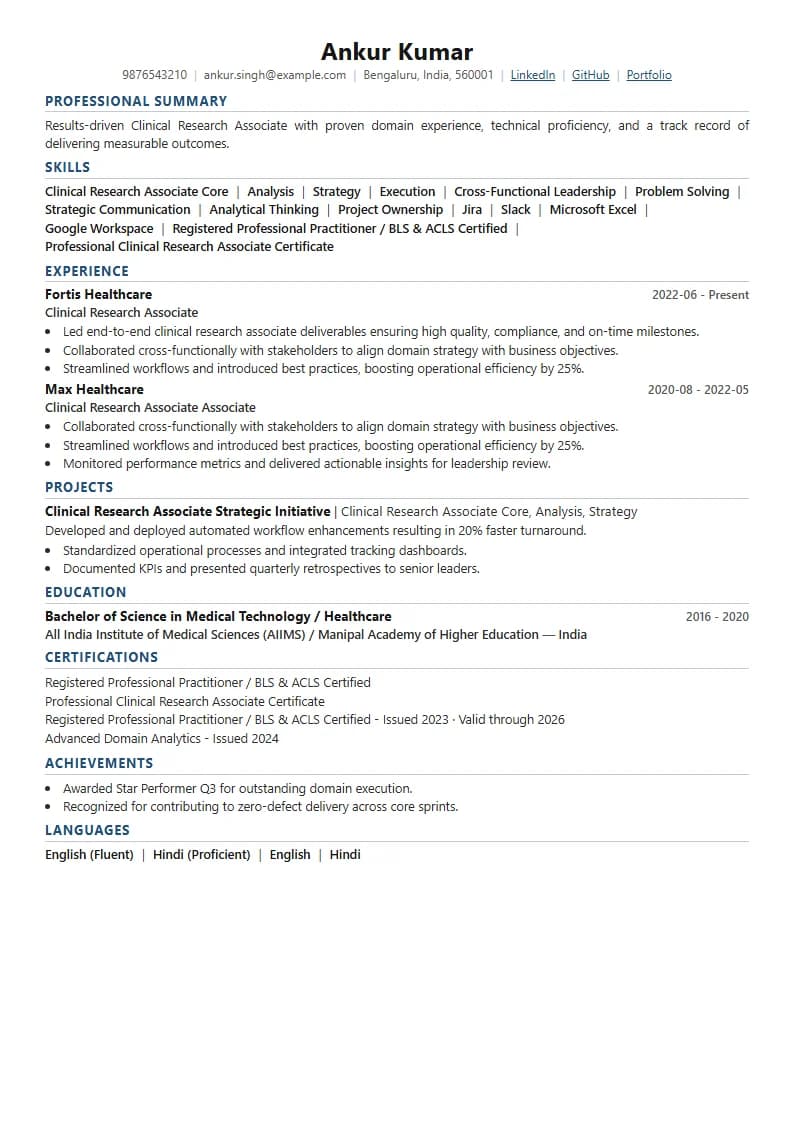
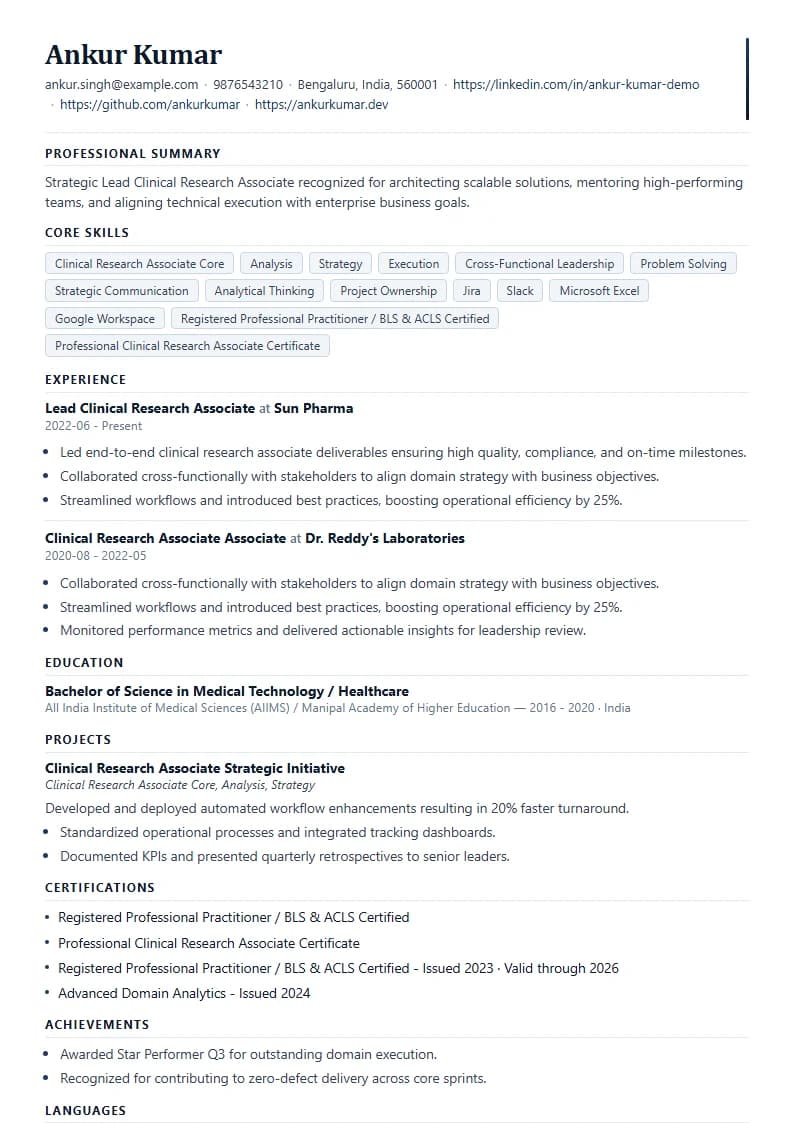
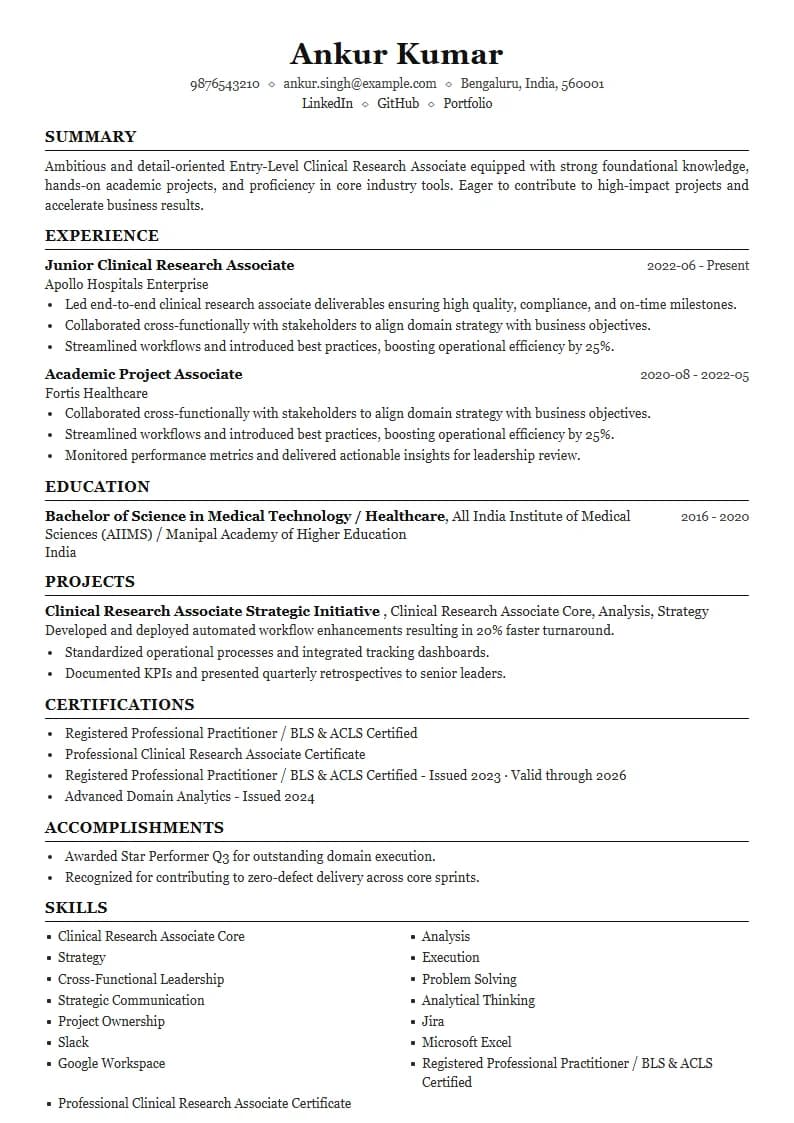
A Clinical Research Associate resume is judged on demonstrated trial-monitoring experience within the specific phase, therapeutic area, and regulatory standards the job description names. CRA roles vary by trial phase (I–IV), therapeutic area, and sponsor or CRO context, and a resume matched to one under-matches the others. GyanBatua AI scores your resume against the exact JD, names the gaps, and helps you close them before you apply.

CRA Matcher

Target: oncology Phase III CRA JD

ATS Match OK
88%Match

Optimization Report

Found 1 critical GCP gap in core signals.

Trial Phase & AreaPhase III oncology monitoring
Regulatory & GCPMissing CDSCO regulatory checklists
Monitoring SystemseCRF & SDV processes present
Free Scan JD-Tuning Micro-payment

Trial Quality Parameters

What a Clinical Research Associate job description screens for

Understanding each one tells you what your resume has to prove for that specific role.

The phase-and-therapeutic-area split is why a single CRA resume rarely wins across openings. An oncology Phase III JD and an early-phase JD reward different exposure, and the JD signals which the sponsor or CRO is hiring for.

The Phase Filter

Trial phase and type

Trial phase and type is the first filter. Phase I, II, III, IV, observational, or device trials — the JD specifies the phase, and a resume that does not foreground relevant phase experience under-matches.

Therapeutic Fit

Therapeutic area

Therapeutic area signals depth. Oncology, cardiology, CNS, infectious disease, and others appear in JDs, and matching the relevant area distinguishes a relevant CRA from a general one.

The GCP Compliance

Regulatory and GCP knowledge

Regulatory and GCP knowledge is core and non-negotiable. ICH-GCP, regulatory submissions, ethics committee processes, and applicable guidelines are screened directly, and a resume missing them under-matches.

Field Oversight

Monitoring competencies

Monitoring competencies convert a match into a shortlist. Site monitoring, source data verification, query resolution, protocol compliance, and CRF review show the candidate can actually run the monitoring function.

CRA Keywords

The Clinical Research Associate resume keywords that matter in 2026

The keywords that matter for a CRA resume are the ones the target JD names — but these categories recur across most Indian CRA JDs in 2026, and your resume should reflect the ones present in the JD.

Trial Phase & Type

Match the primary testing segments specified in the study JDs.

Phase I/II/III/IVobservationalinterventionaldevice trialsbioequivalence

Therapeutic Area

Align with prescribers in critical disease branches.

oncologycardiologyCNSinfectious diseaseendocrinologyrespiratory

Regulatory & GCP

Statutory monitoring regulations and checklist standards.

ICH-GCPregulatory submissionsethics committee/IRBCDSCOprotocol complianceinformed consent

Monitoring & Tools

Review tools and software package experience.

site monitoringsource data verification (SDV)CRF/eCRFquery resolutionEDC systemssite initiation/closeout

Outcome Language

Trial monitoring performance outcomes with metrics.

sites monitoredqueries resolvedaudit/inspection readinessprotocol deviations managed

Avoid Keyword Stuffing: Matching beats padding. A CRA resume that proves the JD's phase, therapeutic area, GCP knowledge, and monitoring competencies will out-score a general clinical-research resume.

Therapeutic vs Generalist

Why CRA resumes under-match on phase and area

CRA resumes under-match when they present general clinical-research exposure rather than the specific phase and therapeutic area the JD wants, because sponsors and CROs screen on that fit. A CRA with mixed-phase experience often lists it evenly, which under-matches a JD that wants clear Phase III oncology monitoring depth.

The fix is to weight the same base resume toward the JD's phase, therapeutic area, and regulatory standards for each application, and to confirm the match before applying.

Clinical Research Fit Comparison

Oncology Phase III Monitoring88% Match

Proven oncology site visits, SDV processes, ICH-GCP logs.

Early Bioequivalence Trials Focus38% Match

Under-weights multicenter clinical phases and IRB filings.

Simple Checking loops

How to check your CRA resume against a real JD

The fastest way to know whether your CRA resume will clear screening is to score it against the actual job description first. GyanBatua AI does this in three steps.

1

Upload & Paste

Upload your resume and paste the Clinical Research Associate JD you are targeting. The free match score shows your alignment now, with the gaps named.

2

Review Gaps

Review the phase, therapeutic-area, and regulatory gaps. You will see which JD signals your resume is missing or under-weighting for this specific CRA role.

3

Tune & Re-Check

Tune and re-check. Get a JD-matched version; re-run the score to confirm the gaps closed before you submit.

Affordable Micro-payments

GyanBatua's micro-payment model means you pay only for the applications you are serious about — nothing for the months you are not searching — and every user gets the same advanced AI on every action.

Interview Protocol

From shortlist to offer: prepare for the CRA interview on the same JD

A matched resume gets you the interview; the same JD should shape your preparation for it. GyanBatua AI's interview practice is built around the job description you matched against, so a Phase III oncology role and an early-phase role generate different practice — phase and therapeutic-area scenarios, GCP and regulatory questions, and the monitoring and site-management cases the role implies. Resume optimization improves your shortlisting odds; JD-based interview prep improves your odds in the room. Both work on the same target role.

FAQ Help

Common questions about Clinical Research Associate resumes

FAQ Help

What should a Clinical Research Associate resume include in 2026?

A CRA resume should foreground the trial phase and therapeutic area the JD names, show ICH-GCP and regulatory knowledge, and demonstrate monitoring competencies like source data verification and query resolution. Because CRA roles vary by phase and area, the emphasis should change per JD.

How important is GCP knowledge on a CRA resume?

ICH-GCP knowledge is core and screened directly on most CRA JDs, so a resume that does not surface it under-matches regardless of other experience. It is a near-baseline expectation alongside the phase and therapeutic-area match the JD specifies.

Why does my CRA resume get rejected despite clinical research experience?

A CRA resume with research experience still gets rejected when it reads as general rather than matching the JD's specific phase, therapeutic area, or regulatory standards. The screening layer scores those signals, so a phase- or area-mismatch causes under-matching.

How do freshers move into a clinical research associate resume?

Freshers and those from life-sciences or pharmacy backgrounds should foreground any clinical-research training, GCP certification, and project or internship exposure in the JD's therapeutic-area language. Demonstrated GCP understanding and any monitoring exposure are the strongest entry signals. Scoring against a real JD shows whether it is landing.

Does GyanBatua charge a subscription for CRA resume help?

No. GyanBatua AI uses micro-payments — you pay per action (for example for a JD-matched resume) only while job-hunting. There is no forced monthly subscription, and every user gets the same advanced AI on every action regardless of price.

Check your Clinical Research Associate resume against a real job description

Ensure GCP guidelines and trial segments are matched, and score instantly.

ATS Optimized
JD-Tuned
Micro-payments