
Back Office Matcher

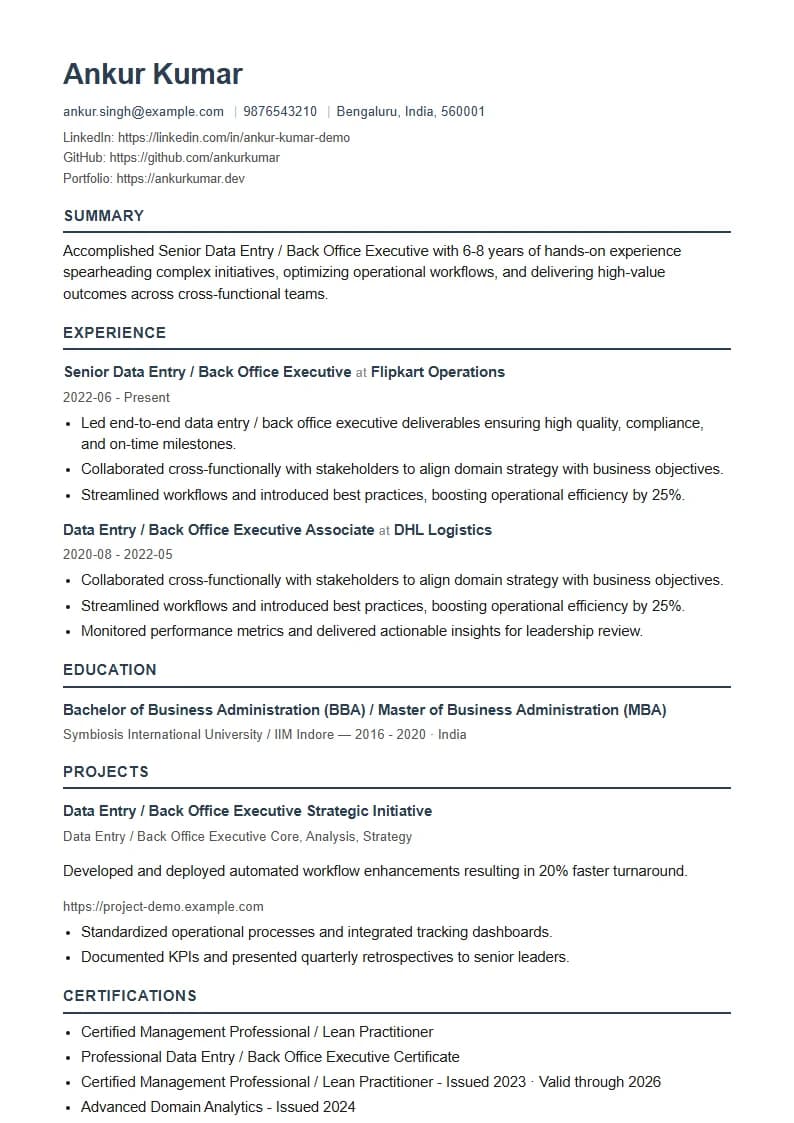
Resume for a Data Entry / Back Office Executive: Match the Process, Software, and Accuracy the JD Names

A Data Entry or Back Office Executive resume is judged on whether your process experience, software, and accuracy match the specific job description. These are very high-volume roles, which makes screening fast and keyword-driven, and a resume that names the JD's specific software and process matches far better than a generic one. GyanBatua AI scores your resume against the exact JD, names the gaps, and helps you close them before you apply.
Back Office Matcher

Target: KYC Verification Executive JD

ATS Match OK
85%Match

Optimization Report

Found 1 critical process gap in core signals.

Operational ProcessKYC & document verification
Software & TypingMissing Tally Prime (Excel present)
Accuracy Outcomes99.5% accuracy rate & speed present
Free Scan JD-Tuning Micro-payment

Operational Typing Filters

What a Data Entry / Back Office job description screens for

Understanding each one tells you what your resume has to prove for that specific role.

This process-and-speed split is why general back office profiles struggle to clear automated screening. An order-processing JD and a KYC-verification JD require completely different compliance checks and software suites, and the JD signals which setup the operations team runs.

The Process Filter

Process type

Process type represents the primary filter. Data entry, transaction processing, document verification, KYC processing, order processing, or back-office operations — the JD names one, and a resume that does not foreground it under-matches.

Speed & Tool Filters

Software and typing skills

Software and typing skills are literal execution filters. MS Excel, data-entry software, ERP, CRM, and typing speed (WPM) appear in JDs, and a resume missing the named tools or a stated typing speed under-matches.

The Performance Indicator

Accuracy and speed

Accuracy and speed signal operational capability in volume roles. Accuracy rate, daily processing volume, and turnaround time (TAT) are key metrics, and surfacing them distinguishes a strong candidate.

The Operations Proof

Compliance and confidentiality

Compliance and confidentiality convert matches into shortlists. Data confidentiality guidelines, SLA compliance, process adherence, and quality control steps prove you can work reliably in strict operational settings.

Back Office Keywords

The Data Entry / Back Office Executive resume keywords that matter in 2026

The keywords that matter for a data-entry/back-office resume are the ones the target JD names — but these categories recur across most Indian Data Entry / Back Office JDs in 2026, and your resume should reflect the ones present in the JD.

Operational Process

Direct back-office process segment targeted.

data entrytransaction processingdocument verificationKYCorder processingback-office operationsrecord maintenance

Software & Typing

Office spreadsheet and entry utilities.

MS ExcelMS Officedata-entry softwareERPCRMtyping speed (WPM)10-key

Efficiency Metrics

SOP speeds and volume throughput values.

accuracy rateprocessing volumeturnaround time (TAT)error rateproductivity

SLA & Compliance

Operational safety and protocol standards.

data confidentialityprocess adherencequality checksSLA

Outcome Language

Performance metrics indicating process efficiency.

accuracy maintainedvolume processedTAT meterror rate reduced

Avoid Keyword Stuffing: Matching beats padding. A back-office resume that proves the JD's process, software, and accuracy or volume will out-score a generic clerical-duties list.

Data Entry vs Document Verification

Why back-office resumes under-match in volume checks

Back-office resumes under-match when they list generic clerical work rather than the JD's specific process, software, and accuracy or speed metrics, because in a high-volume field the screening layer rewards precise matches. A candidate with data-entry experience under-matches a verification-focused role if the resume does not foreground the relevant process and tools.

The fix is to weight the same base resume toward the JD's process, software, and accuracy metrics for each application, and to confirm the match before applying.

Back Office Executive Process Fit

KYC Verification Specialist85% Match

Proven document checking, database lookups, and compliance protocols.

Generic Typing & Filing Focus38% Match

Under-weights analytical verification and specific verification portals.

Simple Checking loops

How to check your back-office resume against a real JD

The fastest way to know whether your back-office resume will clear screening is to score it against the actual job description first. GyanBatua AI does this in three steps.

1

Upload & Paste

Upload your resume and paste the Data Entry / Back Office JD you are targeting. The free match score shows your alignment now, with the gaps named.

2

Review Gaps

Review the process, software, and accuracy gaps. You will see which JD signals your resume is missing or under-weighting.

3

Tune & Re-Check

Tune and re-check. Get a JD-matched version; re-run the score to confirm the gaps closed before you submit.

Affordable Micro-payments

GyanBatua's micro-payment model means you pay only for the applications you are serious about — nothing for the months you are not searching — and every user gets the same advanced AI on every action.

Interview Protocol

From shortlist to offer: prepare for the back-office interview on the same JD

A matched resume gets you the interview; the same JD should shape your preparation for it. GyanBatua AI's interview practice is built around the job description you matched against, so a data-entry role and a verification-processing role generate different practice — process and software scenarios, accuracy and speed discussion, and the compliance questions the role implies. Resume optimization improves your shortlisting odds; JD-based interview prep improves your odds in the room. Both work on the same target role.

FAQ Help

Common questions about Data Entry / Back Office Executive resumes

FAQ Help

What should a Data Entry / Back Office resume include in 2026?

A back-office resume should foreground the process type the JD names (data entry, verification, KYC, order processing), the software and typing skill it specifies, and accuracy or speed metrics. Because these are high-volume, process-specific roles, matching the JD's process and tools precisely is what counts.

Should I include typing speed on a data entry resume?

Yes, if the JD mentions it or implies a speed expectation, because data-entry roles are measured on speed and accuracy. A stated typing speed (WPM) and accuracy rate are concrete, screenable signals that strengthen a data-entry resume.

Why does my back-office resume get rejected despite experience?

A back-office resume with experience still gets rejected when it reads as generic clerical work rather than matching the JD's specific process, software, or accuracy metrics. The high-volume field rewards precise matches, so a process- or tool-mismatch causes under-matching.

How do freshers write a data entry or back office resume?

Freshers should foreground their software and typing proficiency, frame any internship or part-time processing work in the JD's process language, and surface accuracy or volume where they can. Software, typing speed, and accuracy signals matter most for entry roles. Scoring against a real JD shows whether it is landing.

Does GyanBatua charge a subscription for back-office resume help?

No. GyanBatua AI uses micro-payments — you pay per action (for example for a JD-matched resume) only while job-hunting. There is no forced monthly subscription, and every user gets the same advanced AI on every action regardless of price.

Check your Data Entry / Back Office resume against a real job description

Verify typing speed, accuracy metrics, KYC tools, and score instantly.

ATS Optimized
JD-Tuned
Micro-payments