

Skill Gap vs Positioning: What Is Actually Blocking Your Job
கண்ணோட்டம்: Not getting shortlisted? Learn whether your problem is a real skill gap or a positioning gap in your resume, proof, or role-fit communication.

Introduction
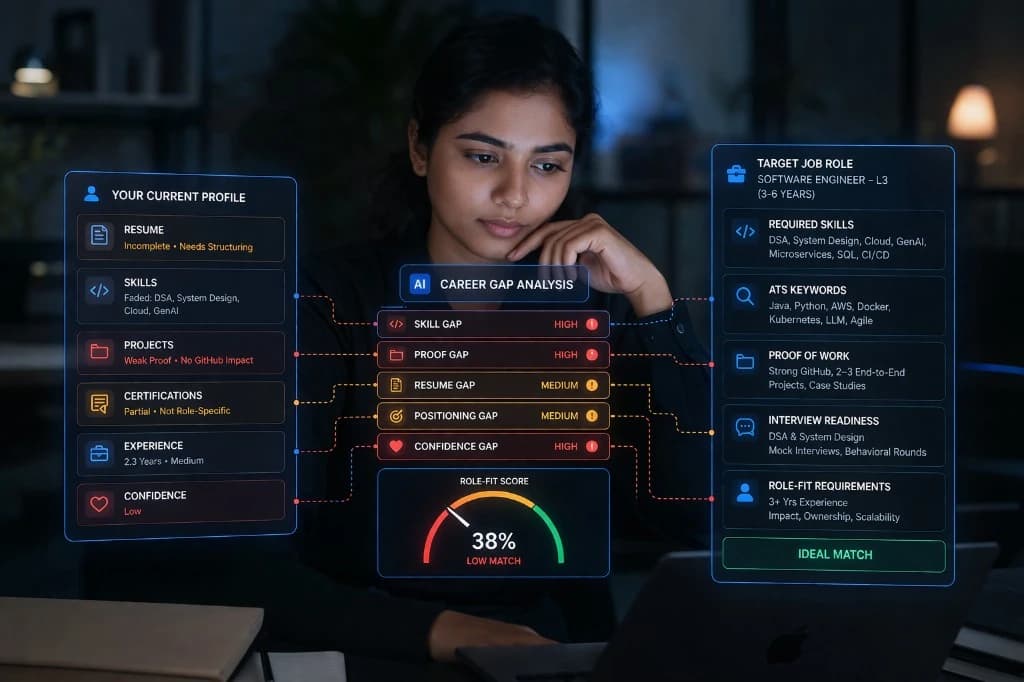
One of the biggest mistakes candidates make is calling every problem a skill gap. No shortlist? Skill gap. No interview call? Skill gap. Low confidence? Skill gap. But that is not always true.
Sometimes the real problem is not missing skill. It is weak positioning. That means: your resume is too generic, your proof is buried, your project descriptions are weak, your role direction is unclear, your skills are not visible enough, or your wording is not aligned to the role.
This matters because skill gaps and positioning gaps need very different solutions. If you solve the wrong problem, you waste time.
For the full framework on skill, proof, and positioning together, read Skill Gap Analysis for the Job You Actually Want (/blog/skill-gap-analysis-for-the-job-you-actually-want). For a JD-led comparison of your resume, use How to Find the Skill Gaps Between Your Resume and the Job Description (/blog/how-to-find-the-skill-gaps-between-your-resume-and-the-job-description). For application-level diagnosis, see How to Diagnose Why Your Job Applications Are Not Converting (/blog/why-job-applications-are-not-converting).
What a real skill gap looks like
A real skill gap means you genuinely do not know or cannot do something the role requires.
- The role needs SQL, but you have never used it.
- The role needs dashboarding, but you have never built one.
- The role needs campaign analytics, but you only know content writing.
- The role needs Git or APIs, but you only know theory.
These are learning gaps. They need practice, learning, project work, repetition, and maybe a course.
What a positioning gap looks like
A positioning gap means you may already have useful overlap, but your profile is not showing it properly.
- You know Excel, but your resume never shows where you used it.
- You worked on a useful project, but described it vaguely.
- You have relevant internship tasks, but they sound too basic on paper.
- Your skills are correct, but buried under filler content.
- Your summary does not make your target role clear.
These are communication gaps. They need better wording, better ordering, stronger proof presentation, role-family resume versions, and clearer role alignment.
Why this confusion hurts candidates
If you mistake a positioning problem for a skill problem, you may take unnecessary courses, keep delaying applications, feel more behind than you really are, or over-learn and under-apply.
If you mistake a skill gap for a positioning problem, you may keep rewriting the resume, apply too early, blame ATS, or stay confused when results do not improve. That is why diagnosis matters.
How to tell which one you have
- Can I do this task right now? If no, it may be a skill gap.
- Have I done something related, but my resume does not show it well? That may be a positioning gap.
- Do I have proof examples, but they sound weak on paper? Positioning gap.
- Is the role asking for something I have never touched? Real skill gap.
- If a recruiter spoke to me directly, would I sound stronger than my resume currently looks? That is often a positioning problem.
Final thought
Not every weak result means you need more learning. Sometimes you need more proof visibility, better role-fit language, stronger project framing, or clearer positioning.
The smartest candidates do not just ask "What should I learn?" They also ask: "What am I already capable of that my profile is failing to show?" That question can save a lot of wasted effort.
Closing section
FAQ
Resume guides
Related Resume Guides
About the Author
Full Stack Software Engineer at Mobiloitte
Full Stack Software Engineer at Mobiloitte, helping freshers navigate placement prep and software workflows.
விலை திட்டம்
உங்கள் திட்டத்தை தேர்வு செய்து வேகமாக தொடங்குங்கள்
அம்சங்கள், விலை, பயன்பாடு ஆகியவற்றை தெளிவாக ஒப்பிட்டு, உங்கள் இலக்குக்கு பொருந்தும் திட்டத்தை தேர்வு செய்யுங்கள்.
அடுத்த படி
உங்கள் ரெஸ்யூமை உண்மையான ஜாப் டிஸ்கிரிப்ஷனுடன் ஒப்பிடுங்கள்
Apply செய்வதற்கு முன் JD match, keyword visibility, மற்றும் skill gaps பார்க்கவும்.
தொடர்புடைய வாசிப்பு
5சமீபத்திய கட்டுரைகள்
6