ID Matcher

Resume for an Instructional Designer: Match the Methodology, Tools, and Domain the JD Names

An Instructional Designer resume is judged on whether your design methodology, authoring tools, and content domain match the specific job description. Instructional design spans corporate L&D, academic/EdTech, and compliance training, using different models and tools, and a resume matched to one under-matches the others. GyanBatua AI scores your resume against the exact JD, names the gaps, and helps you close them before you apply.
ID Matcher

Target: Corporate ID JD

ATS Match OK
90%Match

Optimization Report

Found 1 authoring-tool gap in core signals.

Design MethodologyADDIE & storyboarding present
Authoring ToolsArticulate Storyline & Rise shown
Learning OutcomesSCORM metrics details are thin
Free Scan JD-Tuning Micro-payment

Instructional Design Screening Filters

What an Instructional Designer job description screens for

Understanding each one tells you what your resume has to prove for that specific role.

Instructional design also has a portfolio dimension — samples of courses you have built matter — so the strongest approach is a resume matched to the JD's methodology and tools that also gets your portfolio opened. The JD signals which context and tools an employer needs.

The Methodology Filter

Design methodology

ADDIE, SAM, Bloom's taxonomy, adult learning principles, and instructional models show the candidate designs learning systematically, which most JDs expect.

The Tools Filter

Authoring tools

Articulate Storyline, Rise, Adobe Captivate, LMS platforms, and multimedia tools appear in JDs, and a resume missing the named tools under-matches.

The Context Filter

Content domain

Corporate L&D, academic/higher-ed, K-12 EdTech, compliance, or technical training — matching the JD's domain distinguishes a relevant designer.

Outcomes Verification

Learning outcomes

Courses built, learner engagement, completion or assessment improvements, and stakeholder collaboration show real impact beyond a tool list.

Instructional Design Keywords

The Instructional Designer resume keywords that matter in 2026

The keywords that matter for an instructional-design resume are the ones the target JD names — but these categories recur across most Indian Instructional Designer JDs in 2026, and your resume should reflect the ones present in the JD.

Methodology

Learning models and curriculum framework principles.

ADDIESAMBloom's taxonomyadult learningstoryboardingneeds analysiscurriculum design

Authoring Tools

Interactive e-learning authoring systems and LMS.

Articulate StorylineRiseAdobe CaptivateLMSMoodleCornerstoneCamtasiaVyond

Content Domain

Industry and target target user segments.

corporate L&DacademicEdTechK-12compliance trainingtechnical training

ID Skills

Technical standards and media creation.

e-learningmicrolearningassessment designSCORMxAPImultimediascriptwriting

Outcome Language

Learner progress and project metric signals.

courses builtengagement improvedcompletion rateslearner outcomes

Avoid Keyword Stuffing: Matching beats padding. An instructional-design resume that proves the JD's methodology, tools, and domain, with a portfolio to back it, will out-score a generic training-duties list.

Corporate vs Academic Domain

Why instructional-design resumes under-match

Instructional-design resumes under-match when they describe training delivery rather than design methodology and tool fluency, or do not match the JD's domain. A corporate L&D designer applying to an academic EdTech role under-matches if the resume does not foreground the relevant tools and domain.

The fix is to weight the same base resume toward the JD's methodology, tools, and domain, ensure your portfolio is accessible, and confirm the match before applying.

ID Methodology Match

Corporate L&D ID Role90% Match

ADDIE model, Articulate Storyline fluency, and SCORM standards are shown.

Academic ID Resume43% Match

Under-weights enterprise LMS platforms and corporate Storyline interactive designs.

Simple Checking Loops

How to check your instructional-design resume against a real JD

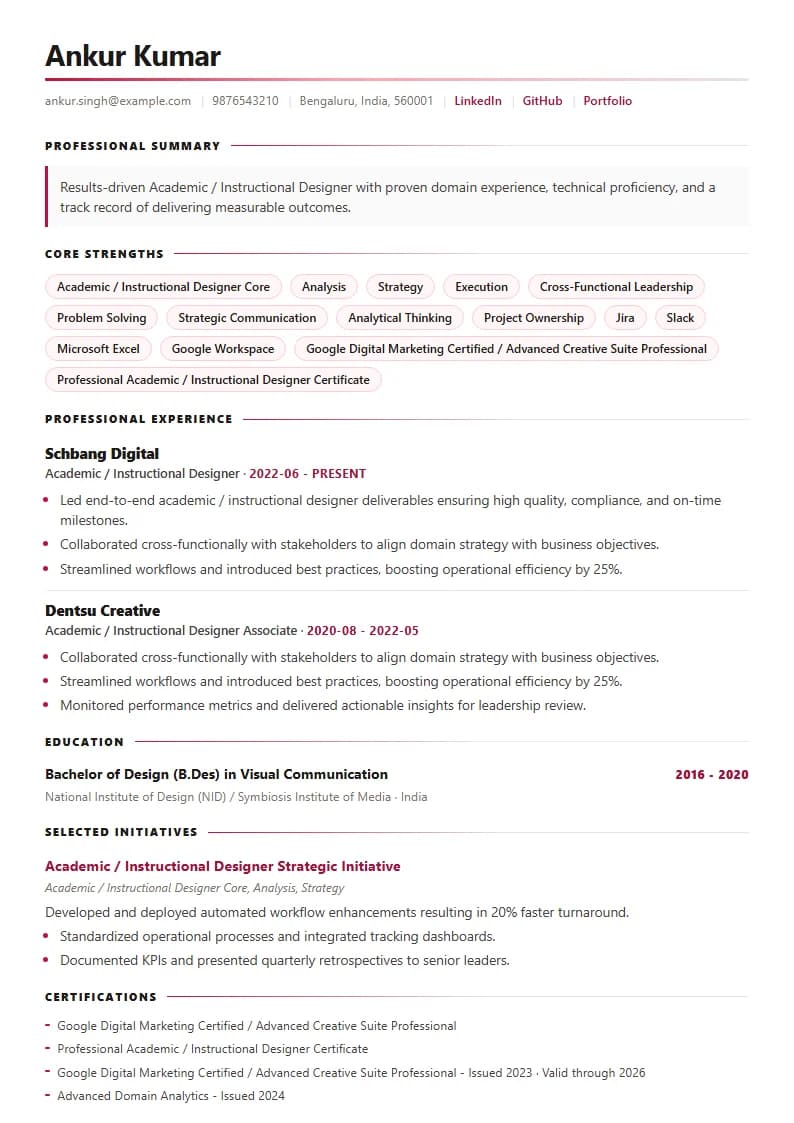
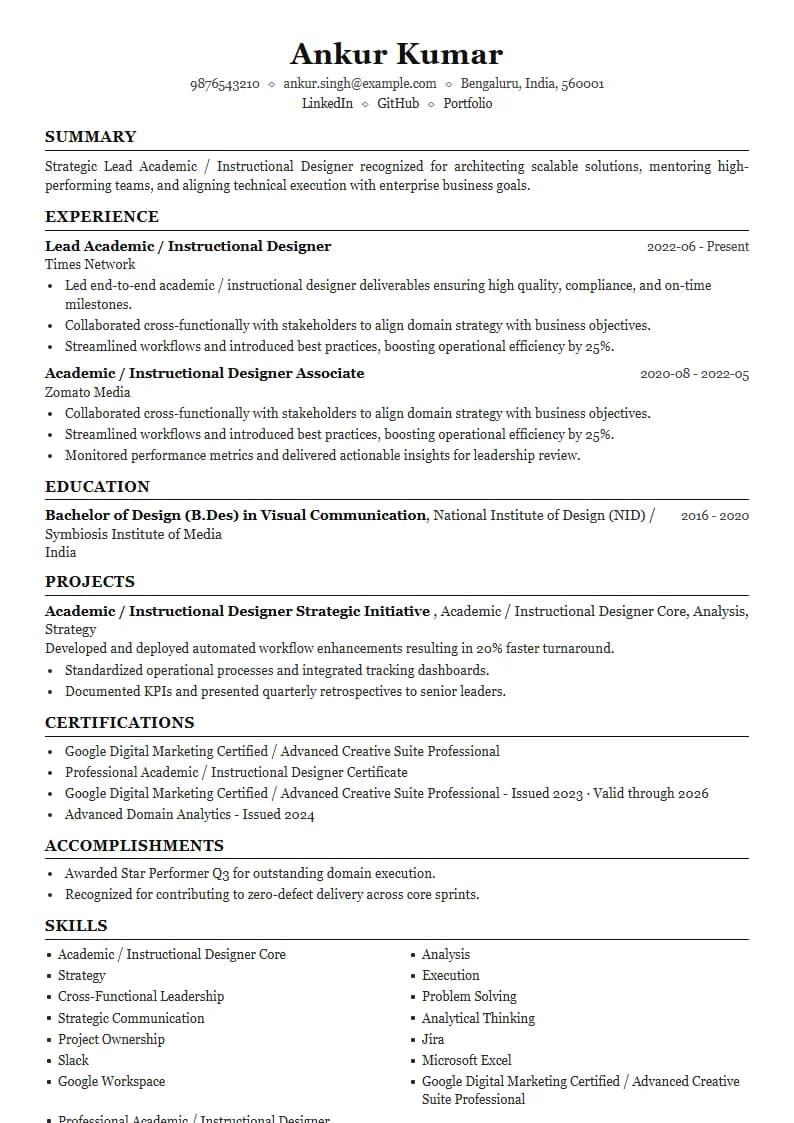
The fastest way to know whether your instructional-design resume will clear screening is to score it against the actual job description first. GyanBatua AI does this in three steps.

1

Upload & Paste

Upload your resume and paste the Instructional Designer JD you are targeting. The free match score shows your alignment now, with the gaps named.

2

Review Gaps

Review the methodology, tool, and domain gaps. You will see which JD signals your resume is missing or under-weighting.

3

Tune & Re-Check

Tune and re-check. Get a JD-matched version; re-run the score to confirm the gaps closed before you submit.

Affordable Micro-payments

GyanBatua's micro-payment model means you pay only for the applications you are serious about — nothing for the months you are not searching — and every user gets the same advanced AI on every action.

Interview Prep

From shortlist to offer: prepare for the ID interview on the same JD

A matched resume gets you the interview; the same JD should shape your preparation for it. GyanBatua AI's interview practice is built around the job description you matched against, so a corporate L&D role and an academic EdTech role generate different practice — methodology and tool scenarios, portfolio-walkthrough framing, and the stakeholder and outcome questions the role implies. Resume optimization improves your shortlisting odds; JD-based interview prep improves your odds in the room. Both work on the same target role.

FAQ Help

Common questions about Instructional Designer resumes

FAQ Help

What should an Instructional Designer resume include in 2026?

An instructional-design resume should foreground the design methodology the JD names (ADDIE, SAM), the authoring tools (Articulate, Captivate, LMS), the content domain, and learning outcomes, with a portfolio of built courses. Because the role spans corporate and academic contexts, the emphasis should change per JD.

Do I need a portfolio for an instructional design role?

Yes. Instructional design is partly portfolio-evaluated, so samples of courses you have built strengthen the application significantly. The resume's job is to match the JD's methodology and tools and get your portfolio opened.

Why does my instructional design resume get rejected?

An instructional-design resume gets rejected when it describes training delivery rather than design methodology and tools, or does not match the JD's domain. The screening layer scores methodology, tools, and domain, so a mismatch there causes under-matching.

How do I move into instructional design from teaching?

Reframe teaching experience as learning design — needs analysis, content creation, assessment — name the authoring tools you have learned, and build a small portfolio of designed modules. Methodology and tool signals plus samples are what convert teaching experience into an ID match. Scoring against a real JD shows whether it is landing.

Does GyanBatua charge a subscription for instructional design resume help?

No. GyanBatua AI uses micro-payments — you pay per action (for example for a JD-matched resume) only while job-hunting. There is no forced monthly subscription, and every user gets the same advanced AI on every action regardless of price.

Check your Instructional Designer resume against a real job description

Verify ID design methodologies, authoring tools, LMS platforms, and course outcomes — score instantly.

ATS Optimized
JD-Tuned
Micro-payments