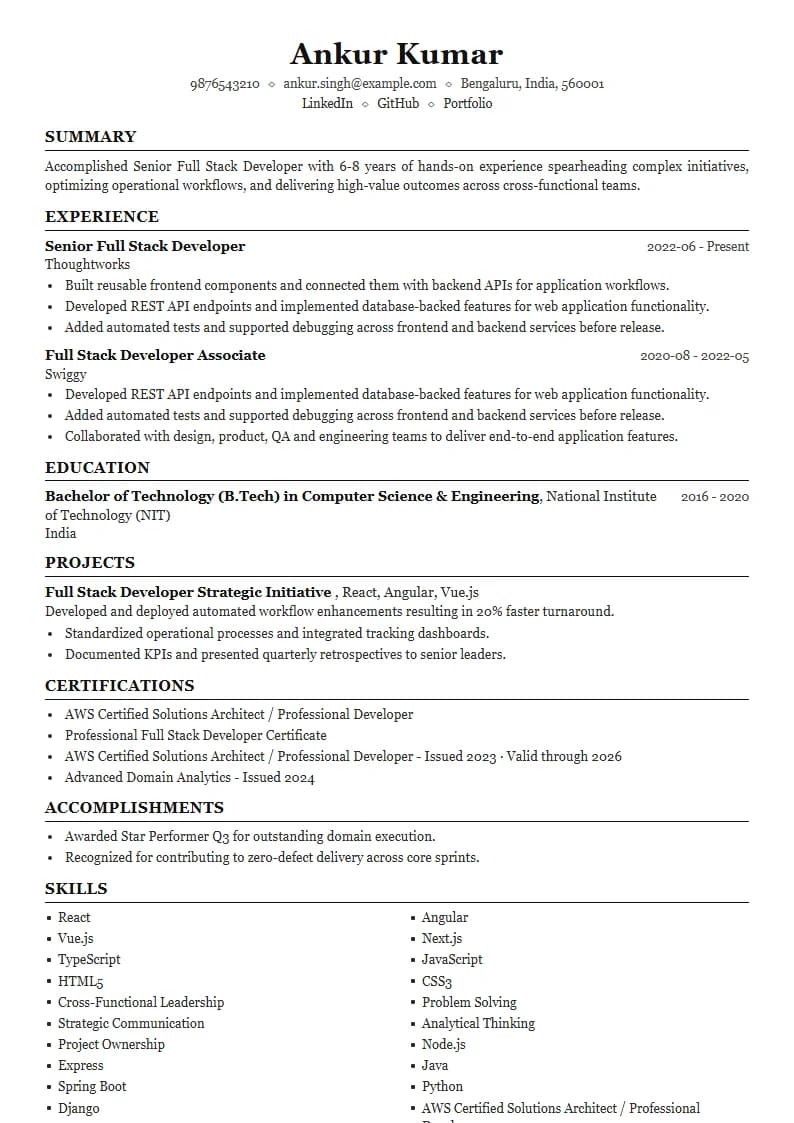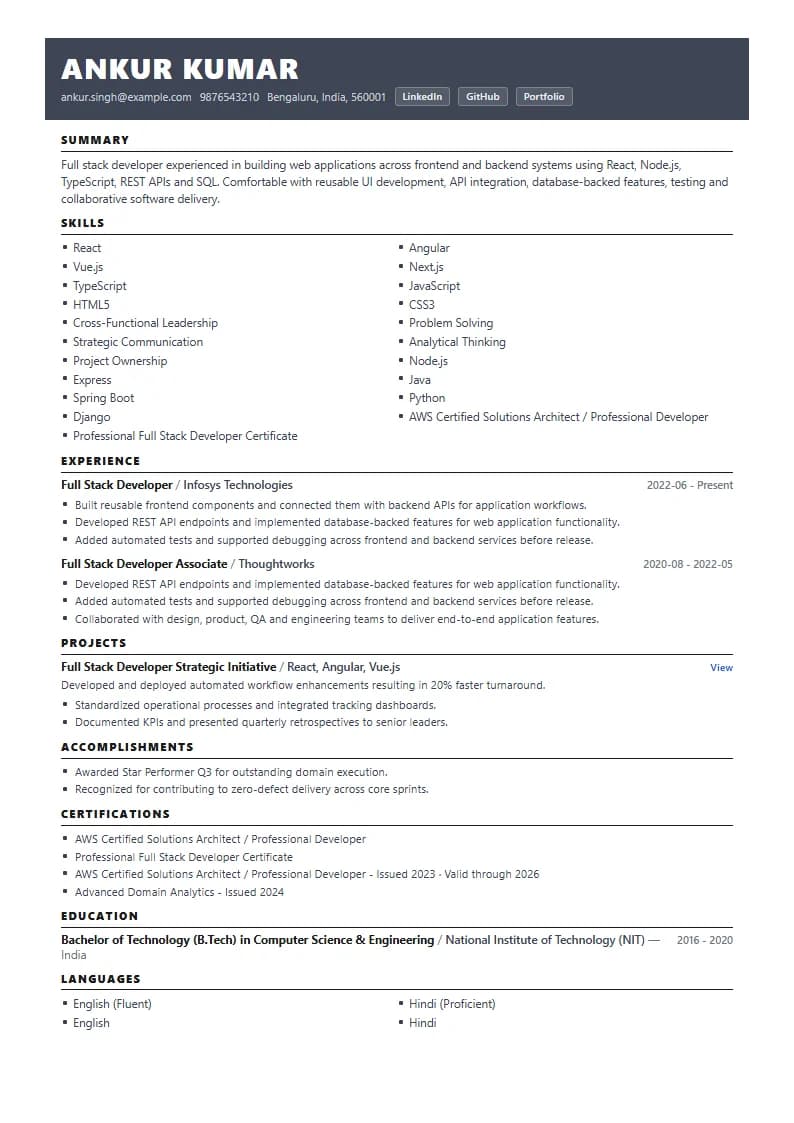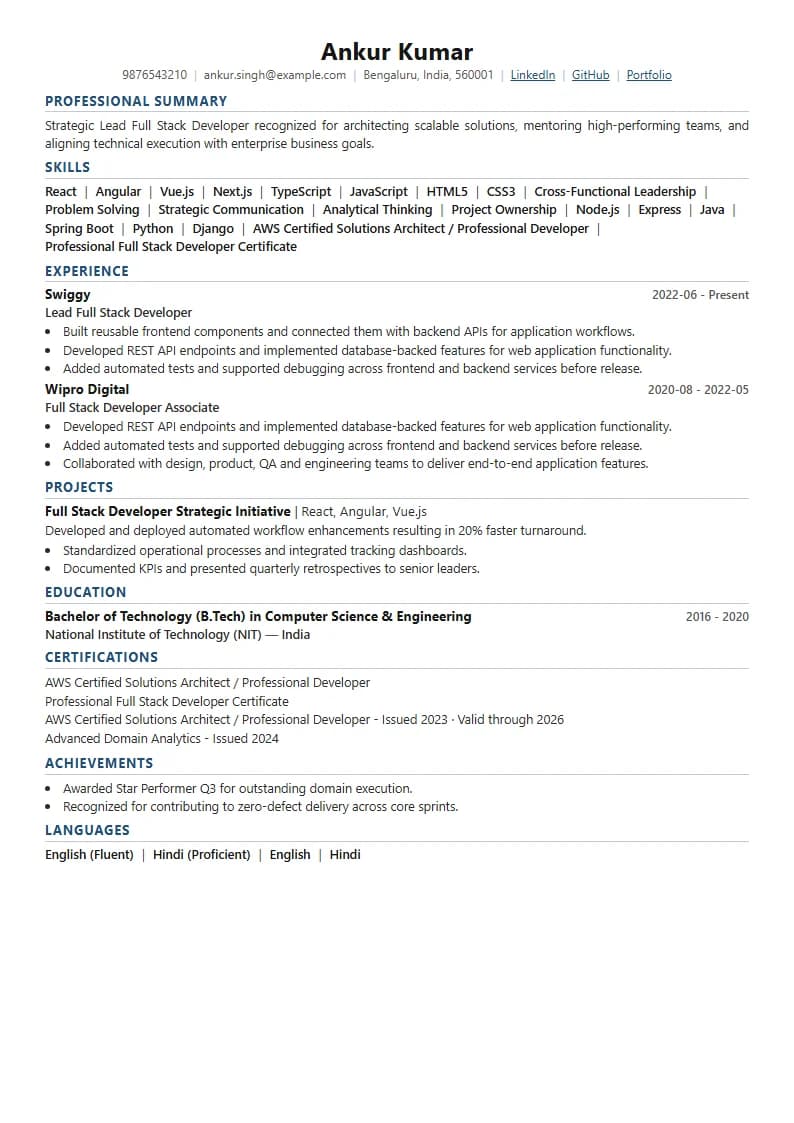

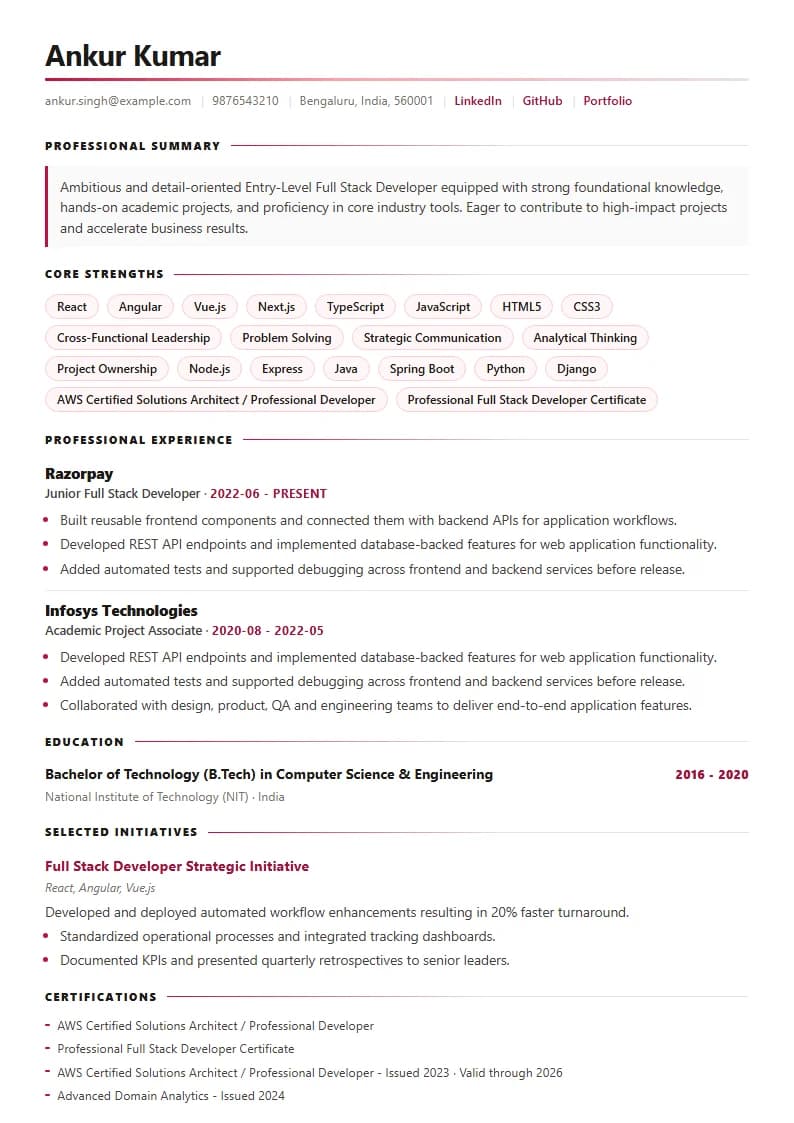
Resume for a Full Stack Developer: Match the Exact Stack the JD Names
A Full Stack Developer resume has to prove competence across front-end and back-end in the specific stack the job description names — and it gets screened on whether that stack matches, term for term. Full stack is the most stack-specific role there is: a MERN JD, a Java-and-Angular JD, and a Django-and-React JD are different jobs, and a resume that names the wrong combination under-matches even a strong generalist. GyanBatua AI scores your resume against the exact JD, names the gaps, and helps you close them before you apply.
Full Stack Resume Matcher
Target: MERN Developer JD
Optimization Report
Found 2 database stack gaps in core signals.
Technical Calibration Filters
What a Full Stack Developer job description screens for
Understanding each one tells you what your resume has to prove for that specific role.
This stack-matching problem is why one full-stack resume rarely wins across openings. The screening layer scores literal technology names, so the same resume can match one stack strongly and a different stack poorly, regardless of the candidate's real range.
The Interface Layer
Front-end stack match
Front-end stack match is the first filter. If the JD names React and your resume leads with Angular, the match drops even though both are front-end frameworks. Mirror the JD's named front-end stack where you have it.
The Server Runtime
Back-end stack match
Back-end stack match is equally literal. Node, Java/Spring, Python/Django, .NET — the JD names one, and a resume centred on a different runtime under-matches. Lead with the back end the JD asks for.
The Integration Signal
The connecting layer
The connecting layer signals true full-stack ability. JDs look for APIs, REST or GraphQL, databases, and authentication — evidence you join the two ends rather than working on one. A resume that shows the integration reads as genuinely full stack.
The Deployment Signal
End-to-end ownership
End-to-end ownership is what converts a match into a shortlist. The strongest full-stack resumes show a feature or product owned from database to interface with a measurable outcome, not two separate skill lists.
Stack Keywords
The Full Stack Developer resume keywords that matter in 2026
The keywords that matter for a full-stack resume are the ones the target JD names — but these categories recur across most Indian full-stack JDs in 2026, and your resume should reflect the ones present in the JD.
Front-end Stack
Visual and client-side web technologies specified in the JD.
Back-end Stack
Server-side runtimes and application framework engines.
Databases & Cache
Data layers and message cache systems expected by target teams.
Connecting Layer
APIs, microservices, and protocols bridging client and server.
Infra & DevOps
Containers and automated cloud delivery processes.
Avoid Keyword Stuffing: Matching beats padding. A full-stack resume that proves the JD's exact stack plus one end-to-end owned feature will out-score one that lists a dozen frameworks with no integration story.
Stack Overlap Bottlenecks
Why strong full-stack developers under-match on stack
Strong full-stack developers under-match because the screening layer scores literal stack names, and a capable developer who works across stacks often lists them all evenly instead of leading with the JD's stack. A developer comfortable in both MERN and Java can match a MERN JD strongly — but only if the resume foregrounds MERN for that application rather than burying it in a long, undifferentiated list.
The fix is to reorder and emphasise the same base resume toward each JD's stack, leading with the named technologies, and to confirm the match before applying.
Stack Congruency Check
Matches React front-end, Express/Node server, MongoDB layer.
Missing required Spring components, Hibernate mappings, SQL variables.
Stack Scanning loops
How to check your full-stack resume against a real JD
The fastest way to know whether your full-stack resume will clear screening is to score it against the actual job description first. GyanBatua AI does this in three steps.
Upload & Paste
Upload your resume and paste the Full Stack Developer JD you are targeting. The free match score shows your alignment now, with the gaps named.
Review Gaps
Review the stack and integration gaps. You will see which JD technologies and signals your resume is missing or under-weighting for this specific role.
Tune & Re-Check
Tune and re-check. Get a JD-matched version; re-run the score to confirm the gaps closed before you submit.
Affordable Micro-payments
GyanBatua's micro-payment model means you pay only for the applications you are serious about — nothing for the months you are not searching — and every user gets the same advanced AI on every action.
Interview Preparation
From shortlist to offer: prepare for the full-stack interview on the same JD
A matched resume gets you the interview; the same JD should shape your preparation for it. GyanBatua AI's interview practice is built around the job description you matched against, so a MERN role and a Java-stack role generate different practice — front-end and back-end questions tied to the named stack, system and API design, and the end-to-end scenarios the role implies. Resume optimization improves your shortlisting odds; JD-based interview prep improves your odds in the room. Both work on the same target role.
FAQ Help
Common questions about Full Stack Developer resumes
FAQ Help
What should a Full Stack Developer resume include in 2026?
A Full Stack Developer resume should name the front-end and back-end technologies the JD specifies, show the connecting layer (APIs, databases, authentication), and prove at least one feature owned end to end with an outcome. Because full stack is highly stack-specific, the emphasis should change per JD.
Should my full-stack resume list every technology I know?
No. Listing every technology evenly makes the resume read as shallow and buries the stack the JD actually names. Lead with the JD's front-end and back-end stack for each application, keep other technologies brief, and prove integration rather than just breadth.
Why does my full-stack resume match some jobs and not others?
A full-stack resume matches inconsistently because the screening layer scores literal stack names, and different JDs name different stacks. The same resume can match a MERN role strongly and a Java role poorly. Reordering the resume to lead with each JD's named stack is what fixes the inconsistency.
How do freshers write a full-stack resume?
Freshers should present projects as end-to-end builds in the JD's stack — front end, back end, and the connection between them — rather than as separate skill lists. A single well-described full-stack project often matches better than a long technology list. Scoring against a real JD shows whether it is landing.
Does GyanBatua charge a subscription for developer resume help?
No. GyanBatua AI uses micro-payments — you pay per action (for example for a JD-matched resume) only while job-hunting. There is no forced monthly subscription, and every user gets the same advanced AI on every action regardless of price.
Career Growth
Explore More Roles & Interview Guides
Complete your profile checklist and match against multiple options.
Software Development Engineer (SDE) Guide
See exactly how well your resume matches an SDE job description before you apply. Free match score, ATS keyword gaps, and a JD-tuned resume.
Data Analyst Guide
Find out how well your resume matches a Data Analyst JD before you apply. Free match score, ATS keyword gaps, and a JD-tuned resume.
Roadmap to Tech Roles
Strategic instructions to transition into high-value product teams.
Mock Interview Guide
Prepare for technical scenarios and domain screens effectively.
Check your Full Stack Developer resume against a real job description
Confirm front-to-back stack alignment, highlight integration APIs, and optimize metadata.