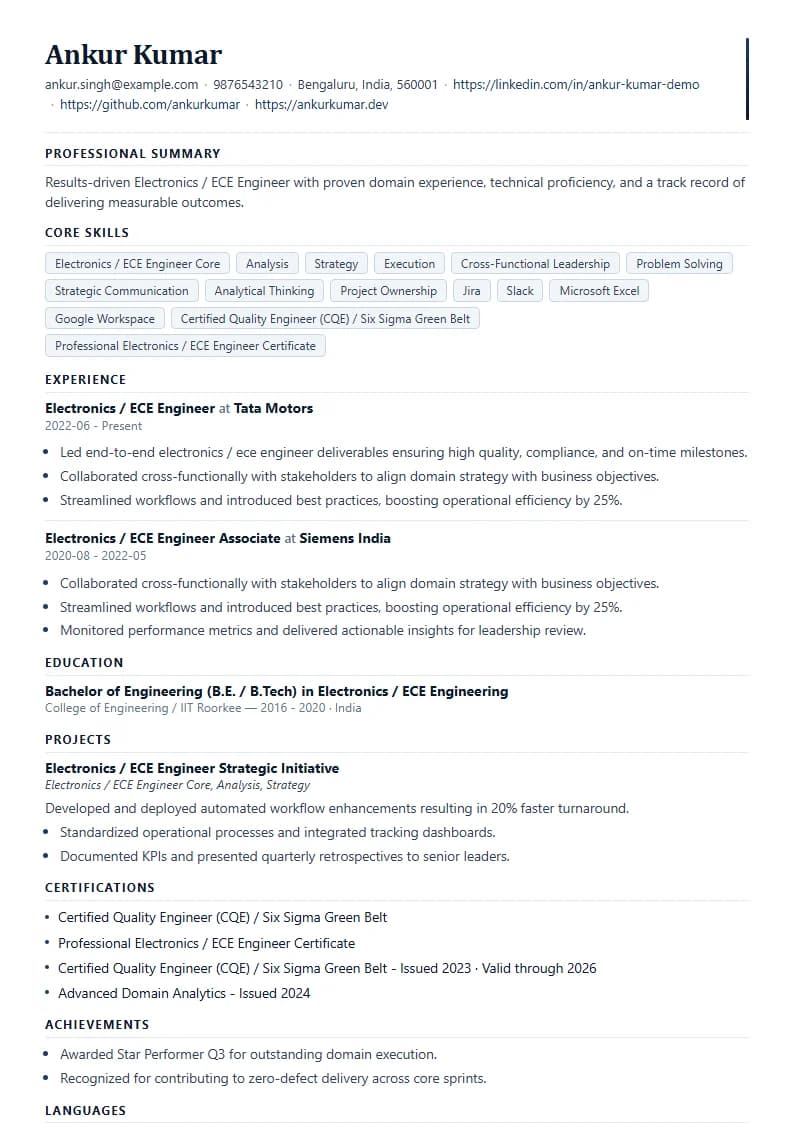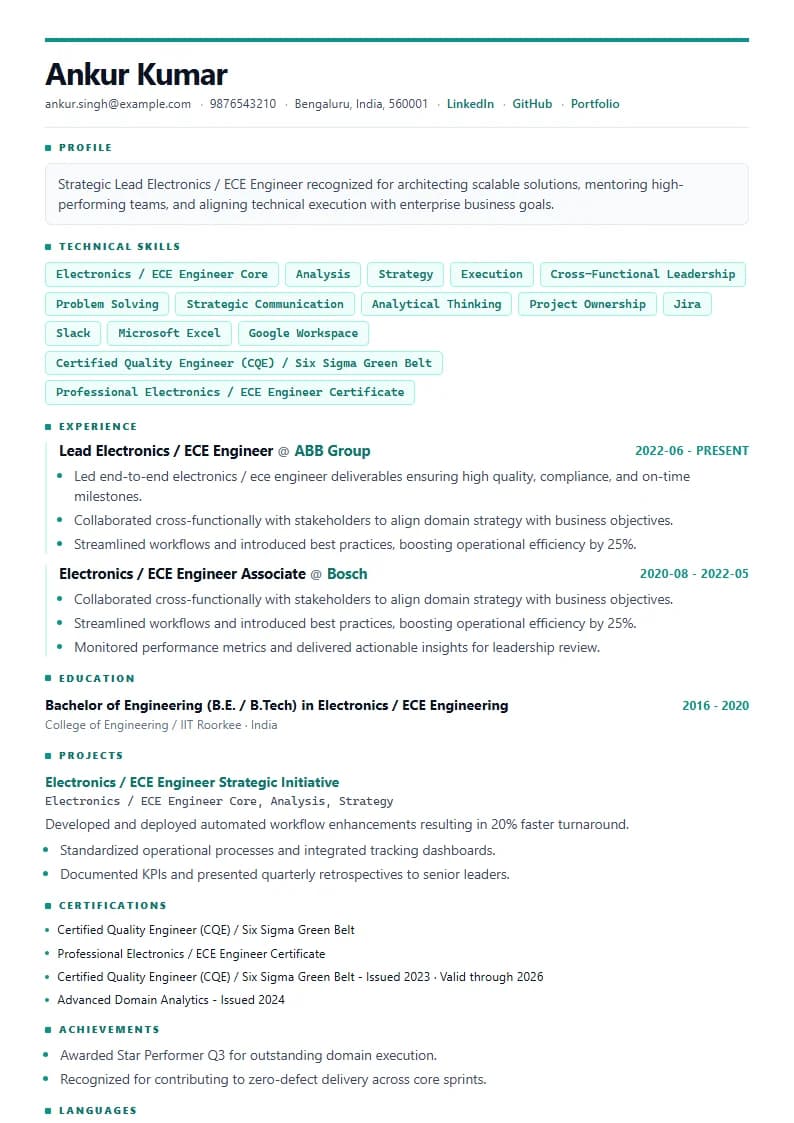

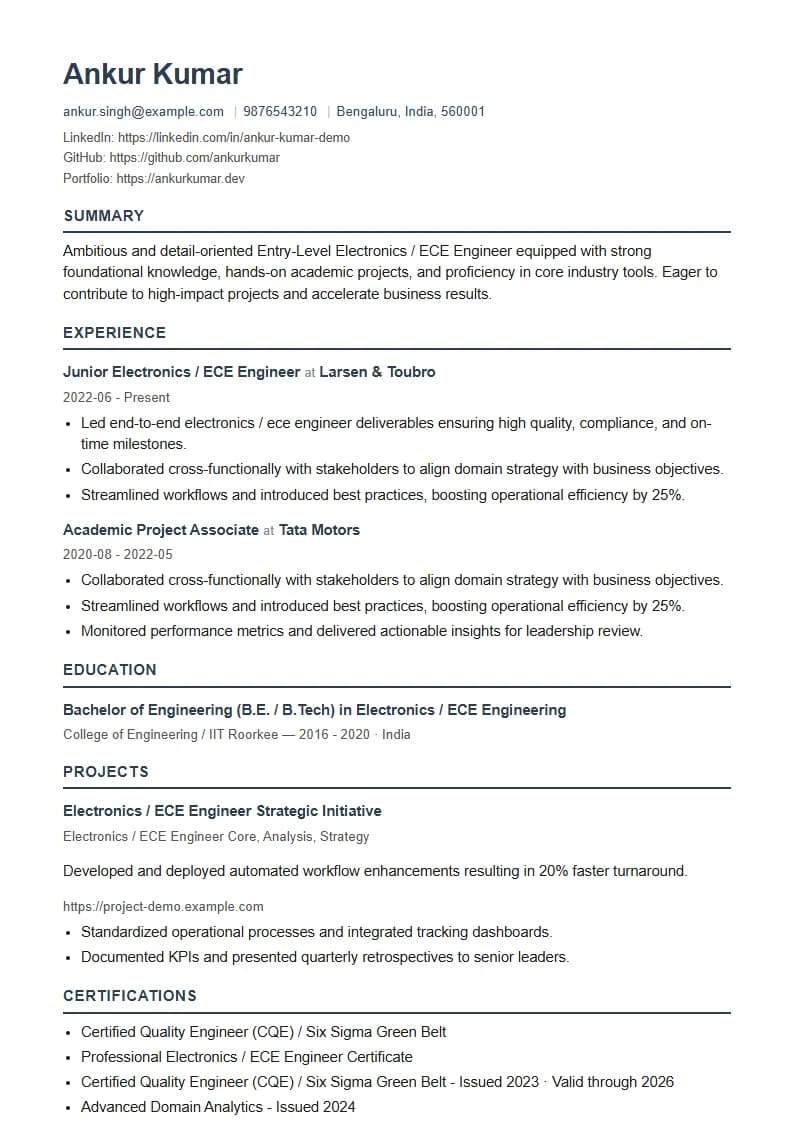
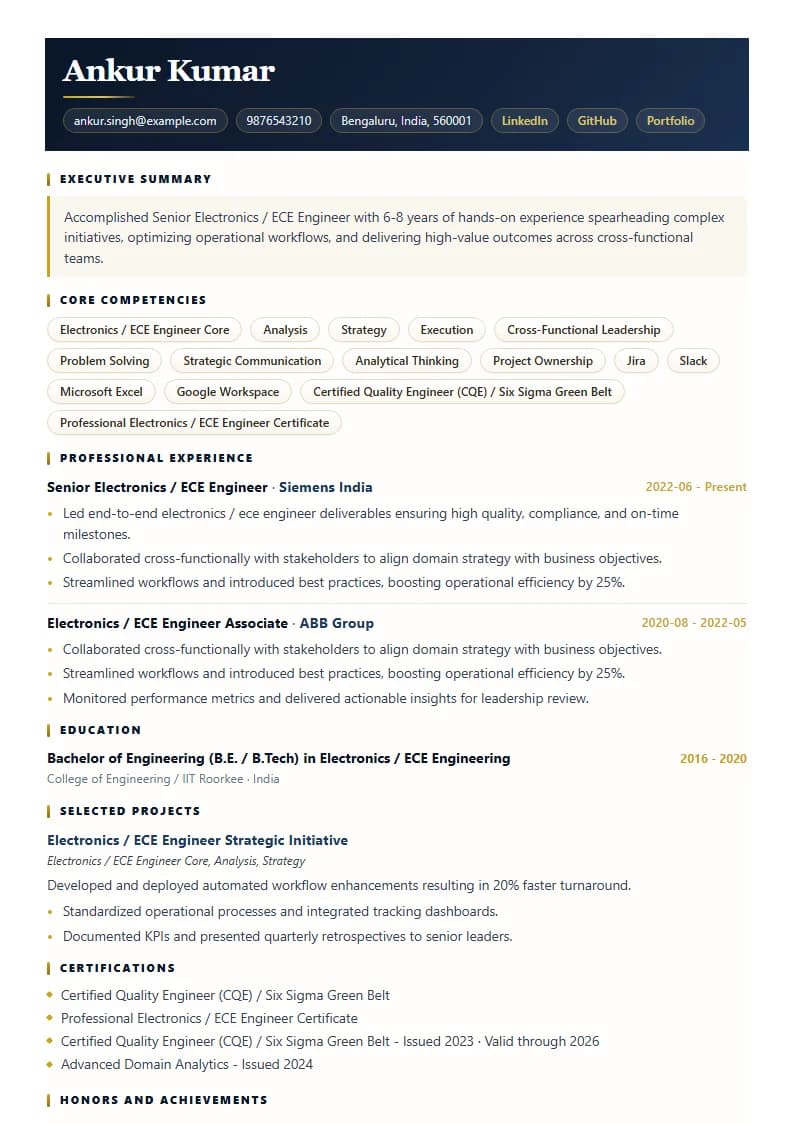
Electronics Matcher

Resume for an Electronics & ECE Engineer: Match the Domain, Board Tools, and Firmware the JD Names

An Electronics and ECE Engineer resume is scored on whether your core domain specialization, board design software, and firmware capabilities align with the job description. Electronics engineering is highly specialized — embedded systems, VLSI design, PCB layout, telecommunications, or IoT — and each domain screens on distinct technical credentials, meaning a generic resume under-matches specific openings. GyanBatua AI rates your resume against the targeted ECE JD, identifies critical gaps, and helps you tune your profile before applying.
ECE Matcher

Target: Embedded Systems Engineer JD

ATS Match OK
88%Match

Optimization Report

Found 1 critical board gap in core signals.

Embedded DomainEmbedded Hardware & Firmware design
Board Tools fitMissing Altium Designer (KiCad present)
Microcontroller & RTOSSTM32 and FreeRTOS present
Free Scan JD-Tuning Micro-payment

Hardware and Firmware Validation

What an Electronics & ECE Engineer job description screens for

Understanding each one tells you what your resume has to prove for that specific role.

This core domain specialization is why a generalist electronics resume struggles to land shortlist callbacks. An embedded firmware JD and a VLSI design JD demand completely different microcontroller and hardware description languages, and the JD signals which specialism is required.

The Domain Filter

Domain specialization

Domain specialization represents the primary filter in electronics screening. Embedded hardware, firmware/RTOS, VLSI/ASIC, PCB design, power electronics, or telecom — the JD is built around a single vertical, and a resume listing all of them evenly under-matches.

Software Filters

Board design and EDA software

Board design and EDA software are literal technical filters. Altium Designer, KiCad, OrCAD, Allegro, Cadence, or Xilinx Vivado appear directly in ECE JDs, and missing these toolsets triggers immediate ATS filtering.

Protocol Signals

Microcontrollers and protocols

Microcontrollers and protocols represent the communication depth expected. ARM Cortex, STM32, Arduino, ESP32, PIC, and interfaces like I2C, SPI, UART, CAN, or Modbus signal hands-on integration capacity.

The Prototype Metric

Technical-outcome evidence

Technical-outcome evidence converts a passive profile into an interview shortlist. The strongest ECE resumes highlight functional outcomes — board layers designed, prototype iterations reduced, code size optimized, or yield improved — with exact numbers.

ECE Keywords

The Electronics & ECE Engineer resume keywords that matter in 2026

The keywords that matter for an electronics resume are the ones the target JD names — but these categories recur across most Indian ECE JDs in 2026, and your resume should reflect the ones present in the JD.

Electronics Domain

Direct ECE domain targeted in the JD.

embedded systemsfirmwareVLSI designPCB layouttelecommunicationsIoTpower electronics

EDA & Board Tools

Electronic design automation packages.

Altium DesignerKiCadOrCADAllegroCadenceVivadoLTspiceMATLAB

Hardware & Firmware

Microcontrollers, programming, and hardware languages.

ARM CortexSTM32embedded CRTOSVerilogVHDLFPGAESP32

Protocols & Standards

Communication interfaces and industry standards.

I2CSPIUARTCAN busModbusEMI/EMC complianceNEMA

Outcome Language

Physical prototyping and design outcome metrics.

boards designedprototypes deliveredEMI defects reducedfirmware optimized

Avoid Keyword Stuffing: Matching beats padding. An ECE resume that proves the JD's core domain, named EDA software, and one prototype outcome will out-score a general engineering list.

Embedded Hardware vs VLSI/Firmware

Why electronics resumes under-match across specialisms

Electronics resumes under-match when they present as a broad generalist rather than highlighting the specific firmware or VLSI track specified by the job description. An engineer who splits their resume between board layout and RTL coding under-weights both, causing the screening algorithm to score them below candidates who specialize.

The fix is to align your profile's hardware, programming, and EDA tools directly with the target JD, verifying your match index before sending the application.

Electronics Engineer Domain Fit

Embedded Hardware Specialization88% Match

Proven board designs (Altium), microcontrollers (STM32), EMI troubleshooting.

VLSI / Chip Design Focus35% Match

Under-weights circuit board layouts, component selection, and firmware coding.

Simple Checking loops

How to check your electronics resume against a real JD

The fastest way to know whether your electronics resume will clear screening is to score it against the actual job description first. GyanBatua AI does this in three steps.

1

Upload & Paste

Upload your resume and paste the Electronics & ECE JD you are targeting. The free match score shows your alignment now, with the gaps named.

2

Review Gaps

Review the domain, EDA software, and microcontroller gaps. You will see which JD signals your resume is missing or under-weighting for this specific role.

3

Tune & Re-Check

Tune and re-check. Get a JD-matched version; re-run the score to confirm the gaps closed before you submit.

Affordable Micro-payments

GyanBatua's micro-payment model means you pay only for the applications you are serious about — nothing for the months you are not searching — and every user gets the same advanced AI on every action.

Interview Protocol

From shortlist to offer: prepare for the electronics interview on the same JD

A matched resume gets you the interview; the same JD should shape your preparation for it. GyanBatua AI's interview practice is built around the job description you matched against, so a hardware design role and a firmware role generate different practice — firmware scenarios, microcontroller routing, and the lab-testing or layout debugging the role implies. Resume optimization improves your shortlisting odds; JD-based interview prep improves your odds in the room. Both work on the same target role.

FAQ Help

Common questions about Electronics & ECE Engineer resumes

FAQ Help

What should an Electronics & ECE Engineer resume include in 2026?

An Electronics & ECE Engineer resume should foreground the core domain targeted (embedded hardware, firmware, VLSI, PCB design), the design and simulation software (Altium, KiCad, Vivado), the specific microcontrollers/protocols, and a prototype outcome. Because ECE is highly specialized, the emphasis must shift per JD.

How important is board design software (Altium/KiCad) on an ECE resume?

Board design and EDA software is a critical, high-weight signal in ECE screening, and a resume missing the named tools under-matches those JDs. Match the exact design tool specified in the JD (for example, Altium versus KiCad) rather than listing all packages generically.

Why does my electronics resume get filtered out despite multiple projects?

An electronics resume gets filtered out when it presents projects across unrelated domains rather than matching the target JD's specific engineering track. The screening layer scores domain alignment, so a hardware-firmware mismatch causes under-matching.

How do fresher ECE graduates write a resume?

Fresher ECE graduates should highlight their domain specialization, name the EDA tools and microcontrollers they know, and frame academic or personal projects as prototypes built in the JD's domain language. Tool proficiency and working prototype exposure matter most. Scoring against a real JD shows whether it is landing.

Does GyanBatua charge a subscription for electronics resume help?

No. GyanBatua AI uses micro-payments — you pay per action (for example for a JD-matched resume) only while job-hunting. There is no forced monthly subscription, and every user gets the same advanced AI on every action regardless of price.

Check your Electronics & ECE Engineer resume against a real job description

Verify Altium designs, microcontroller specialities, and score instantly.

ATS Optimized
JD-Tuned
Micro-payments