
Why Recruiters Skip Your Resume in Seconds — What to Fix
आढावा: Recruiters often skip resumes in seconds when role-fit, skills, or proof are unclear. Learn the top reasons and how to make your resume stronger.

Introduction
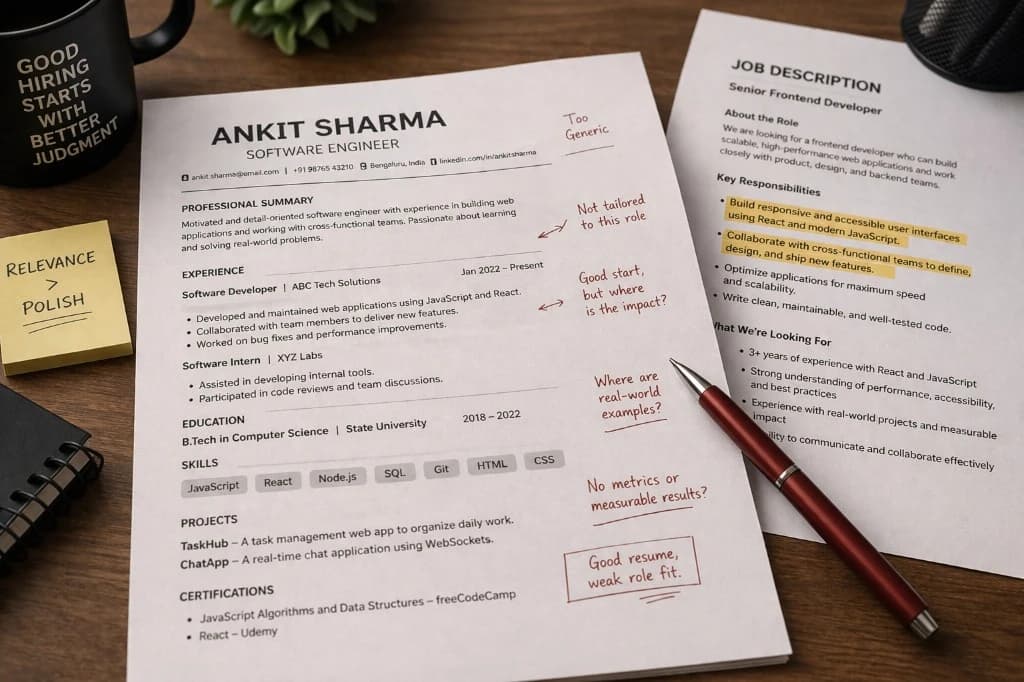
It sounds rude, but it is true. Many resumes get skipped in seconds.
That does not always mean the candidate is weak. It often means the resume is making the recruiter work too hard.
Recruiters usually scan quickly before they read deeply. In that first scan, they are trying to decide:
- is this relevant?
- do I understand the role fit?
- is there enough proof to continue?
- should I shortlist this or move on?
If your resume does not answer those questions fast enough, it can get ignored even if your background has real potential.
Here are the 7 biggest reasons that happens.
1. The role direction is unclear
If the recruiter cannot tell what role you are targeting, your resume starts weak.
For example, if one resume seems to be trying for:
- marketing
- HR
- operations
- analyst roles
all at once, the recruiter struggles to classify you. And when classification is hard, shortlisting becomes less likely.
What to do instead
Make the role family clearer through:
- summary
- skill order
- project order
- internship framing
- keywords
2. The summary is generic
Many resumes open with lines like:
- seeking a challenging opportunity
- motivated individual looking to grow
- hardworking candidate with good communication skills
These lines are not offensive. They are just not useful.
They do not tell the recruiter:
- what role you fit
- what relevant exposure you have
- what makes your profile worth reading further
What to do instead
Write a short, role-directed summary that sounds real and specific.
3. The skill section is full of filler
A lot of resumes waste important visual space with things like:
- hardworking
- team player
- quick learner
- leadership
- communication
These may matter later, but they are weak early shortlist signals. Recruiters want to see role-fit skills first.
For example:
- Excel
- SQL
- Power BI
- content writing
- campaign support
- sourcing
- customer onboarding
- React
- Python
What to do instead
Make the skill section role-specific and easy to scan.
4. The best proof is buried
Sometimes the candidate does have good proof. But it is hidden.
The strongest project, best internship, or most relevant skill is too low on the page. That is a design and structure problem, not just a content problem.
What to do instead
Surface your strongest role-fit evidence early.
5. The bullets are too vague
Weak bullet examples:
- worked on marketing
- helped with hiring
- did analysis project
- handled reports
These lines are too broad.
They do not show:
- tools
- context
- actions
- outputs
- role relevance
What to do instead
Rewrite bullets using clearer evidence.
For example: Weak: Worked on marketing. Better: Supported social media content planning and campaign execution for engagement-focused digital marketing activities.
6. The resume does not match the JD enough
A recruiter is hiring for a specific role, not your general potential.
If your resume does not reflect:
- the right skills
- the right tools
- the right role language
- the right business context
your relevance drops.
What to do instead
Before applying, compare your resume with the JD and adjust the wording, order, and emphasis honestly.
7. The resume feels broad instead of intentional
One of the fastest ways to lose recruiter confidence is to look unfocused.
A resume that feels intentional tells the recruiter:
- this person understands what they are applying for
- this profile is positioned for this role
- this candidate looks serious
A broad resume does the opposite.
Final thought
Recruiters do not always skip resumes because candidates are weak. They skip resumes because the fit is not obvious quickly enough.
That is why resume improvement is not only about making it “better.” It is about making it easier to shortlist.
Closing section
FAQ
Resume guides
Related Resume Guides
About the Author
Director - HR & Corporate Relations at Mobiloitte
Director of HR & Corporate Relations at Mobiloitte, specializing in recruitment strategy, placement readiness, and corporate partnerships.
प्राइसिंग
तुमचा प्लॅन निवडा आणि लवकर सुरुवात करा
फीचर्स, किंमत आणि वापर स्पष्टपणे तुलना करा, आणि तुमच्या उद्दिष्टासाठी योग्य प्लॅन निवडा.
पुढची पायरी
तुमचा रेझ्युमे खऱ्या जॉब डिस्क्रिप्शनशी तपासा
Apply करण्यापूर्वी JD match, keyword visibility आणि skill gaps पहा.
संबंधित वाचन
13अलीकडील लेख
6